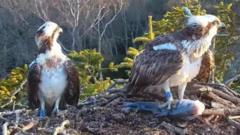
The wind off the salt marsh carries a specific, biting chill that shouldn't feel like a welcome. But for the small crowd gathered at the edge of the wildlife sanctuary, it feels like an invitation. They are clutching binoculars with gloved hands, their eyes fixed on a ragged bundle of sticks perched atop a weathered wooden platform. They are waiting for a miracle of timing.
Every spring, a biological clock buried deep within a four-pound bird begins to chime. It is a relentless, driving force that ignores geopolitical borders, Atlantic storms, and the sheer exhaustion of a 3,000-mile flight. When the ospreys return, they don't just bring the spring; they bring a masterclass in domestic stability that puts our own messy lives to shame.
Last year was different. Last year was a soap opera of avian proportions.
Imagine, if you will, the perspective of a local birdwatcher we’ll call Sarah. She’s spent fifteen years documenting the same nesting pair. For a decade, the routine was clockwork. The male would arrive, spruce up the "house" with a few fresh sticks, and wait for his mate. Then, the female would drop from the sky, and the season would begin. But last year, the timing broke. The female was late—perhaps delayed by a headwind over the Sahara or a late-season storm in the Caribbean.
In her absence, a "floater"—a younger, unattached female—saw an opening. She moved in. When the rightful matriarch finally arrived, the marsh erupted in a feathered civil war. It was loud. It was violent. It was a domestic displacement that ended in failed eggs and a fractured season.
This year, the stakes felt personal.
The Mathematics of Instinct
To understand why we care about a bird’s relationship status, you have to look at the sheer physics of their existence. An osprey is essentially a living circuit board tuned to the Earth's magnetic field. They don't have the luxury of "finding themselves" or taking a gap year. If they don't synchronize their arrival, the entire genetic line for that year hits a dead end.
Consider the energy expenditure. A migratory osprey burns through its body fat at a rate that would hospitalize a human athlete. They cross the vast stretches of the Atlantic, navigating by stars and internal compasses, only to arrive at a specific zip code they haven't seen in six months.
They don't return to the same general area. They return to the same branch.
When we talk about "avoiding drama," we aren't just talking about a lack of fighting. We are talking about the perfect alignment of two separate journeys. This season, the male arrived on a Tuesday. He spent forty-eight hours hauling eelgrass and driftwood, reinforcing the rim of the nest against the spring gales. He didn't look at the other females circling the perimeter. He waited.
On Thursday afternoon, a speck appeared on the horizon.
There was no hesitation. The female landed, and within minutes, the two were working in tandem. No intruders. No territorial disputes. No wasted energy. To the casual observer, it’s just a bird on a platform. To those who understand the razor-thin margins of survival, it’s a triumph of biological engineering.
Why We Project Our Shadows on the Sky
We have a habit of anthropomorphizing these raptors. We call them "loyal" or "faithful," applying human virtues to ancient instincts. But perhaps the fascination isn't that they are like us. Perhaps it’s that they are exactly what we wish we could be: certain.
In a world where our own "migrations"—to new jobs, new cities, new relationships—are fraught with anxiety and second-guessing, the osprey offers a vision of absolute clarity. They don't check a map. They don't consult a therapist about the "drama" of the previous year. They simply recalibrate.
The chaos of the previous season acted as a stress test for the local ecosystem. When a nest fails, it ripples. The local fish population shifts because there are fewer hungry chicks to feed. The crows and hawks become bolder, sensing a weakness in the neighborhood. A "quiet" season is actually a high-functioning one. It means the system is in balance.
The beauty of this year’s lack of conflict lies in its silence. There are no screeching territorial battles echoing across the water. Instead, there is the steady, rhythmic work of survival. It is the sound of the wind through primary feathers and the dull thud of a fish being dropped onto a bed of moss.
The Invisible Threads
We often view nature as something separate from our urban lives, a "landscape" to be visited on weekends. But the ospreys prove that the world is much smaller than we think. The bird sitting on that platform in a quiet coastal town was, only weeks ago, perched above a river in Brazil or a mangrove swamp in Colombia.
They are the ultimate connectors. They carry the dust of two continents on their wings.
When they avoid the drama of a contested nest, they are ensuring that these two worlds remain linked. A successful brood means three or four new navigators will be born. In five months, those juveniles will stand on the edge of the nest, look south, and commit to a journey they have never taken, guided by a map they’ve never seen.
If the parents spend their energy fighting off intruders, that training time is lost. The chicks are weaker. The map is blurrier.
Sarah, our birdwatcher, watches through her lens as the male brings in a large menhaden. He drops it at the female's feet. There is a brief, subtle communication—a tilt of the head, a specific chirp—that signals the transition from weary travelers to a unified unit.
The drama of last year has been paved over by the urgency of the now.
It is a reminder that resilience isn't about never failing. It’s about the ability to return to the center after the storm has passed. The marsh is quiet now, save for the lapping of the tide against the pilings. The intruders have moved on, seeking their own empty platforms elsewhere, and the rightful occupants have reclaimed their kingdom.
High above the salt marsh, the male takes flight again. He isn't looking for a fight anymore. He is looking for the next meal, his shadow flickering over the water, a sharp, dark anchor in an uncertain world. He circles once, twice, and then dives, hitting the water with a force that defies his weight, rising again with silver in his talons, heading straight for the home he traveled halfway across the globe to protect.