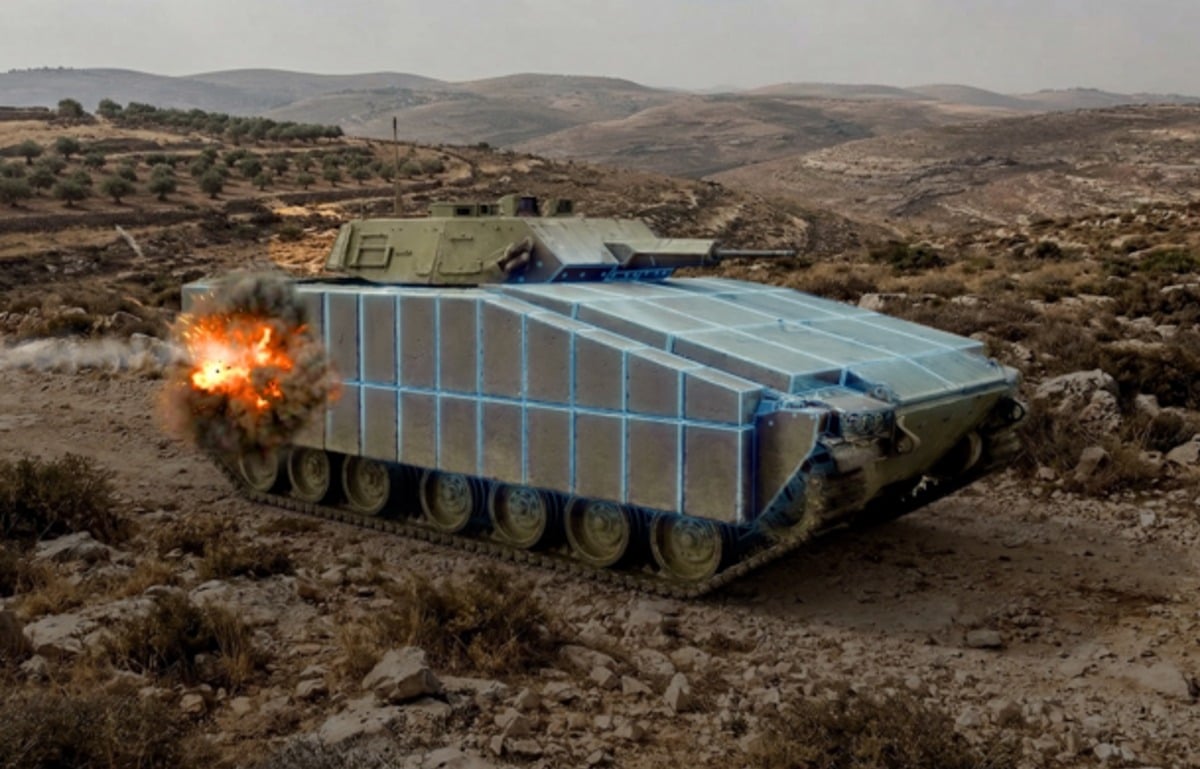
Traditional defense contractors are fighting the last war with heavier sheets of steel. When an industry giant rolls out modular armor kits or multi-wheeled configurations designed to absorb modern combat impacts, the boardrooms applaud. The marketing materials promise complete survivability. They tell procurement officers exactly what they want to hear: that your multi-million-dollar vehicle can be saved if you just bolt on enough proprietary composite material.
It is a lie. It is a financially ruinous delusion that ignores the fundamental physics of the modern battlefield. In related news, read about: The Economics of Fleet Preservation: How Sensor Retrofits Alter Global Airpower Equations.
I have watched defense agencies incinerate tens of millions of dollars trying to harden light tactical vehicles against evolving vertical threats. The logic always follows the same bankrupt path. A new threat emerges, the vehicle gets heavier, the suspension strains, the fuel consumption skyrockets, and the operational footprint swells.
We have reached the absolute physical limit of passive protection. Trying to stop a $500 first-person view (FPV) kamikaze drone carrying a shaped-charge warhead by adding dead weight to a 4x4 chassis is like trying to build a better castle wall while the enemy is flying hot air balloons over it. The math does not work, the economics are inverted, and continuing down this path ensures tactical obsolescence. CNET has provided coverage on this critical issue in great detail.
The Mathematical Collapse of Passive Mass
The industry standard approach to vehicle survivability relies on a flawed equation. For decades, protection meant increasing the thickness or density of the hull material to defeat kinetic penetrators or blast fragments. This worked when threats moved horizontally across a flat plane.
It fails completely when the threat originates from a vertical angle, targeting the thinnest, most vulnerable points of an armored asset.
Consider the reality of production economics. A commercial off-the-shelf quadcopter costs peanuts. It can be outfitted with a standard PG-7VL rocket-propelled grenade warhead capable of penetrating over 500 millimeters of rolled homogeneous armor. To counter this using passive composite kits, a vehicle must carry hundreds of additional kilograms of top-attack protection.
$$Weight_{penalty} = Area_{roof} \times Thickness_{required} \times Density_{material}$$
When you apply this formula across an entire fleet of tactical patrol vehicles, the geometric expansion of mass destroys the original mission profile of the asset. A light, agile reconnaissance vehicle becomes a sluggish, top-heavy target that sinks into soft mud and burns through its transmission components. You are sacrificing tactical mobility to purchase an illusion of security.
The Modular Illusion
The prevailing consensus among defense manufacturing executives is that modularity solves the weight dilemma. The pitch is simple: install the heavy armor packages when entering high-threat zones, and remove them during transport or low-risk operations.
This completely misunderstands the fluid nature of modern operational environments. There are no clean lines on a map anymore. There is no safe staging area where mechanics can casually unbolt armor plates before a vehicle goes on a logistics run.
Furthermore, flatpack or modular armor kits do nothing to alter the structural vulnerability of the underlying automotive platform. When a drone strikes a modular vehicle, the blast energy does not disappear just because the hull remained unbreached. The shockwave transfers directly through the frame, shattering axle housings, shearing engine mounts, and causing severe internal pressure waves that incapacitate the occupants anyway.
If a vehicle is mechanically immobilized after a single drone hit, the armor did not save it. It just turned the vehicle into a highly protected coffin that requires a multi-ton recovery asset to retrieve under fire.
Kinetic Energy Versus Chemical Energy
We must define our terms precisely to understand why bolt-on composites are failing. Defense marketing teams frequently blur the line between kinetic energy protection (stopping armor-piercing bullets) and chemical energy protection (defeating shaped charges).
Passive armor is highly efficient at absorbing kinetic impacts from small arms fire or artillery splinters by fracturing and dispersing the energy across ceramic matrices. However, a shaped charge warhead does not rely on raw kinetic force. It utilizes a high-explosive charge to collapse a metal liner into a hyper-velocity, high-temperature jet of molten metal that cuts through passive material like a torch through butter.
Defeating this mechanism requires distance, disruption, or active deflection—not merely more mass.
- Slat Armor: Deforms the nose cone of incoming projectiles to prevent fuse detonation, but adds immense width and catches on urban obstacles.
- Reactive Armor: Explodes outward to disrupt the molten jet, but cannot be safely deployed on light, thin-skinned tactical vehicles without blowing the vehicle's own doors inward.
- Active Protection Systems (APS): Hard-kill systems that shoot down incoming threats before impact, which represent the only viable path forward but are currently too expensive and heavy for light fleets.
The harsh reality is that the single best protection for a light vehicle is remaining unseen and moving quickly. Heavy armor kits achieve the exact opposite. They increase the thermal and visual signature of the asset while slowing its acceleration.
The Economic Asymmetry Trap
The most devastating argument against the heavy armor status quo is not mechanical; it is financial.
Imagine a scenario where an army deploys a fleet of light patrol vehicles, each valued at $400,000. To protect them from the drone threat, procurement buys a specialized composite armor package for $150,000 per vehicle. The total asset cost is now $550,000.
An opposing force can mass-produce 1,100 FPV attack drones for the cost of that single vehicle. If a swarm of five drones targets that vehicle, the statistical probability of a catastrophic software or hardware failure on at least one drone is factored in. The remaining four will hit the vehicle from multiple vectors—front, top, rear, and the vulnerable wheel wells.
The defense industry wants you to believe that the answer to this asymmetry is more expensive armor. They want to sell you a continuous cycle of upgrades. But you cannot win an attrition war when your defensive cost curve scale is linear while the enemy's offensive cost curve scale is exponential.
Fix the Doctrine, Not the Steel
Stop trying to fix the vehicle by bolting heavier junk onto the frame. The solution to drone-age survival requires a complete rejection of passive defense strategies in favor of systemic, electronic, and kinetic interception.
If a tactical formation does not possess an integrated local electronic warfare umbrella capable of severing command links or jamming GNSS signals within a five-kilometer radius, no amount of armor will save it. If the formation lacks dedicated, low-cost kinetic interceptor drones or rapid-firing directional air-burst munitions, it is already dead.
We must shift our capital investment away from heavy metallurgical engineering and directly into autonomous counter-UAS integration. Vehicles must become mobile sensor nodes that detect and eliminate threats at distance, rather than passive boxes waiting to take a punch.
The era of relying on passive mass to bring soldiers home safely is over. The companies insisting otherwise are simply trying to liquidate their remaining inventory of steel and ceramics before the entire market realizes the paradigm has shifted without them. Turn down the armor upgrades. Invest in electromagnetic dominance and distributed, autonomous strike options. Anything less is just an expensive way to lose a vehicle.