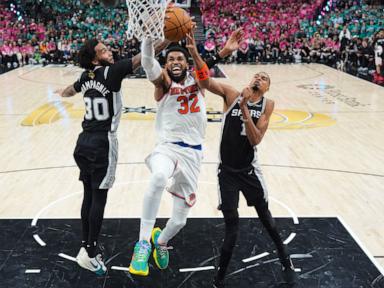
The sports media echo chamber is celebrating again. Ratings for Game 1 of the NBA Finals are up 90% year-over-year, and the consensus narrative is already locked in: star power sells, the league is back, and linear television has found its savior in a high-profile matchup.
It is a comforting story. It is also entirely wrong. Also making waves in this space: The Anatomy of Roland Garros 2026: A Brutal Breakdown of the Men Singles Final.
When you look past the breathless press releases issued by network executives, that 90% spike evaporates. It transforms from a sign of roaring health into a textbook example of base-rate fallacy and creative scheduling math. The industry is high on its own supply, mistaking a temporary scheduling anomaly for a fundamental shift in consumer behavior.
I have spent nearly two decades analyzing media rights deals and audience metrics. I have watched networks burn billions of dollars chasing fleeting viewership spikes while ignoring the structural rot underneath. The celebratory headlines surrounding this opener are not just misleading; they are actively blinding the industry to a precarious reality. Further information into this topic are explored by ESPN.
The Mirage of the Year-Over-Year Comparison
To understand why a 90% jump is meaningless, you have to look at what happened twelve months ago. Last year’s Game 1 was a statistical disaster, a perfect storm of bad timing, low-market appeal, and fragmented streaming distribution. Comparing this year's opener to that historical baseline is like a tech startup bragging about 500% revenue growth when they went from making one dollar to five dollars.
The media likes a clean narrative. They want you to believe that a 90% increase means twice as many human beings suddenly decided they love professional basketball. Here is what actually happened:
- The Baseline Was Artificially Depressed: Last year’s matchup featured two small-market teams with minimal national footprint, playing on a night when counter-programming pulled away casual viewers.
- The Out-of-Home (OOH) Data Trap: Nielsen altered its tracking metrics to more aggressively capture viewing in bars, restaurants, and hotel rooms. You did not gain millions of new fans; you just finally counted the guy staring at a muted screen while waiting for his chicken wings.
- The Multi-Network Simulcast Trick: The game was broadcast across three corporate sibling networks simultaneously. If you pool the audience from three different channels, your total number goes up. That is not organic growth; it is aggressive distribution.
When a network claims a massive percentage jump, they are hiding the raw numbers. If Game 1 goes from a historically abysmal 4 million viewers to a mediocre 7.6 million viewers, that is a 90% increase. But in the grand scheme of broadcast television, 7.6 million viewers for a flagship championship event is nothing to brag about. For context, regular-season football games regularly draw double that audience without trying.
Why Star Power is a Financial Cop-Out
The lazy consensus blames or credits "star power" for every fluctuation in the charts. If LeBron James, Steph Curry, or Jayson Tatum are on the court, ratings go up. If small-market developmental successes make the Finals, ratings go down.
This diagnosis completely misinterprets the product.
Relying on individual superstars to drive a multi-billion-dollar entertainment ecosystem is a broken business model. It creates a boom-and-bust cycle that prevents sustainable growth. When a league's economic viability hinges entirely on whether three specific humans remain healthy and make the postseason, that league is not running a stable business. It is running a casino.
Imagine a scenario where a major Hollywood studio only makes money if the exact same three actors star in every movie. The moment those actors retire or break a leg, the studio goes bankrupt. That is exactly how the sports media complex treats the NBA. By attributing the 90% jump entirely to star power, executives are admitting they have failed to build a compelling product that audiences care about outside of individual celebrity culture.
The Flawed Premise of Modern Sports Media
People always ask: "How can the NBA secure a massive new media rights deal if the ratings are actually in a long-term decline?"
The question itself is built on a misunderstanding of how television rights work. Networks do not buy live sports because the ratings are high relative to the 1990s. They buy live sports because everything else on television is completely dead.
Live sports are the final thread holding the traditional cable bundle together. A network will gladly overpay for an NBA package that draws a volatile audience because it is the only programming that viewers will not fast-forward through. The rights fees go up while the core audience shrinks. It is a classic economic bubble, inflated by desperate cable providers trying to delay their inevitable obsolescence.
The Uncomfortable Truth About Younger Audiences
The league constantly boasts about its dominance on social media. They point to billions of views on short-form video platforms, TikTok clips, and Instagram reels as proof that the sport is more popular than ever.
Here is the brutal reality: you cannot monetize a five-second highlight clip on TikTok the way you monetize a three-hour live broadcast.
The modern basketball fan has been conditioned to consume the sport via algorithmic feeds. They watch the crossover, the dunk, and the post-game drama. Then they scroll away. They do not sit on a couch for three hours to watch a game in its entirety. The 90% spike in Game 1 viewership does not change the fact that the median age of a linear television viewer is rising every single year. The younger demographic is not transitioning from phone screens to television screens as they age; they are abandoning the concept of long-form viewing altogether.
Stop Chasing the Casual Fan
The ultimate mistake networks make during the Finals is tailoring the entire experience to the casual viewer who only tunes in once a year. This strategy results in bloated pre-game shows, endless commercial breaks, and commentary that explains the basic rules of the sport instead of analyzing the high-level strategy.
This approach alienates the core audience while doing nothing to retain the casual fan. The casual fan tunes in because of the hype, stays for an hour, and then forgets the sport exists until the next season.
Instead of engineered spectacles designed to manufacture a temporary 90% bump, the industry needs to rethink the entire broadcast mechanism:
- Kill the Bloat: A standard basketball game takes 48 minutes to play. A televised broadcast takes two and a half hours. The endless review cycles, commercial timeouts, and intentional fouling at the end of games destroy the pacing that modern audiences demand.
- Decouple from Linear Metrics: Stop judging the health of a sport based on how many people watched it on a traditional channel on a Thursday night. Nielsen ratings are an archaic relic of a dying era.
- Accept Lower Baselines: Acknowledge that the monoculture is dead. The NBA will never again see the sustained, massive domestic television audiences of the Michael Jordan era. Attempting to manufacture those numbers through corporate simulcasts and statistical gymnastics is an exercise in futility.
The downside to this contrarian view is obvious: admitting the numbers are inflated means admitting the current valuation of sports media rights is unsustainable. It means acknowledging that the next television deal might be the peak before a massive market correction. No executive wants to admit that on an earnings call.
But continuing to celebrate a 90% increase without analyzing the artificial factors that created it is pure denial. The data is not telling you that basketball is experiencing a cultural renaissance. The data is telling you that last year was terrible, this year is slightly less terrible, and the underlying platform is still burning.
The celebrations are premature. The math is a trap. Turn off the champagne fountains.