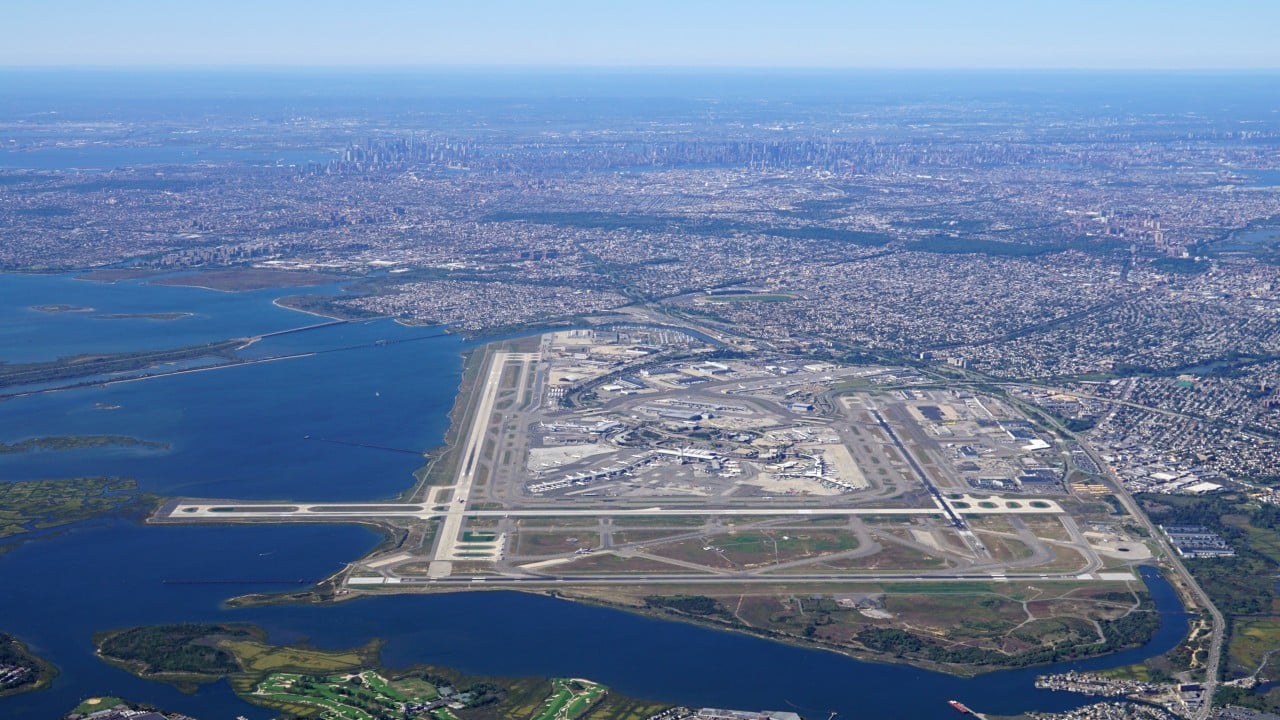
The reported mid-air collision between JetBlue Flight 948 and an unauthorized drone at 3,000 feet during its final approach to John F. Kennedy International Airport exposes a critical structural failure in low-altitude airspace management. While the Airbus A321 suffered zero structural damage and landed safely, the incident highlights a growing geometric optimization problem: commercial transport aircraft are highly vulnerable during terminal arrival phases where their flight paths intersect with the expanding operating envelope of consumer and commercial Unmanned Aircraft Systems (UAS). Managing this friction requires understanding the kinetic mechanisms of high-velocity impacts and the systemic failures of current regulatory and geofencing frameworks.
The Kinetic Impact Function: Mass, Velocity, and Vulnerability
To understand why a collision that left no physical evidence on an Airbus A321 hull remains a high-priority federal investigation, one must analyze the kinetic energy formula governing mid-air impacts:
$$E_k = \frac{1}{2} mv^2$$
In this equation, $m$ represents the combined mass of the objects, and $v$ represents the relative closing velocity.
A standard consumer drone weighs between 250 grams and 2 kilograms. However, an Airbus A321 on final approach travels at an airspeed of approximately 140 to 160 knots (roughly 236 to 270 feet per second). Because velocity is squared, the kinetic energy transferred during an impact scales exponentially rather than linearly.
A 1.5-kilogram drone colliding with an airliner traveling at 150 knots generates an instantaneous kinetic energy transfer of over 12,000 joules. This is comparable to the muzzle energy of a heavy anti-material military rifle. The structural consequences of this energy transfer are dictated by three variables:
- Material Density: Unlike birds, which are primarily fluid and soft tissue, drones contain dense components including lithium-polymer (LiPo) batteries, brushless electric motors, and carbon-fiber structural framing.
- Location of Impact: The JetBlue flight crew reported an impact "right above the cockpit". This area consists of reinforced aluminum fuselage skin. The lack of damage suggests the object may have been a micro-UAS (under 250 grams), or it was a glancing blow where the full vector of kinetic energy was not absorbed orthogonally.
- Engine Ingestion Dynamics: The primary catastrophic failure mode is engine ingestion. If a dense LiPo battery and metal motor enter a high-bypass turbofan engine during a high-workload phase like final approach, the debris can cause uncontained fan blade failure, tearing through the engine housing and severing critical hydraulic or fuel lines.
The Three Pillars of Airspace Vulnerability
The incident occurred 10 to 12 miles from the runway threshold, just north of Sea Bright, New Jersey, as the aircraft was executing a turn at 3,000 feet. This specific altitude and location point to a broader vulnerability framework. The risk profile of terminal airspace can be categorized into three distinct operational bottlenecks.
1. The Altitude Enforcement Deficit
The Federal Aviation Administration (FAA) mandates a 400-foot ceiling above ground level (AGL) for recreational and commercial drone operations under Part 107, unless explicit Low Altitude Authorization and Notification Capability (LAANC) approval is granted. At 3,000 feet, the drone involved in the JFK incident was operating 2,600 feet above the legal threshold.
This breach demonstrates the limitation of software-defined restriction systems. While major UAS manufacturers implement internal firmware restrictions to prevent takeoffs within specific airport grids, these systems can be bypassed via open-source flight controller software or aftermarket firmware modifications.
2. Operational Blind Spots in Air Traffic Control
Commercial air traffic control (ATC) relies primarily on secondary surveillance radar, which interrogates transponders aboard aircraft to determine altitude, heading, and identity. Primary radar, which detects physical objects via radio wave reflections, is tuned to filter out ground clutter, weather phenomena, and small objects like birds or consumer drones to prevent screen saturation.
As a result, terminal radar approach control (TRACON) controllers are functionally blind to small UAS operating in their sectors. The first notification of a hazard typically comes from pilot visual acquisition, which occurs too late for evasive maneuvering due to the high closing speeds.
3. Asymmetric Regulatory Enforcement
The FAA receives more than 100 drone-sighting reports near airports every month. The current enforcement model relies on retrospective investigation rather than real-time interdiction. Unless law enforcement personnel are positioned to locate the drone operator at the point of takeoff or landing, the probability of identifying the violator remains low. This creates a severe enforcement asymmetry where the cost of non-compliance for the operator is effectively zero until a catastrophic event occurs.
Systemic Flaws in Technical Mitigation
Current industry strategies to mitigate UAS incursions rely on two main technologies: Remote ID and active counter-UAS (C-UAS) detection arrays. Both possess distinct architectural limitations.
Remote ID acts as a digital license plate, requiring drones to broadcast their identity, altitude, and control station location via radio frequency signals. However, Remote ID is a cooperative system. It assumes the operator is using compliant hardware and has not disabled the broadcast module. Malicious or negligent operators flying outside regulatory bounds simply disable these systems, rendering them useless for preventing high-altitude incursions.
Active detection systems, including radio frequency scanners, optical cameras, and acoustic sensors, are increasingly deployed around critical infrastructure. While effective at protecting localized areas, their detection range is typically limited to a 3-to-5-mile radius. Because commercial airliners begin their descents dozens of miles away from the airport runway, a drone operating at 3,000 feet on the periphery of the terminal environment remains completely outside the detection envelope of airport-centric security systems.
Strategic Interdiction: The Low-Altitude Blueprint
Resolving the conflict between commercial transport aviation and unmanned systems requires moving away from reactive policing and adopting integrated airspace engineering.
The immediate operational priority must be the mandatory hardware-level integration of Direct Remote ID coupled with tamper-proof, multi-constellation GNSS geofencing. Regulatory agencies must mandate that flight controller hardware sold domestically contain cryptographic signatures tied to verified user identities. Attempts to alter this firmware must brick the device at the hardware level.
Simultaneously, the mitigation envelope must expand beyond the immediate perimeter of the airport. Telecommunications infrastructure, specifically regional 5G cellular networks, can be leveraged to establish a continuous low-altitude surveillance grid. By requiring commercial and high-performance consumer drones to connect to cellular networks for network-based tracking, aviation authorities can monitor non-cooperative aircraft movements across the wider metropolitan areas that feed major terminal approach corridors.
Without these structural interventions, the intersection of expanding commercial flight paths and unmonitored low-altitude drone traffic will continue to rely entirely on luck to avoid structural hull failures.