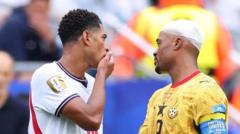
The modern regulatory apparatus of international football operates on a dual-axis framework: maintaining structural flow and ensuring absolute accountability. When images of England midfielder Jude Bellingham covering his mouth while conversing with Ghana's Jordan Ayew surfaced during the 2026 FIFA World Cup, public discourse immediately identified a contradiction in regulatory enforcement. Media analysis questioned why Bellingham remained on the pitch while Paraguay's Miguel Almirón suffered a straight red card days prior for an ostensibly identical physical gesture. The disparity is not an error in officiating; it is the logical result of an unquantified threshold system governed by specific operational triggers.
Understanding why Bellingham avoided a dismissal requires a rigorous breakdown of the new directive, colloquially designated the Vinicius Law. The rule does not penalize the physical act of occlusion itself. It penalizes occlusion as a mechanism for concealing discriminatory or highly abusive language during explicit field altercations.
The Tri-Factor Threshold for Mouth-Covering Sanctions
FIFA's enforcement framework for mouth-covering behaviors relies on three strict criteria. A disciplinary intervention by the referee or the Video Assistant Referee (VAR) can only occur when all three variables return a positive state.
- The Gestural Variable (Occlusion): The deliberate deployment of an arm, jersey, or hand to completely obscure the lips from technical cameras and officiating view.
- The Intent Variable (Animosity): The presence of a demonstrably hostile or confrontational exchange, verified by spatial proximity, aggressive body mechanics, and escalated player metrics.
- The Audience Variable (Targeting): Directing the concealed verbal output at an opposing player or match official within an active flashpoint zone.
The core systemic bottleneck identified by critics is the assumption that occlusion equals guilt. Pierluigi Collina, FIFA’s head of referees, outlined the explicit operational boundaries before the tournament began, noting that players retain the right to cover their mouths for non-hostile, standard tactical or social dialogue.
The structural divergence between the Bellingham event and the Almirón dismissal is mapped directly across these three variables:
| Operational Variable | Miguel Almirón Event (Dismissal) | Jude Bellingham Event (No Sanction) |
|---|---|---|
| Physical Occlusion | Present (Full hand cover) | Present (Jersey/hand cover) |
| Tactical Context | Active mass confrontation / melee | Standard post-phase transition |
| Verified Hostility | High (Aggressive body language) | Low (Collaborative/neutral stance) |
| Officiating Action | VAR Review leading to Straight Red | Zero technical or disciplinary review |
The Mechanics of Hostility Verification
The primary filter used by VAR officials to differentiate a tactical conversation from a sanctionable offense is the evaluation of kinetic data on the pitch. When Bellingham interacted with Ayew during England's scoreless draw against Ghana in Boston, the physical distance between the competitors, their deceleration rates, and the lack of secondary cluster movements—where other teammates rush to intervene—indicated a baseline of zero animosity.
A red card under this directive is fundamentally designed as a deterrent against hate speech and unprovoked vitriol, a policy catalyzed by a previous six-match ban issued to Benfica's Gianluca Prestianni for homophobic conduct. The protocol mandates that if the underlying conversation is evaluated as neutral or conversational, the gestural variable becomes secondary and non-punishable. Almirón triggered a maximum severity response because his occlusion occurred inside an active confrontation with a Turkish opponent. This converted the gesture into a high-probability shield for abusive language.
This binary implementation introduces a distinct administrative limitation. Referees cannot act on speculation. Without lip-reading capability or structural markers of a dispute, an isolated gesture remains outside the scope of factual match intervention.
Officiating Jurisdiction and Technical Dead Zones
A secondary layer of friction exists regarding the physical space where these regulations apply. Reports from the encounter highlighted that Bellingham engaged in highly animated verbal exchanges as he moved toward the tunnel at halftime, specifically involving Ghana coach John Paintsil.
This scenario introduces a clear jurisdictional boundary. While the Vinicius Law targets player-to-player interactions during active play, general verbal misconduct in the technical area falls under standard disciplinary codes regarding dissent and unsporting behavior. If the refereeing team does not personally witness the insult, and the gesture occurs outside an active match phase, the VAR framework prevents retroactively checking subjective verbal quality unless a clear act of violent conduct or gross discrimination is identified through auxiliary audio-visual feeds.
The strategic play for managing competitive personnel under this regime requires an immediate shift in communication training. Operational staff must treat mouth-covering not as a tactical shield, but as an immediate risk vector. Because the rule relies on the referee's real-time interpretation of player intent, any high-velocity gesture performed within five meters of an opponent during a stoppage risk triggering an unreviewable subjective evaluation. Field tactics must evolve to mandate open-faced communication during matches, minimizing the situational variables that lead to catastrophic disciplinary errors.