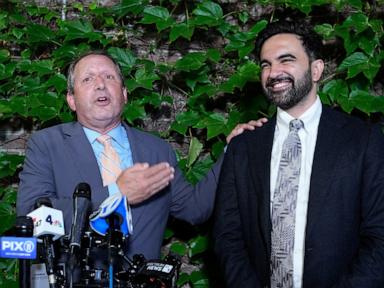
The June 2026 Democratic primary outcomes in New York City demonstrate that incumbent survival in safely partisan urban districts is no longer a function of institutional seniority, but of demographic and ideological alignment. The sweeping victories of the candidate slate backed by New York City Mayor Zohran Mamdani—comprising Brad Lander, Claire Valdez, and Darializa Avila Chevalier—mark a structural shift in the municipal and federal legislative pipeline. By ousting two entrenched congressional incumbents and securing an open battleground seat, this coalition exposed deep vulnerabilities in the traditional establishment apparatus overseen by House Minority Leader Hakeem Jeffries and regional party organizations.
To evaluate how a insurgent executive municipal faction systematically dismantled multi-decade incumbent operations, the election must be broken down into its core mechanics: demographic sorting, resource asymmetries, and the weaponization of high-salience foreign policy cleavages.
The Three Pillars of Insurgent Structural Advantage
The victories of Lander (NY-10), Valdez (NY-7), and Avila Chevalier (NY-13) were not erratic anomalies. They occurred across highly specific geographic corridors optimized for progressive turnout models. The success of the Mamdani slate rests on three distinct operational pillars.
Geographic and Demographic Sorting
The modern progressive electorate within New York City is concentrated in high-density, college-educated, rented-residential tracts—frequently referred to colloquially as the "Commie Corridor" spanning northern Brooklyn and western Queens, but increasingly spreading into lower Manhattan and parts of Upper Manhattan.
In NY-7, Claire Valdez capitalized on the accelerating influx of younger, non-native residents to defeat Brooklyn Borough President Antonio Reynoso, despite Reynoso holding the endorsement of retiring veteran Representative Nydia Velázquez. The traditional ethnic succession models that historically governed these districts failed because the underlying demographic base shifted faster than the institutional party's endorsement mechanisms could adapt.
Asymmetric Salience and Foreign Policy Polarization
A central mechanism driving the unseating of Representative Dan Goldman in NY-10 and Representative Adriano Espaillat in NY-13 was the structural decoupling of voter priorities from traditional domestic metrics. The Mamdani-backed slate leveraged high-salience, polarizing international issues—specifically the Israel-Haza conflict—to draw stark ideological boundaries.
Lander anchored his challenge against Goldman by criticizing Goldman’s alignment on foreign policy, turning a federal primary into a referendum on international ideological purity. This strategy successfully converted passive progressive dissatisfaction into active electoral participation among targeted voting blocs, completely neutralising the conventional advantage of incumbent name recognition.
Coalition Aggregation and Executive Endorsement Power
Historically, New York City mayors find their electoral influence diminished when attempting to project power into federal legislative primaries due to localized friction with entrenched party bosses. Mayor Mamdani inverted this dynamic. By utilizing his municipal bully pulpit, media ecosystems, and field operations, Mamdani acted as a centralized validator for political outsiders.
In NY-13, Darializa Avila Chevalier entered the race with zero prior office-holding experience and a campaign budget dwarfed by Espaillat’s institutional backing. The executive endorsement provided an immediate injection of legitimacy, effectively acting as an alternative party line that bypassed the county democratic machines entirely.
The Incumbency Cost Function: Why the Establishment Failed to Insulate
The defeat of multi-term incumbents like Espaillat and Goldman indicates a profound breakdown in the defensive strategies traditionally deployed by party leadership. The establishment failed to accurately calculate its own political cost function, which grew prohibitively expensive due to three compounding vulnerabilities.
Institutional Inertia + Financial Exposure + Structural Decoupling = Incumbency Disregard
The first limitation lay in the reliance on corporate and institutional political action committees (PACs), specifically groups like the American Israel Public Affairs Committee (AIPAC). While these entities provided substantial financial defense for establishment candidates, the capital injections carried an equal and opposite reactionary cost. Insurgent campaigns successfully framed this financial backing as evidence of a corrupt, out-of-touch elite. For instance, voters who wavered in Upper Manhattan ultimately migrated to Avila Chevalier upon identifying the heavy external PAC funding flowing into Espaillat's campaign apparatus.
The second bottleneck was the failure of establishment surrogates to match the grassroots field velocity of the Democratic Socialists of America (DSA) and allied progressive networks. House Minority Leader Hakeem Jeffries attempted to downplay the primary's significance by pointing to the sheer size of the 215-member House Democratic caucus, suggesting a handful of losses would not alter national party identity.
This macro-level dismissal, however, created a localized vacuum. While national leadership viewed the races through the lens of seat retention for a general election majority, local voters viewed the primary as a low-risk, high-reward mechanism to register dissatisfaction with the national status quo. In safe, non-competitive "blue" seats, the general election is effectively won in June; thus, the establishment's primary defense strategy—warning of general election vulnerabilities—carried zero mathematical weight with the electorate.
Strategic Forecasting: The Post-Primary Realignment
The structural realignment observed in these primaries yields a definitive blueprint for the intermediate-term trajectory of both New York municipal politics and federal intra-party dynamics heading toward the 2028 cycle.
Rather than viewing these results as a unified leftward lurch, analysts must recognize the emerging limitations of the progressive coalition itself. A critical fracture remains between the pragmatic progressive left and the strict democratic socialist wing. The strategic friction between Mayor Mamdani and Representative Alexandria Ocasio-Cortez during the lead-up to these primaries illustrates this divide.
Mamdani selectively backed congressional insurgents while intentionally withholding endorsements from challengers facing state legislative incumbents, protecting his working relationship with powerful state figures like Assembly Speaker Carl Heastie. Conversely, Ocasio-Cortez backed state legislative challengers while avoiding direct conflict with congressional incumbents. This structural fragmentation means that while the progressive wing can successfully execute targeted decapitation strategies against isolated federal incumbents, it still lacks the unified internal cohesion required to seize total control of state or national party infrastructure.
The immediate operational play for establishment forces is clear: they will pivot to leveraging these primary results in moderate, suburban swing districts across the country during the November midterm elections. National branding campaigns will actively seek to isolate these newly elected New York democratic socialists, using their platforms—such as pledges to defund specific federal law enforcement arms or institute aggressive tax restructuring—as rhetorical foils to insulate moderate candidates in competitive battlegrounds.
Concurrently, within the municipal arena, these primary victories put an immediate target on long-serving establishment figures like Senate Minority Leader Chuck Schumer ahead of 2028. The primary data proves that the institutional protective layer has eroded; any incumbent failing to systematically maintain grassroots field operations and demographic alignment within their geographic core is now structurally exposed to factional displacement.