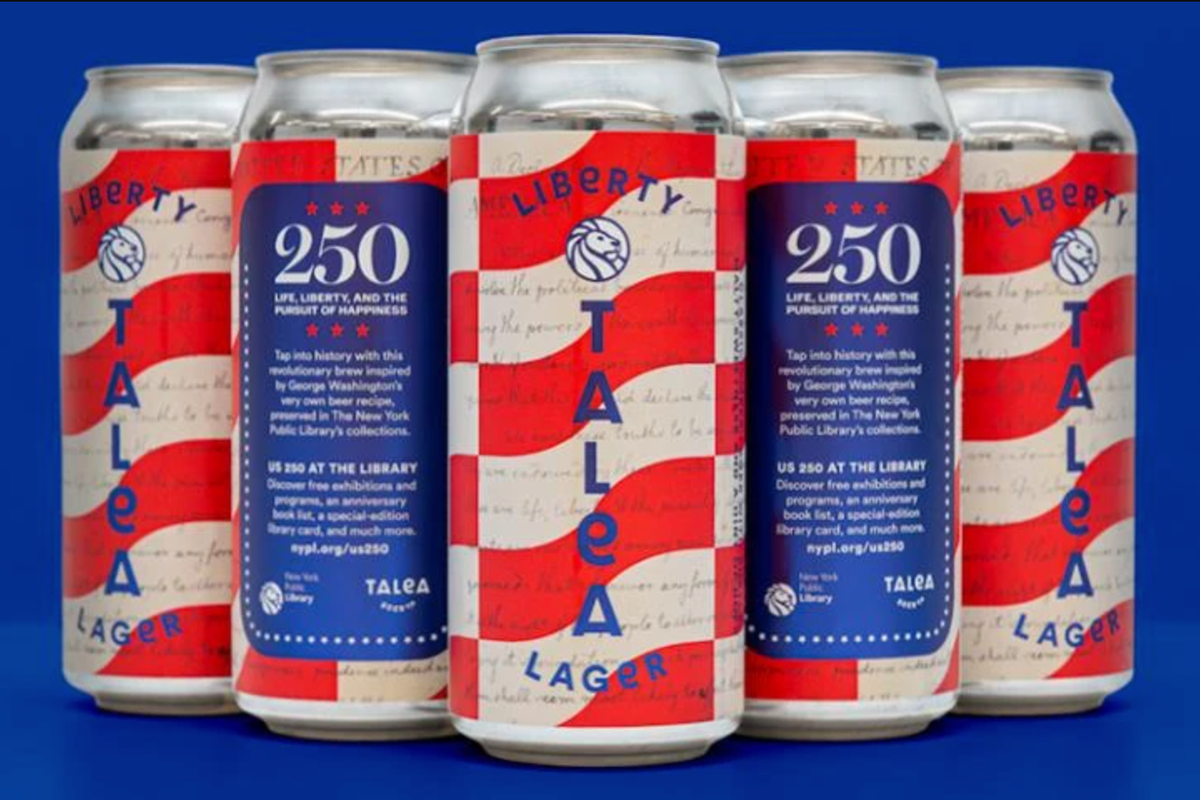
The utilization of historical intellectual property to drive contemporary consumer engagement rests on a fundamental paradox: authentic reproduction frequently yields an unpalatable product. This reality is demonstrated by the partnership between the New York Public Library (NYPL) and TALEA Beer Co., organized to commemorate the United States semi-quincentennial. By extracting George Washington’s 1757 "small beer" recipe from his French and Indian War military notebook, the entities have executed a dual-product strategy that illustrates the operational friction between historical fidelity and modern commercial viability.
To transform a 269-year-old manuscript into a scalable retail asset, brands must navigate three distinct structural constraints: biological preservation mechanisms, raw material variance, and consumer palate evolution. Analyzing these variables exposes the precise economic and technical engineering required to monetize cultural artifacts without alienating the modern target demographic.
The Tri-Pillar Framework of Eighteenth-Century Brewing Economics
Historical records evaluate military provisions through the lens of operational security rather than gastronomic pleasure. In 1757, then-Colonel George Washington recorded a protocol "To Make Small Beer" while leading the Virginia militia. Deconstructing this recipe reveals a specific production system designed around resource scarcity and microbiological risk mitigation.
[Militia Rations: Bran & Hops] ──> [3-Hour Thermal Boil] ──> [Pathogen Elimination]
                                                                     │
[Low Attenuation (Low ABV)]   <── [Raw Molasses Hydration] <─────────┘
The Pathogen Elimination Function
Small beer was not engineered for intoxication; it served as a primary hydration mechanism when potable water systems were routinely contaminated with waterborne pathogens like Vibrio cholerae and Salmonella enterica. The core mechanism of the process relies on the three-hour boiling phase of bran and hops. This extended thermal exposure acted as a sterilization cycle, eliminating local bacterial loads before fermentation.
The Fermentable Carbohydrate Substitution Matrix
Unlike premium colonial ales that relied on malted barley—a resource requiring labor-intensive malting kilns and agricultural infrastructure—Washington’s recipe utilizes molasses as the exclusive source of fermentable sugars.
The formula dictates a strict volumetric ratio:
$$3\text{ gallons of molasses} : 30\text{ gallons of water}$$
This 10% volumetric concentration of unrefined sugarcane byproduct provided a highly dense, nitrogen-poor substrate. The resulting beverage lacked the complex enzymatic profile of grain-based beers, operating instead as a rapidly fermentable, low-cost ration.
The Low-Attenuation Safety Model
The fermentation cycle was brief, lasting only twenty-four hours in an open cooling vessel before transfer to wooden casks. This abbreviated window, paired with the wild, unpredictable yeast strains of the era, caused low attenuation. The yeast consumed only a fraction of the heavy complex sugars in the crude molasses, leaving a dense, sweet, viscous liquid with a low alcohol by volume (ABV) profile. This low ethanol concentration preserved military readiness while providing essential caloric intake to soldiers enduring physical exertion.
The Production Bottleneck: Material and Chemical Variance
A direct replication of Washington's recipe exposes a stark divergence in raw material supply chains between the pre-industrial era and modern commerce. TALEA Beer Co.’s pilot batches demonstrated that literal adherence to the 1757 text produces a flavor profile described by contemporary brewers as an unpalatable, "funky syrup." This friction stems from two structural shifts in ingredient composition.
The primary systemic variance exists within the sugar substrate. Eighteenth-century molasses was a crude, minimally processed byproduct of Caribbean sugar boiling. It retained high concentrations of inverted sugars, mineral salts, and organic ash. Modern industrial molasses undergoes highly efficient centrifugation and clarification, stripping out vital nutrients while concentrated bitter compounds are left behind.
Consequently, utilizing modern commercial molasses yields an entirely different chemical profile than what was available in a colonial military camp.
The second material bottleneck is the ambiguity of early biological measurements. Washington’s mandate for "a quart of yeast" introduces significant variance. Modern brewing relies on isolated, monoculture strains of Saccharomyces cerevisiae with known cell-density counts and attenuation profiles.
In contrast, a colonial military unit utilized top-cropped slurry salvaged from prior fermentations, rich with wild Brettanomyces strains and lactic acid bacteria. This historical yeast package introduced volatile acidity and phenolic compounds—tastes that modern quality control parameters purposefully classify as defects.
The Dual-Product Commercialization Blueprint
To extract scalable value from this archive while maintaining brand prestige, the strategy requires bifurcating the output into two distinct product tiers: an Educational Novelty Asset and a Scalable Modern Variant.
Tier 1: The Historical Fidelity Benchmark
This product serves strictly as an archival proof-of-concept. By retaining the full molasses-base and open-air fermentation signatures, the brewery delivers an educational asset targeted at institutional events, historians, and high-affinity collectors. Its commercial potential is naturally capped by its low repeat-purchase intent, as the flavor profile conflicts directly with modern consumer expectations of beverage crispness and balance.
Tier 2: The Adapted Consumer Product (Liberty Lager)
To capture broader market share across the 1,300 retail accounts, bars, and taprooms in the Tri-State distribution network, the recipe was structurally re-engineered into an amber lager. The table below details the technical divergence between the historical baseline and the commercial optimization strategy:
| Formulation Variable | Historical Baseline (1757 Recipe) | Optimized Commercial Strategy (Liberty Lager) |
|---|---|---|
| Primary Carbohydrate Source | 100% Unrefined Molasses | Malted Barley Base with Residual Molasses Accents |
| Fermentation Profile | 24-Hour Top Fermentation (Wild Ale) | Extended Bottom Fermentation (Clean Lager Yeast) |
| Target ABV | Minimal ($\approx 1.0% - 2.5%$) | $6.5%$ |
| Organoleptic Goal | Caloric Density & Hydration | Subdued Malt Sweetness & Balanced Hop Bitterness |
| Market Function | Archival Curiosity | High-Velocity, Food-Friendly Volume Driver |
By shifting the product architecture from an unattenuated small beer to a $6.5%$ amber lager, the producers preserved the historical narrative (the aesthetic profile and the integration of molasses) while shifting the liquid matrix onto a proven commercial framework. The bitter hop notes and clean finish of a lager format lower the sensory barrier to entry, rendering the beverage viable for high-volume settings like standard restaurant draft lines and consumer outdoor events.
Systemic Risks in Heritage-Driven Product Launches
While leveraging historical intellectual property provides an immediate competitive advantage in narrative differentiation, it introduces distinct operational vulnerabilities that management must mitigate.
First, the strategy introduces an inevitable authenticity deficit. In marketing a historical revival, the brand establishes an expectation of time-travel via consumption. When the final liquid is altered to fit modern palates, a segment of high-affinity consumers perceives the modification as an compromises of core authenticity. The brand must carefully position the commercial product as an "interpretation" rather than a "recreation" to avoid reputational blowback.
Second, the product lifecycle for anniversary-linked assets is highly compressed. The consumer demand curve for a product tied directly to America's 250th anniversary is rigidly bound to the celebratory calendar. Overproduction poses a significant inventory risk. Once the commemorative window closes, the velocity of the inventory will decay sharply, forcing deep retail discounting or product destruction.
Tactical Playbook for Nostalgia-Based Brand Extensions
Organizations planning to commercialize historical IP should execute a structured deployment model based on the TALEA and NYPL execution:
- Audit the Physical Asset: Identify high-friction variables in the historical recipe or design (such as toxic components, unavailable raw materials, or offensive flavor profiles) before committing to public timelines.
- Decouple Narrative from Formula: Treat the historical text as a brand narrative framework rather than a literal manufacturing blueprint. Optimize the chemical composition for immediate consumer acceptance while reserving literal replication for low-volume PR executions.
- Implement a Finite Scarcity Model: Limit the production run of the historical variant to short, highly controlled batches to drive immediate PR value, while focusing capital expenditures on the distribution and scaling of the modern, adapted variant.
This structural separation ensures that while history draws the consumer to the brand, modern beverage engineering drives the recurring revenue.
The video below analyzes how early American colonial brewing practices relied on specific agricultural constraints and alternative sugar sources to supply civilian and military populations alike.
This video provides an overview of the original 1757 manuscript and details how contemporary brewers translated those historical parameters into a retail-ready format for modern distribution.