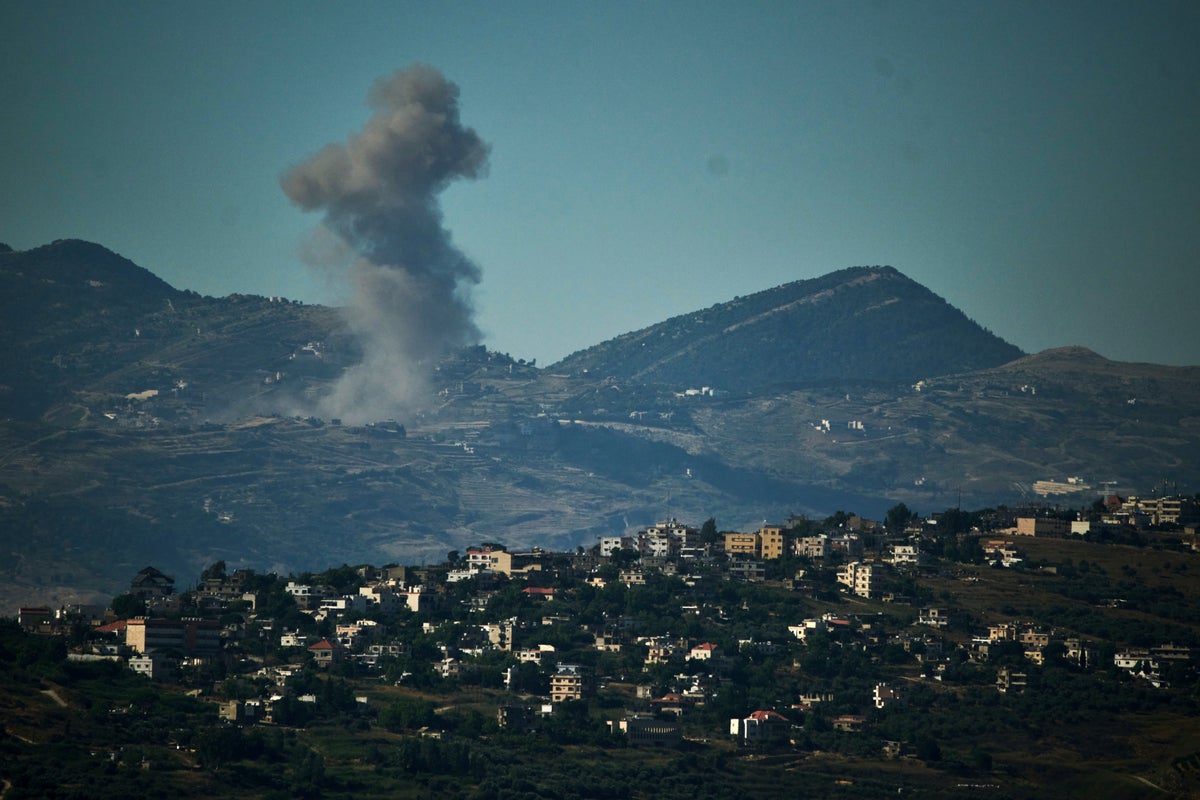
The diplomatic architecture established by the June 17, 2026, Memorandum of Understanding (MoU) between the United States and Iran is fundamentally unstable because it relies on a faulty structural assumption: that a bilateral agreement between an extra-regional superpower and a regional patron can bind non-signatory sovereign actors who possess existential security mandates. The immediate postponement of follow-up technical talks in Switzerland following intense kinetic exchanges between the Israel Defense Forces (IDF) and Hezbollah in southern Lebanon exposes this design flaw. While the structural framework of the agreement assumes that a cessation of hostilities can be enforced globally, the tactical incentives on the ground create an inevitable escalation loop.
To evaluate whether this interim peace pact can survive its 60-day window, one must analyze the structural mechanics of the agreement, the conflicting security logic of the local actors, and the operational friction that halted negotiations within 48 hours of signature. Don't forget to check out our earlier coverage on this related article.
The Tri-Lateral Cost Function of the June 17 MoU
The preliminary agreement signed by Washington and Tehran aims to decouple global energy security from regional proxy conflicts. It addresses the economic and strategic pressures that culminated in the open hostilities following the outbreak of the war on February 28. However, the agreement distributes economic incentives and strategic risks unevenly across three distinct tiers of actors.
1. The Primary Bilateral Layer (US and Iran)
For Washington and Tehran, the MoU operates as a transactional exchange designed to alleviate severe economic and strategic bottlenecks: If you want more about the context of this, Associated Press offers an informative summary.
- The Global Energy Incentive: The agreement successfully neutralized the immediate energy crisis by halting hostilities in the Persian Gulf and re-opening the Strait of Hormuz to commercial shipping. The primary concession granted by the United States—lifting the blockade on Iranian ports and permitting the uninhibited sale of crude oil—addresses Iran's capital constraints while stabilizing global oil and natural gas flows.
- The Financial Reconstruction Fund: The promise of a $300 billion postwar reconstruction fund and the gradual unfreezing of international assets serve as a massive economic carrot for Iran's domestic stability.
- The Technical Timeline: The MoU establishes a rigid 60-day window to negotiate a permanent resolution regarding Iran's nuclear program, the underlying driver of the broader conflict.
2. The Non-Signatory State Layer (Israel)
Israel is not a party to the bilateral MoU, meaning its state defense calculus remains entirely external to the agreement's incentives. The Israeli executive branch operates under a domestic security mandate that views any retention of Hezbollah's kinetic capacity along its northern border as an existential vulnerability.
The declaration of a multi-hundred-square-mile "security zone" in southern Lebanon by Prime Minister Benjamin Netanyahu represents a strategic enforcement mechanism designed to decouple Israeli border security from Washington's diplomatic maneuvers. This actions-on-the-ground policy generates an irreconcilable contradiction: Israel will maintain an active military occupation of Lebanese territory so long as its tactical intelligence indicates a residual threat, irrespective of diplomatic frameworks signed in Washington or Tehran.
3. The Non-State Proxy Layer (Hezbollah)
Hezbollah’s operational logic is tied directly to territorial sovereignty and patron survival. The group's refusal to permanently halt kinetic operations is contingent upon a complete IDF withdrawal from Lebanese soil. This stance is reinforced by the Lebanese Armed Forces, which view unilateral Israeli strikes—such as the fatal targeting of a Lebanese soldier on the Kfar Rumman-Nabatieh road—as deliberate subversions of state stability. Consequently, Hezbollah retains its defensive justification, interpreting any Israeli presence within the forward defense zone as an active invitation to retaliate.
The Escalation Loop: Why Ceasefires Fail Mechanically
The breakdown that paused the Switzerland talks reveals a repeating sequence of tactical action and reaction, which can be mapped as a closed kinetic loop.
[Diplomatic MoU Signed]
       │
       ▼
[Tactical Probe / Border Friction]
       │
       ▼
[Symmetric / Asymmetric Retaliation] (e.g., 4 IDF Deaths at Kfar Tebnit)
       │
       ▼
[Massive Punitive Counterstrike] (e.g., 150 Targets / 80 Infrastructure Sites)
       │
       ▼
[Diplomatic De-platforming] (Iran suspends technical talks)
       │
       ▼
[Emergency Mediation / Fractured Renewal]
This mechanical failure occurs because the definition of a "ceasefire violation" is entirely asymmetrical. Between midnight and late afternoon on June 19, the United Nations Interim Force in Lebanon (UNIFIL) tracked a severe spike in combat intensity, recording 748 projectile trajectories—695 attributed to the IDF and 53 to non-state actors—alongside 49 airspace violations and 51 distinct airstrikes.
To the IDF, striking 150 Hezbollah targets in Nabatiyeh and the Bekaa Valley constitutes a legitimate punitive response to a localized ambush that claimed the lives of four Israeli soldiers near Kfar Tebnit. To Iran and Hezbollah, these heavy retaliatory salvos, which resulted in dozens of casualties, represent a flagrant violation of the first clause of the MoU, which dictates a comprehensive ceasefire on all fronts, including Lebanon.
Because Clause One is interpreted by Tehran as an absolute prerequisite for subsequent negotiations, any localized tactical friction instantly halts the broader diplomatic track. The technical talks cannot resume in earnest because the baseline condition for their existence is being constantly dismantled on the ground in southern Lebanon.
The Shipping Tariff Variable and Strategic Risk Escalation
While military attention remains focused on the Blue Line in Lebanon, a critical economic bottleneck is developing in the Persian Gulf that threatens the core trade-off of the MoU. Under the terms of the temporary agreement, transit through the Strait of Hormuz is supposed to remain completely unrestricted and untariffed for the duration of the 60-day negotiating window.
However, the newly established Persian Gulf Strait Authority—the Iranian organ tasked with maritime oversight—issued operational guidance requiring all commercial vessels to register directly with Tehran. Although the authority stated that safety, environmental, and security tariffs would be temporarily absorbed by the Iranian government during the initial 60 days, the creation of this regulatory infrastructure signals an intent to monetize and regulate global shipping channels post-negotiation.
This development adds an aggressive variable to the strategic risk matrix:
- Sovereignty Assertion: By forcing commercial shipping lines to register, Iran is establishing a de facto legal precedent of administrative control over an international waterway.
- Economic Leverage: The architecture for a maritime tariff system creates a permanent leverage point that Tehran can activate if the United States fails to deliver sanction relief or the promised reconstruction funding.
- The Counter-Blockade Hazard: Should Israel or the United States interpret this administrative registration as an aggressive breach of international maritime law, the probability of a secondary maritime blockade increases, instantly collapsing the temporary economic stability that the MoU achieved.
The Tactical Outlook for the 60-Day Window
The renewal of the fragile ceasefire via Qatari, American, and Iranian mediation on June 19 represents a temporary stabilization rather than a structural solution. The underlying limitation of this diplomatic strategy is its reliance on indirect enforcement. The United States lacks the political leverage to force immediate concessions from a highly resistant Israeli coalition government, while Iran cannot fully suppress Hezbollah's localized defensive actions without compromising its most critical deterrent asset.
The strategic play for the next phase of negotiations relies entirely on creating a synchronized verification mechanism. If envoys Steve Witkoff and Jared Kushner intend to get the technical talks back on track with Iranian Foreign Minister Abbas Araqchi in Switzerland, diplomats must abandon the pursuit of an unmonitored, all-encompassing ceasefire. Instead, they must introduce a highly structured, localized disengagement protocol that defines clear geographic boundaries for Israel’s forward defense zone and binds both parties to a pre-calculated, non-escalatory escalation tariff for minor border infractions. Without this tactical insulation, localized kinetic friction in southern Lebanon will continuously dictate—and ultimately derail—global diplomatic agreements.