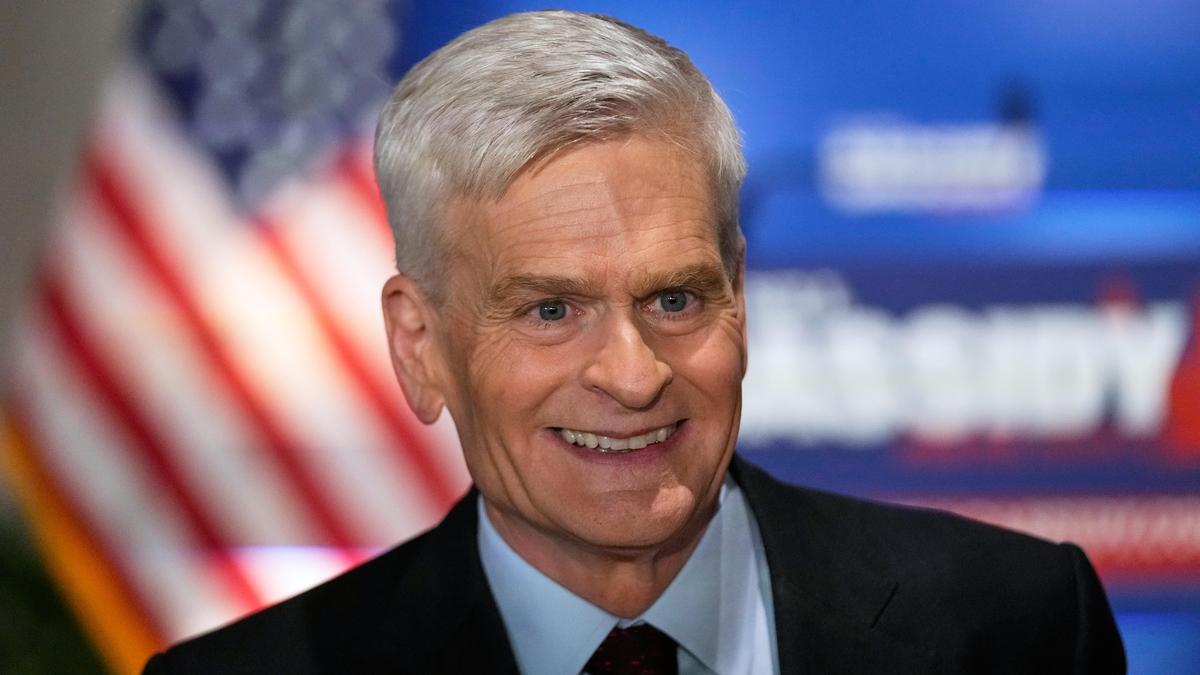
The 50-47 Senate procedural vote to advance a War Powers Resolution restricting military action in Iran reveals a structural shifts in legislative leverage, driven by changes in individual political risk insulation. Congressional oversight of executive military actions is rarely a function of pure constitutional principle; instead, it operates as an equilibrium between executive enforcement mechanisms and individual lawmaker electoral vulnerability. The defection of Senator Bill Cassidy (R-La.) following a primary election loss demonstrates how the elimination of future electoral risk fundamentally alters a legislator's utility function, effectively disabling the executive branch's primary tool of party discipline.
To evaluate the sustainability and systemic impact of this legislative development, the underlying mechanics must be categorized into three operational frameworks: the structural erosion of executive deterrence, the economic inputs driving congressional friction, and the legal optimization strategies used by the executive to bypass statutory constraints.
The Political Risk Function and Executive Enforcement Decay
Executive control over a legislative conference depends on the credible threat of electoral retaliation. When a president possesses a high approval rating among the primary electorate, the cost of defection for an incumbent legislator is high, often resulting in a well-funded primary challenger and a loss of party resources. The executive enforcement model can be expressed as an assessment of net political utility:
$$U_{legislator} = P_{re-election} \cdot V_{office} - C_{defection}$$
Where $P_{re-election}$ represents the probability of retaining office, $V_{office}$ is the systemic value of holding the seat, and $C_{defection}$ is the political cost imposed by executive opposition.
The primary loss suffered by Senator Cassidy altered this equation by reducing $P_{re-election}$ to zero for the upcoming cycle, removing the variable of future electoral vulnerability. Consequently, the cost of defection ($C_{defection}$) also dropped to zero, creating a structural insulation that allowed the legislator to vote to advance the War Powers Resolution. This behavior is not an isolated anomaly but a systemic feature of what can be termed the legislative term-limitation effect. Lawmakers who are retiring, representing highly insulated states, or those who have already lost their primaries no longer face the same electoral incentives that ensure party discipline.
The current Senate configuration contains multiple distinct categories of risk-insulated legislators:
- The Post-Primary Defector: Lawmakers who have already lost their primary contests and possess a zero-probability metric for immediate re-election, eliminating the efficacy of executive endorsement threats.
- The Intentional Retirees: Legislators who have chosen not to seek re-election, permanently lowering their long-term political risk profile.
- The Structurally Insulated: Senators representing states with independent or non-partisan primary systems that reward cross-party voting behavior, rendering executive enforcement mechanisms less effective.
The aggregation of these categories has degraded the executive floor majority down to a narrow margin. With a 50-47 vote to discharge the resolution from committee, the defection of a single risk-insulated senator can disrupt party unity, allowing the opposition party to pass procedural motions that previously failed.
Economic Feedback Loops as Drivers of Legislative Action
While individual risk profiles explain how a legislator can vote against executive preferences, macroeconomic pressures explain why the broader legislative body is facing increased pressure to do so. The military intervention in Iran—initiated in late February under Operation Epic Fury—has generated external economic pressures that directly impact domestic voter sentiment.
The primary economic variable driving congressional action is the rapid increase in domestic energy costs. Since the deployment of military assets and the subsequent introduction of friction into the global energy supply chain, retail gasoline prices in the United States have increased significantly. This domestic inflationary pressure creates a parallel feedback loop:
- Military escalation alters maritime shipping risks and threatens regional production facilities, causing global crude prices to rise.
- Higher crude prices transition into retail energy inflation, reducing consumer discretionary income and lowering broad consumer confidence metrics.
- This inflation increases dissatisfaction among voters across the political spectrum, raising the political cost for legislators who support continuing the conflict without a defined end state.
This economic pressure reduces the domestic political durability of the military campaign. Lawmakers are caught between executive demands for party unity and constituent dissatisfaction over rising costs. When the executive branch fails to provide clear strategic parameters, the domestic economic costs begin to outweigh the perceived geopolitical benefits, driving centrist and risk-insulated legislators toward legislative mechanisms that limit the conflict.
Statutory Avoidance and Technical Ceasefires
The legislative vehicle under consideration—the War Powers Resolution of 1973—contains structural vulnerabilities that limit its effectiveness as a tool for restricting executive military action. The statute requires the executive to withdraw United States Armed Forces from unauthorized hostilities within 60 to 90 days unless Congress issues a specific declaration of war or statutory authorization. However, the executive branch relies on a specific legal interpretation to limit the statute's enforcement mechanisms.
The current conflict is operating under a fragile, temporary ceasefire. The executive branch utilizes this operational pause to claim that active "hostilities" have technically ceased. By defining hostilities strictly as active, kinetic engagements, the administration argues that the statutory clock governing unauthorized deployments is paused.
This legal strategy relies on a deliberate interpretation of statutory terms:
- The Hostilities Loophole: The executive defines "hostilities" narrowly to exclude troop deployments, intelligence gathering, and defensive positioning during a ceasefire, maintaining that the War Powers Resolution's withdrawal mandate does not apply.
- Strategic Opacity: By withholding operational details and classifying the underlying strategic plan of Operation Epic Fury, the administration limits the ability of congressional oversight committees to challenge its legal definitions.
This dynamic creates a significant structural challenge. Even if the resolution secures a simple majority in both chambers, it remains vulnerable to an executive veto. Overriding a presidential veto requires a two-thirds supermajority in both the Senate and the House—a threshold that current voting alignments indicate is mathematically unlikely. Consequently, the legislative advancement of the bill serves primarily as a signaling mechanism to increase the political costs for the administration rather than an immediate, enforceable halt to military operations.
Strategic Forecast and Legislative Alignment
The tactical utility of the War Powers Resolution is limited by structural constraints, yet its advancement alters the legislative landscape through several specific dynamics.
The House of Representatives is scheduled to vote on a matching War Powers resolution. Given that a previous iteration failed in a tie vote, the shift in Senate alignment increases pressure on marginal House members. The passage of a concurrent resolution would mark the first formal, bicameral legislative challenge to the administration's military policy during this conflict.
The administration will likely attempt to prevent further defections by offering targeted disclosures. To secure the votes of wavering senators who have not completely broken with the administration, the executive branch may use private briefings or offer public hearings to outline its strategic goals, similar to previous accommodations made during the Venezuela oversight disputes.
The legislative process will face a critical bottleneck when absent senators return for the final passage vote. The 50-47 procedural victory occurred with three Republican absences. If those absent lawmakers return and maintain a pro-executive stance, the margin for final passage disappears, making the structural alignment of the remaining risk-insulated senators the decisive factor in whether the bill passes the chamber.
The core vulnerability for the administration is no longer just the opposition party's strategy, but the growing number of lawmakers whose political risk profiles have been structurally altered. As the legislative calendar progresses toward midterms and further primary contests conclude, the number of risk-insulated legislators will naturally increase, further limiting the executive branch's ability to maintain party discipline on foreign policy decisions.


/cdn.vox-cdn.com/uploads/chorus_asset/file/12849563/penthouses.0.1510182761.jpg)