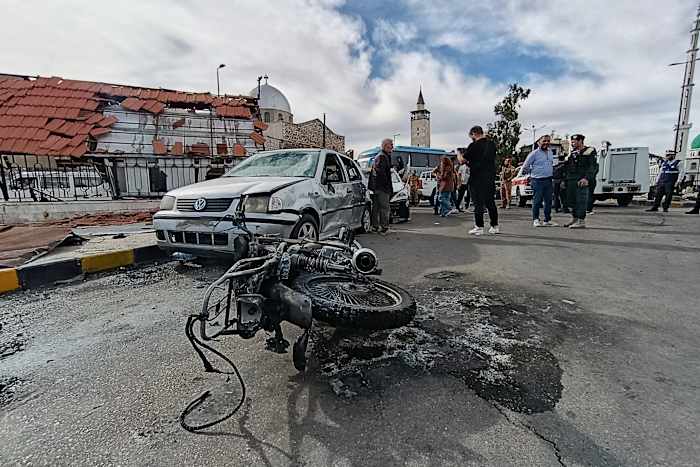
The detonation of an improvised explosive device (IED) paired with a secondary car bomb outside a Syrian Defense Ministry facility in Damascus reveals that the transitional government has not yet achieved a monopoly on violence within the capital. This asymmetric strike, occurring in the central Bab Sharqi district on May 19, 2026, utilized a classic bait-and-switch tactical framework. By baiting military personnel with a stationary, discoverable explosive device, the perpetrators delayed security forces in an exposed perimeter before triggering a secondary vehicle-borne IED (VBIED). The resulting blast killed one soldier and wounded 12 individuals, including civilians.
This operational profile points directly to the persistent vulnerability of the post-Assad state apparatus, which assumed authority after the collapse of the Ba'athist regime in December 2024. While regional news reporting treats such bombings as isolated incidents of urban unrest, a structural analysis reveals they are calculated stress tests designed to exploit the transitional government's fragmented security architecture.
The Dual Device Tactical Framework
The Bab Sharqi attack was not a simple act of sabotage; it relied on an operational sequence engineered to maximize casualties among technical specialists and first responders. In asymmetric warfare, this sequence functions via three distinct phases.
Phase 1: The Static Bait
An initial IED is planted with intentional vulnerability to detection. The primary objective is not immediate detonation, but rather the disruption of local transit and the concentration of defensive assets. When the Syrian military discovered the device in Bab Sharqi, it triggered standard operating procedures: cordoning the area and deploying explosive ordnance disposal (EOD) personnel.
Phase 2: The Perimeter Anchor
As EOD technicians attempt to defuse or render the initial device safe, a time bottleneck is created. Security personnel are forced to remain static in an exposed, predictable urban sector. This eliminates their mobility advantage and concentrates high-value military assets—such as specialized engineers and command staff—within a predetermined kill zone.
Phase 3: The Kinetic Secondary Trigger
Once the perimeter anchors the defensive forces, the primary kinetic mechanism is initiated. In this instance, a secondary VBIED parked within the blast radius was detonated. The sudden escalation bypasses the protective posture of the initial cordon, converting the security perimeter into a fragmentation trap. The data from the Bab Sharqi incident reflects this design: a single fatality among the military personnel dismantling the bait, with a high volume of peripheral casualties (12 wounded) spanning both military and civilian bystanders.
The Strategic Cost Function of Urban Asymmetric Warfare
For insurgent networks operating in a post-regime landscape—primarily remnants of the Islamic State (IS)—urban bombings yield exceptionally high asymmetric returns relative to their resource inputs. The operational efficiency of these attacks can be evaluated using a basic cost function:
$$C_{\text{attack}} = I_{\text{mat}} + I_{\text{log}} - E_{\text{strat}}$$
Where $I_{\text{mat}}$ represents low-cost material inputs (commercial explosives, stolen vehicles, cellular triggers), $I_{\text{log}}$ represents minimal localized logistics, and $E_{\text{strat}}$ represents the compounding strategic erosion inflicted on the state. The value of $E_{\text{strat}}$ is driven by three distinct mechanisms.
- Intelligence Degradation: Successfully placing a dual-device configuration outside a building linked directly to the Ministry of Defense proves a severe deficit in counter-intelligence. It demonstrates that the state lacks localized human intelligence networks and signals intelligence surveillance capable of monitoring high-priority urban sectors.
- Economic Friction: Securing an ancient, densely populated district like Bab Sharqi requires intensive military checkpoints, structural barriers, and stop-and-frisk protocols. Forcing the transitional government to implement these measures drives up the economic cost of governance, strangling local commerce and slowing urban reconstruction.
- Political Delegitimization: The fundamental contract of the post-Assad transitional authority relies on providing superior security and stability relative to the civil war era. High-visibility blasts in the capital systematically erode public trust, signaling to the population that the new administration cannot secure its own central ministries.
Transitional Vulnerabilities and Institutional Friction
The persistence of these security failures is directly linked to the structural transition of the Syrian state following the December 2024 transition of power. The replacement of a centralized, authoritarian security apparatus with a coalition-based transitional government has introduced structural friction in three critical areas.
The Security Sector Reform Gap
The dismantling of the former regime’s intelligence networks left an information vacuum. The new Syrian Armed Forces and the newly established General Security Service are simultaneously managing external border security, tribal insurgencies in eastern Syria, and localized urban counter-terrorism. Without an integrated, centralized biometric and vehicle tracking infrastructure, tracking components for VBIEDs across provincial lines remains functionally impossible.
Sectoral Vulnerability of Defense Infrastructure
The Ministry of Defense statement noted that the explosion occurred outside a building "linked" to the ministry, rather than the primary headquarters. This highlights a critical defensive vulnerability: secondary administrative offices, logistical hubs, and housing facilities lack the hardened perimeters, blast walls, and signal-jamming equipment reserved for Tier-1 command centers. Insurgent factions actively exploit these soft underbellies of the state bureaucracy.
Geopolitical Distractions and Resource Reallocation
The transitional government’s security assets are severely overextended. Throughout early 2026, significant military resources, including the 66th and 72nd Divisions, were diverted to the northeastern Syria offensive to manage territorial frictions with Kurdish-led forces and secure tribal alignments. This geographic displacement of veteran troops leaves the capital dependent on less experienced regional garrisons, creating optimal conditions for urban insurgent cells to operate.
Proactive Counter Measures and Defensive Reconfiguration
To mitigate the recurrence of coordinated urban bombings, the Syrian transitional authority must shift from a reactive EOD posture to a predictive denial strategy. Relying on personnel to manually defuse discovered devices in unjammed environments represents an unacceptable risk to human capital.
First, the Ministry of Defense must establish automated electronic warfare (EW) bubbles around all state-affiliated real estate in Damascus. These localized jamming fields neutralize radio and cellular triggers, which are the primary mechanisms used to detonate secondary VBIEDs from a safe distance.
Second, the current perimeter defense model must be abandoned in favor of a layered standoff strategy.
[Tier 3: Urban Buffer Zone] -> [Tier 2: EW & Video Analytics] -> [Tier 1: Hardened Perimeter]
Urban administrative buildings require a minimum 100-meter vehicular standoff zone where no unvetted civilian vehicles can idle or park. When a suspicious device is located, standard operating procedures must mandate the immediate evacuation of the entire outer tier, utilizing remote-operated vehicles (ROVs) rather than human EOD units to conduct the initial assessment.
Finally, counter-terrorism units must implement algorithmic vehicle-flow analysis across the entry points of the Bab Sharqi district. Insurgent logistics rely on moving explosive precursors from rural safe houses into urban nodes. By cross-referencing automated license plate recognition data across the Damascus periphery, security forces can isolate anomalous transit patterns before vehicles reach high-value government targets. Failure to implement these structural adjustments will ensure that Damascus remains an open theater for high-yield asymmetric attrition.

%2BAngkor%2BWat%2C%2BCambodia%2B-%2BThe%2B19%2BMost%2BStunning%2BSacred%2BPlaces%2BAround%2Bthe%2BWorld.jpg)