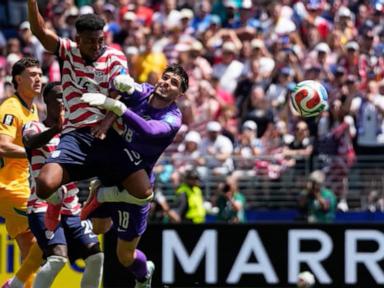
The United States Men’s National Team secured qualification for the FIFA World Cup 2026 knockout round with a 2-0 victory over Australia in Seattle, achieving maximum points from their opening two group stage matches for the first time in the modern era. While standard match narratives attribute the result to a continuous linear progression from the previous 4-1 victory over Paraguay, the underlying tactical reality reveals a triumph of operational adaptation over personnel deficit. Playing without primary attacking catalyst Christian Pulisic due to a calf injury, the United States structural design altered its offensive progression vectors to exploit specific vulnerabilities in Australia’s defensive mechanics.
The match demonstrated that localized structural disruption, rather than prolonged possession dominance, dictates outcomes in high-stakes international tournament play. By analyzing the structural mechanics of the attacking phases, the defensive isolation models, and the optimization of set-piece variables, a blueprint emerges regarding how elite tactical design mitigates the absence of marquee individual talent.
The Mechanism of Induced Errors: Exploiting the Low Block
International soccer analysts frequently categorize defensive systems binary as either "high pressing" or "low block," yet this dichotomy obscures the actual friction points within defensive transitions. Australia operated in a compact low block designed to compress horizontal passing lanes in the middle third. To dismantle this, the United States utilized asymmetric flank progression, deliberately overloading the left wing through the combined movements of fullback Antonee Robinson and forward Folarin Balogun.
The opening goal in the 11th minute, recorded as an own goal by Australian defender Cameron Burgess, was the direct byproduct of this structural stress testing. The tactical sequence did not rely on chance; it functioned via a distinct three-phase progression model:
- Vertical Triggering: Robinson initiated an immediate vertical line pass into the half-space, bypassing Australia’s secondary defensive line.
- Deceleration and Isolation: Balogun used a high-velocity dribble to isolate the recovering defender, forcing the Australian backline to shift from a zonal orientation to an emergency recovery state.
- Low-Trajectory Delivery: By driving a hard, low cross across the face of the six-yard box toward striker Ricardo Pepi—who started in place of the injured Pulisic—the United States introduced a high-risk variable for the retreating central defenders.
When a defensive line is forced to sprint toward its own goal line while facing its own net, the margin for mechanical error decreases exponentially. Burgess’s subsequent misclearance illustrates how sustained physical pressure and precise spatial attacking force technical failure from opposition units. The United States became the first team in tournament history to benefit from own goals in two consecutive World Cup matches, a metric that reflects a systematic pattern of forced defensive collapse inside the eighteen-yard box rather than random variance.
Spatial Optimization and Second-Ball Mechanics
The second goal in the 43rd minute demonstrated how structural adaptability offsets a deficit in pure creative ball-handling. After Pepi executed a hold-up action near the right endline to draw a foul, the United States maximized a set-piece opportunity via calculated secondary positioning.
The initial delivery resulted in a contested aerial duel, generating a loose ball inside the six-yard box after a deflected shot by Sergiño Dest went straight into the air. In these chaotic micro-environments, positioning is dictated by predictive anticipation rather than ball-watching. Defender Alex Freeman, the 21-year-old fullback making his second tournament start, anticipated the falling trajectory while the Australian defensive block and goalkeeper Patrick Beach over-committed to the initial shot angle.
Freeman’s close-range header highlighted two core tactical prerequisites for utilizing defenders in offensive phases:
- Target Depth: Inserting physical presence into the six-yard box during second-phase set pieces forces the opposing goalkeeper into a compromised decision-making matrix. Beach was caught out of position, adjusting his weight to the right before Freeman altered the ball's trajectory.
- Physical Leverage: Exploiting height advantages against fatigued defenders late in a half creates a distinct statistical probability of winning secondary aerial duels.
Defensive Containment and Pass Completion Metrics
The preservation of the 2-0 margin required an entirely different structural framework in the second half, as Australia shifted its lines forward to create numerical overloads. The United States transitioned from an expansive attacking shape into a mid-block defensive shell, prioritizing passing efficiency over risky progressive actions to neutralize transition threats.
Central to this defensive stability was the distribution efficiency of center back Chris Richards. Richards completed 91 of 95 total pass attempts during the match, maintaining a high-volume retention rate that starved Australia of counter-pressing opportunities. By stringing together low-risk horizontal and recycling passes between the backline and defensive midfielders, the United States effectively managed the game clock and mitigated defensive fatigue.
The primary limitation of this containment strategy is the internal pressure it places on the defensive line to remain flawless inside their own defensive third. Australia increased its offensive intensity, generating 5 total shots, but failed to record high-quality expected goals (xG) opportunities due to the spatial compression maintained by the United States central pairing of Richards and Tim Ream. The structural discipline yielded the team's first clean sheet in 11 international fixtures, establishing a baseline of defensive competence necessary for deep knockout-stage progression.
The Limits of Depth and Strategic Forecast
While the victory confirms qualification for the Round of 32 prior to the final Group D match against Türkiye in Los Angeles, the data highlights structural vulnerabilities that require correction. The absence of Pulisic forced a heavier reliance on Balogun’s individual dribbling metrics to break lines, creating an offensive bottleneck when Australia double-teamed the left flank in the final 30 minutes of the match.
The tactical adjustments made by head coach Mauricio Pochettino showed a clear understanding of roster limitations, using late-game substitutions like Auston Trusty, Joe Scally, and Haji Wright to reinforce defensive structures and preserve physical stamina. Relying on forced errors and secondary set-piece deflections is a highly effective methodology against rigid defensive units like Australia, but it introduces volatility against elite opponents capable of sustained counter-pressing.
The strategic imperative for the upcoming match against Türkiye involves calibrating the central midfield axis to generate central penetration, reducing the team's systemic reliance on wide-flank overloads.