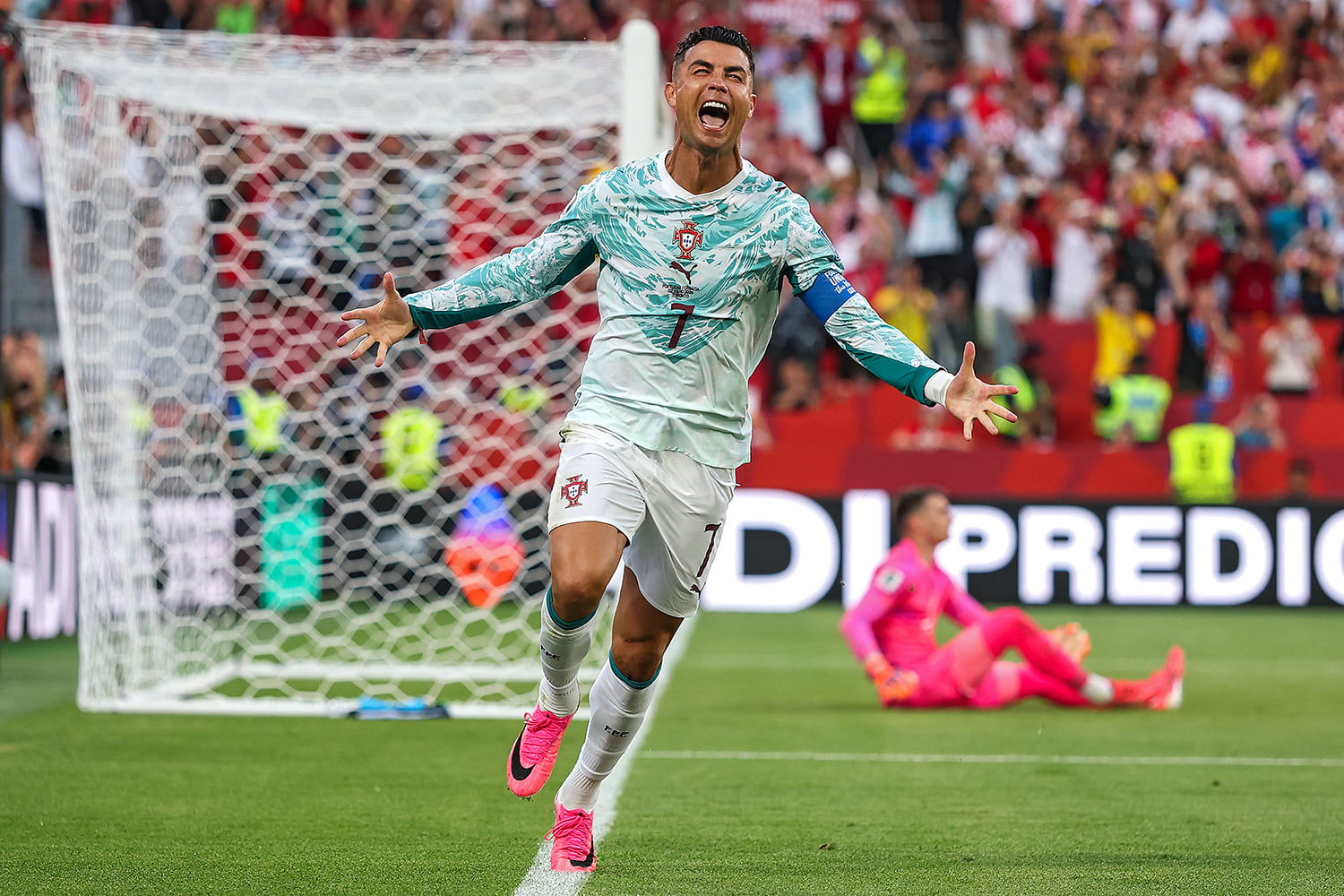
Elite international tournament football is governed by structural thresholds. When Portugal defeated Croatia 2-1 in the 2026 FIFA World Cup Round of 32 in Toronto, popular narratives focused heavily on emotional swings, late-game drama, and refereeing controversy. A cold technical analysis reveals a different reality. The outcome was dictated by a measurable transition in structural optimization: Portugal adjusted its offensive profile to maximize physical leverage in the box, while Croatia succumbed to systemic fatigue that degraded their defensive spacing by fractions of a centimeter.
The match can be deconstructed through three precise operational lenses: the breakdown of Croatia's low-block sustainability, the risk-reward matrix of substituting a legendary asset, and the mechanical precision of data-driven officiating. If you liked this article, you might want to check out: this related article.
The Decay Function of Croatia’s Defensive Low-Block
Croatia’s initial tactical setup relied on an asymmetrical mid-to-low block designed to choke vertical passing lanes into the final third. When Ivan Perišić exploited a defensive breakdown from Rúben Dias in the 53rd minute to put Croatia ahead, the tactical mandate shifted toward absolute preservation. However, maintaining a compact defensive block carries a steep physical cost function, particularly against an opponent commanding the luxury of superior rotational depth.
The breakdown of Croatia's defensive integrity follows a predictable fatigue curve. In the first half, Croatia successfully limited Portugal’s central progression by maintaining a vertical distance of less than 15 meters between their midfield and defensive defensive lines. The first variable to fail under physical exhaustion is structural discipline. As the match progressed past the 75th minute, Croatia’s midfield line dropped an average of four meters deeper into their own half, creating an operational vacuum in the half-spaces. For another look on this event, refer to the latest update from CBS Sports.
This structural regression manifested in the 94th minute. Rafael Leão was permitted sufficient temporal and spatial clearance on the left flank to deliver an uncontested cross. Because Croatia's central midfielders could no longer press the wide delivery zone, Portugal's wide attackers could isolate their targets. The physical profile of substitute Gonçalo Ramos presented a mismatch against a fatigued Croatian backline. Ramos’s downward header was the direct consequence of a defensive unit unable to adjust its feet due to lactic acid accumulation, allowing Portugal to exploit the vertical window between the two central defenders.
The Substitution Matrix: Balancing Legacy and High-Intensity Pressing
Roberto Martínez’s decision to substitute Cristiano Ronaldo in the 82nd minute, with the score tied at 1-1, provides an ideal case study in high-stakes human asset management. Earlier in the match, Ronaldo had neutralized Croatia’s opener by converting a 68th-minute penalty—a goal that established him as the oldest scorer in World Cup knockout history at 41 years old.
From a purely analytical standpoint, retaining an elite finisher on the pitch maximizes potential value inside the penalty area during chaotic, late-game scenarios. However, the modern tactical framework demands a pressing intensity that a 41-year-old physical profile cannot sustain over 90 minutes. Ronaldo’s retention on the pitch creates an out-of-possession bottleneck:
- Defensive Phase Disconnect: The forward line fails to trigger the initial press, forcing the midfield unit to cover an extra 5 to 10 meters per defensive rotation.
- Transition Delays: A lower baseline running speed prevents the forward from exploiting sudden gaps during rapid counter-attacks.
By replacing Ronaldo with a younger physical asset, Martínez rebalanced Portugal's pressing efficiency. The substitution forced Croatia's deep playmakers, including a tiring 40-year-old Luka Modrić, to expedite their distribution under increased physical pressure. The tactical trade-off sacrificed Ronaldo's elite penalty-box instincts to secure the high-intensity defensive coverage required to pen Croatia into their own defensive third during the final ten minutes.
The Connected Ball Architecture: Officiating by the Millimeter
The defining controversy of the match—Josko Gvardiol's disallowed equalizer deep into stoppage time—serves as a case study for the integration of Internet of Things (IoT) hardware in professional sports. Initial broadcast angles suggested that the ball reached Mario Pašalić via a deflection off Portuguese defender Renato Veiga, an action that would have invalidated any offside position.
The final determination relied on Adidas Trionda Connected Ball Technology, which utilizes an Inertial Measurement Unit (IMU) sensor suspended at the center of the ball. The system samples spatial and impact data at 500 Hz (500 times per second).
[Spatial Positioning Data] + [500 Hz IMU Sensor Inside Ball]
                      │
                      ▼
        [Semi-Automated Offside Engine]
                      │
                      ▼
[Heartbeat Graphic: Confirmed Matanović Touch] ──► [Offside Validated]
The sensor data captured a specific micro-impact prior to the ball reaching Pašalić. The IMU sensor logged a distinct high-frequency peak in the data stream, visualizing a "heartbeat graphic" that confirmed an internal touch by Croatian forward Igor Matanović. Because Matanović made micro-contact with the ball while Pašalić was positioned exactly 12 centimeters ahead of the second-to-last defending line, the semi-automated offside engine triggered an objective infraction.
The primary limitation of this technological paradigm is not its accuracy, but the psychological disruption caused by its temporal latency. The review process required over three minutes to reconcile the automated spatial tracking data with the referee's field perspective. This delay creates an emotional vacuum, pausing high-intensity athletic performance and altering the psychological momentum of both teams.
Strategic Forecast for the Iberian Derby
Portugal’s advancement to face Spain in Dallas on July 6 introduces a fundamentally different tactical equation. While Croatia focused on low-block preservation and structural counter-attacks, Spain operates on a high-pressing, possession-dominant paradigm designed to exploit defensive transition vulnerabilities.
Portugal cannot rely on late-stage physical decay to bail out structural deficiencies in their central defense. If Rúben Dias and Renato Veiga replicate the spatial assignment errors that allowed Perišić to score cleanly in the 53rd minute, Spain’s inside forwards will exploit those gaps within the first half-hour.
The strategic imperative for Martínez requires a permanent shift to a mid-block 4-3-3 formation from the opening whistle. This configuration must deploy high-mobility central midfielders capable of matching Spain’s passing tempos, rather than relying on late-game offensive substitutions to rescue a deficit.