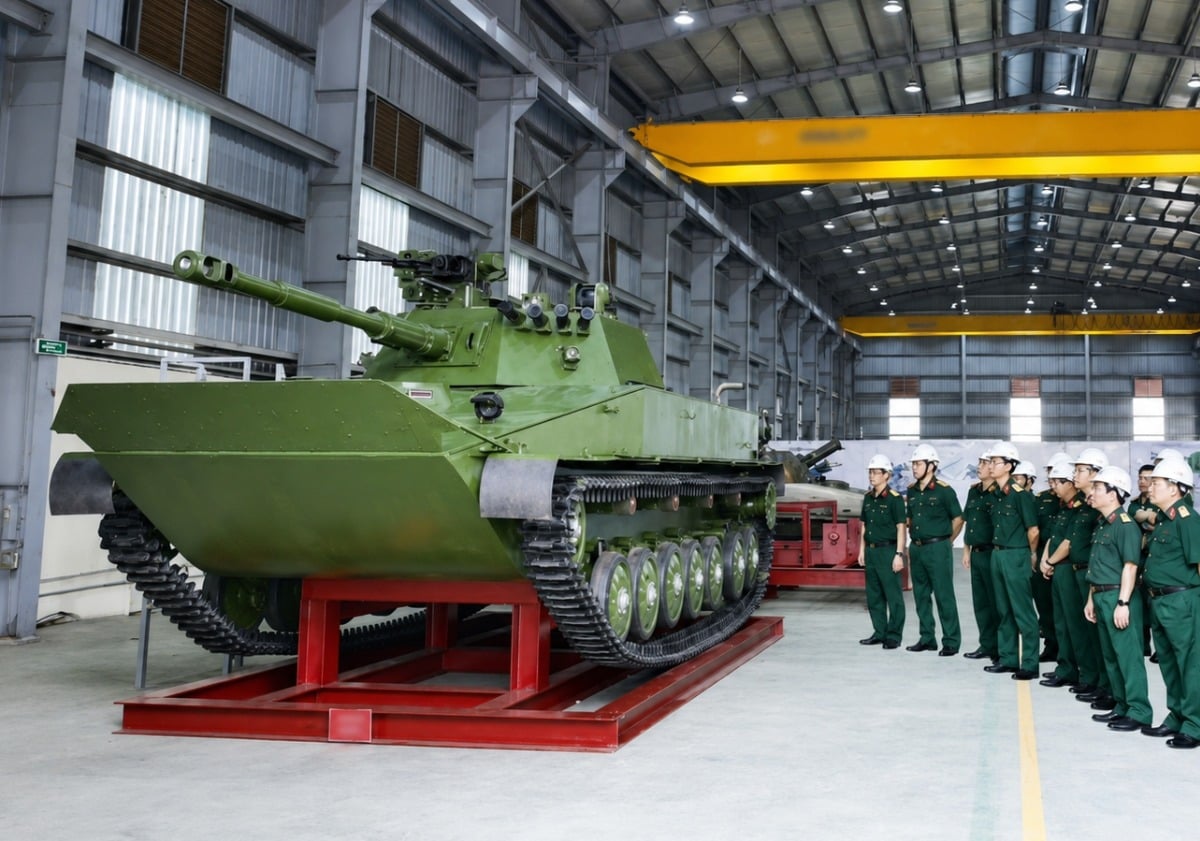
Vietnam's defense industrial base has quietly reached an inflection point with Factory Z125's assembly of the T-1 prototype, the nation’s first domestically developed amphibious light tank. While superficial observations dismiss the platform as a mere cosmetic iteration of the Soviet-era PT-76, an engineering analysis reveals a calculated strategy to solve a specific regional operational challenge. The People's Army of Vietnam (PAVN) faces a dual-theater defense problem: navigating the waterlogged, delta-heavy topography of the domestic mainland while maintaining a viable littoral counter-landing capability against technologically superior adversaries.
The T-1 project is not an attempt to match the frontline capabilities of modern main battle tanks (MBTs). It is a highly optimized, resource-constrained asset designed to operate within an asymmetric defense ecosystem where heavy armor cannot step. Understanding the engineering tradeoffs, structural bottlenecks, and doctrine behind the T-1 reveals how middle powers maximize defensive utility when denied access to high-end global supply chains. Meanwhile, you can read other developments here: The Technical Illusion Behind AI Memory and the Pursuit of True Machine Persistence.
The Tri-Frontier Mobility Optimization Framework
The design of any amphibious armored fighting vehicle is governed by a strict mathematical trade-off between mass, internal volume, and displacement. To achieve buoyancy without complex, failure-prone flotation screens, the T-1 relies on an enlarged, lightweight hull structure. The physics of hydrodynamic displacement dictate that a vehicle must displace a volume of water equal to or greater than its own mass to float. By using a hull design heavily influenced by the Cold War PT-76 but modified with modern track arrangements derived from the PTH-01 (a domestic 2S1 Gvozdika variant), the T-1 achieves a critical power-to-weight ratio needed for soft-soil and riverine navigation.
The operational terrain of Vietnam presents three distinct mobility bottlenecks: To explore the complete picture, we recommend the detailed analysis by TechCrunch.
- The Delta/Paddy Constraint: High soil-moisture content and deep mud reduce the shear strength of the ground. Heavy vehicles with high ground pressure sink, bogging down completely. The T-1 features wide tracks and hollow road wheels, reducing its ground pressure footprint to allow traverse over terrains that would immobilize a 50-ton MBT.
- The Riverine Transition Zone: Crossing rivers requires immediate transition from driving to swimming without stopping for reconfiguration. The T-1 utilizes an integrated trim vane and mechanical bilge pumps, enabling the crew to enter the water directly from a march.
- The Littoral Hydrodynamic Challenge: Internal water-jet propulsion systems allow the vehicle to steer and counter currents while swimming. This design isolates propulsion from the tracks during water operations, minimizing mechanical drag and maximizing transit speed across inland waterways and calm coastal bays.
The Cost Function of Retaining the 76mm Armament
The most debated element of the T-1 prototype is its reliance on a 76mm rifled main gun, a caliber universally recognized as obsolete for tank-on-tank engagements since the late Cold War. However, evaluating this weapon choice through a pure anti-armor lens misinterprets the platform's mission parameters. The selection of the 76mm architecture is driven by a logistical and financial cost function, rather than tactical maximization.
[Domestic Stockpile Utilization] ---> [Low Marginal Procurement Cost]
                                             |
                                             v
[76mm High-Explosive Firepower] ---> [Infantry Support Optimization]
                                             |
                                             v
[Reduced Weight & Recoil Force] ---> [Maintains Hull Hydrodynamics]
The first variable in this function is industrial inertia. The PAVN maintains massive stockpiles of 76x385mm ammunition, originally procured for the ZiS-3 divisional gun and legacy PT-76 fleets. Introducing a new caliber, such as a 100mm smoothbore or a 105mm NATO standard rifled gun, would require an overhaul of the domestic supply chain, driving up procurement costs. By matching the turret's breech mechanism to existing ammunition types, the marginal cost of supplying a T-1 unit drops significantly.
The second variable is recoil force management. A larger caliber weapon generates a higher impulse upon firing. For a lightweight, thin-skinned amphibious hull to absorb the kinetic energy of a 105mm gun without capsizing while afloat or cracking structural welds, it requires complex muzzle brakes, heavy hydro-pneumatic recoil mechanisms, and structural reinforcing. The 76mm gun minimizes these mechanical stresses, preserving the integrity of the lightweight hull and ensuring stability when firing while swimming.
The third variable is tactical utility alignment. In modern asymmetric warfare, tank-on-tank duels are exceedingly rare. Heavy anti-tank guided missiles (ATGMs) and loitering munitions handle high-tier armor threats. The T-1’s main gun is intended as a rapid-firing assault weapon, utilizing High-Explosive Fragmentation (HE-Frag) rounds to suppress enemy infantry positions, dismantle light field fortifications, and neutralize light armored vehicles or infantry fighting vehicles (IFVs) from the flanks. The gunner's cycle time is constrained by legacy optical layouts, but the high rate of fire inherent to smaller shells provides sustained fire support directly tied to infantry maneuvers.
Open Architecture and the Modular Survival Vector
According to directives from the Ministry of National Defense, the T-1 prototype integrates an open architecture and modular design philosophy. This structural choice acknowledges that a baseline aluminum or thin-steel hull cannot survive modern kinetic energy penetrators or tandem-charge anti-tank missiles. The vehicle's survival vector relies on a three-tier defensive hierarchy:
Detection Avoidance (Low Profile)
The T-1 maintains a low physical silhouette, minimizing its visual and radar cross-section. In heavily vegetated environments, a small geometric footprint reduces the probability of early detection by aerial reconnaissance platforms.
Modular Upgradability
The open architecture allows Factory Z125 to bolt on specialized defensive packages as threat profiles change. The baseline hull protects against 12.7mm heavy machine gun fire and artillery fragmentation. To counter modern threats without permanently overloading the suspension, the hull can accept localized appliqué armor or lightweight composite panels during specific high-risk deployments.
Payload Flexibility
The modular turret design leaves physical volume and weight margins to integrate complementary subsystems. While the initial prototype focuses on basic operations, the architecture allows for the future integration of external ATGM launchers, situational awareness sensors, or local electronic warfare counter-drone suites without requiring a complete redesign of the core chassis.
Strategic Realism and Platform Bottlenecks
The T-1 light tank is a pragmatic solution, but it possesses distinct operational boundaries. The strategy of using legacy calibers and lightweight structures creates structural vulnerabilities that dictate how the weapon must be deployed.
The primary vulnerability is passive armor deficiency. The necessity of maintaining a high power-to-weight ratio and positive buoyancy means the side and rear hull armor remains highly vulnerable to modern anti-material rifles, heavy autocannons, and man-portable anti-tank weapons. If caught out of position or ambushed on open, non-riverine terrain, the platform lacks the physical protection to survive.
The second constraint is sensor obsolescence. A modern combat vehicle is only as effective as its target acquisition cycle. If the T-1 relies on legacy analog optics without thermal imaging or integrated laser rangefinders, its effective night-combat and all-weather capability drops sharply. The platform must be integrated into a larger network where external assets, like scout infantry or domestic tactical unmanned aerial vehicles (UAVs), feed targeting data to the tank crews.
Target Operational Deployment
The deployment of the T-1 will likely bypass traditional armored brigade roles, focusing instead on specialized environments where its unique attributes provide an asymmetric advantage.
       [High-Threat Littoral/Delta Terrain]
                       |
        -------------------------------
        |                             |
        v                             v
[Defensive Riverine Screens]   [Asymmetric Amphibious Raids]
  - Delay enemy advances        - Strike vulnerable flanks
  - Secure river crossings      - Exploit difficult terrain
  - Support light infantry      - Maximize tactical mobility
The primary application is defensive riverine screens. In the event of a cross-border contingency, T-1 units can utilize Vietnam’s complex network of waterways to establish mobile blocking positions. They can swim into positions that an adversary’s heavy armored columns cannot easily target or access, acting as mobile, amphibious artillery pieces to delay advancing forces.
The secondary application is asymmetric amphibious raids. In littoral maneuvers, the ability to launch light armor from hidden coastal positions to strike an adversary's vulnerable logistical tail or soft-skinned command nodes creates a tactical complication. The T-1 excels in these high-mobility, low-duration operations where speed, terrain independence, and immediate fire support matter more than sustained, heavy armor protection. Mass production and testing protocols scheduled ahead of the Vietnam Defense Expo signify that the PAVN views this platform as a vital, highly reproducible asset for native defense manufacturing independence.