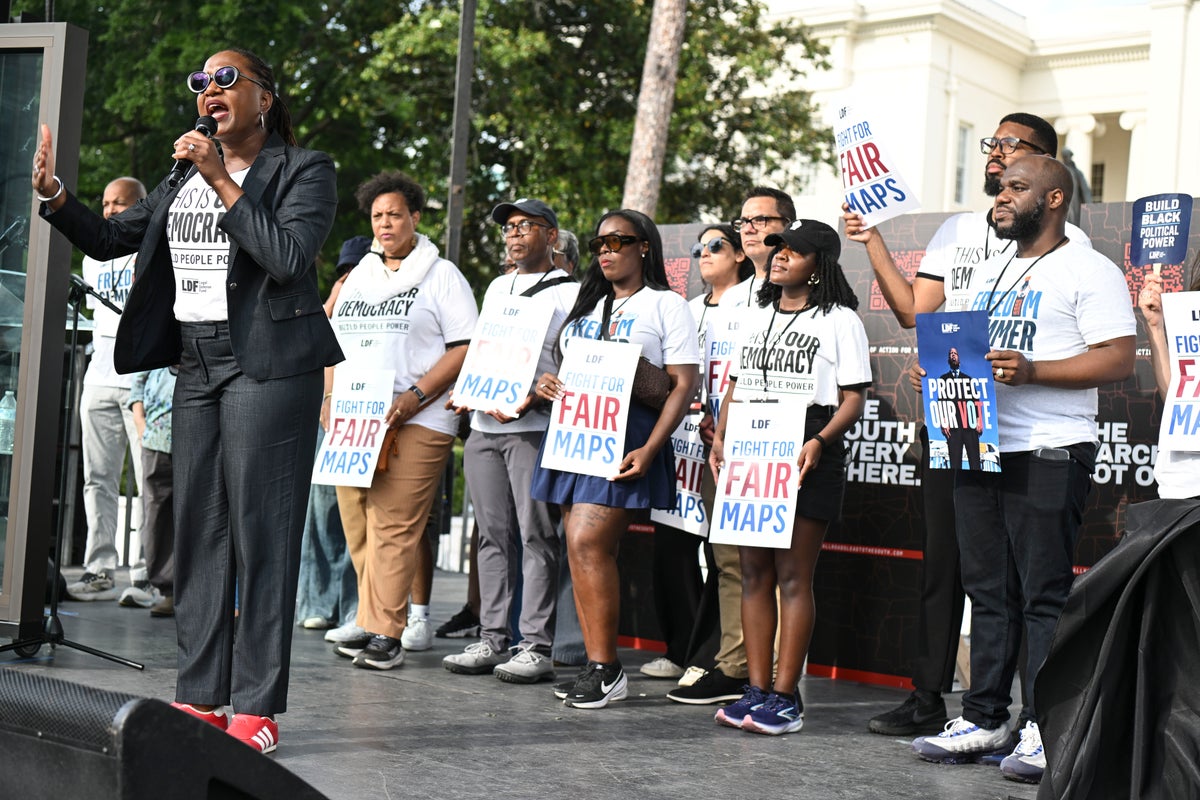
The intersection of constitutional law, partisan geography, and statutory interpretation functions as a complex Optimization game where rules dictate outcomes. When a three-judge federal panel blocked Alabama's attempt to reinstate its 2023 congressional map for the upcoming midterm elections, the decision did more than alter the immediate trajectory of a single U.S. House race. It exposed a fundamental structural conflict between state legislative autonomy, the evolving parameters of the Voting Rights Act of 1965 (VRA), and the strict evidentiary standards governing intentional racial discrimination under the Fourteenth Amendment.
Understanding this conflict requires moving beyond partisan narratives to analyze the structural mechanisms of electoral mechanics, judicial precedent, and the tactical maneuvers deployed by state actors to maximize legislative advantages.
The Core Structural Disconnect: Cracking and Packing Mechanics
The underlying technical conflict stems from the spatial distribution of a demographic cohort relative to geographic district boundaries. In Alabama, Black citizens comprise approximately 27% of the total population, yet historically occupied a meaningful voting majority in only one of the state’s seven congressional districts—representing roughly 14% of the state's total federal representation.
This structural asymmetry is achieved via two distinct boundary-drawing optimization techniques:
- Packing: Concentrating a target demographic group into a single district in overwhelming percentages (e.g., exceeding 60-70% of the Voting Age Population), thereby "wasting" their surplus votes and limiting their influence in neighboring boundaries.
- Cracking: Dispersing the remaining target demographic across multiple surrounding districts, ensuring their population concentration in each individual district remains well below the threshold required to constitute a decisive voting bloc.
In the initial 2021 redistricting cycle, Alabama utilized these mechanisms within the historic Black Belt region—a contiguous, rural area of majority-Black counties—by fragmenting the population across four distinct congressional districts. While Section 2 of the VRA requires the creation of an additional "opportunity district" when a minority population is sufficiently large, geographically compact, and politically cohesive to elect a representative of its choice, the state maintained a configuration that minimized this outcome.
The structural framework used by courts to evaluate these scenarios relies on the Gingles test, a three-part diagnostic hurdle established in Thornburg v. Gingles:
- Geographic Compactness and Numerosity: Can the minority group demonstrate it is large and compact enough to form a majority in a reasonably drawn, contiguous district?
- Political Cohesiveness: Does the minority group vote as a distinct, unified political bloc?
- Racial Bloc Voting: Does the majority population vote sufficiently as a bloc to consistently defeat the minority group’s preferred candidate?
When these three structural conditions are met, the statutory remedy typically dictates the drawing of a secondary opportunity district.
The Legal Pinball: Precedent, Vacatur, and Jurisdictional Arbitrage
The ongoing litigation reveals a calculated sequence of jurisdictional steps designed to exploit shifting federal jurisprudence. The timeline of this legal mechanism moves through distinct phases of optimization, resistance, and judicial review.
[2021 Plan (1 Black District)] ──> [2022 Court Order to Redraw] ──> [2023 Enacted Plan (Defied Court, 1 Black District)] ──> [SCOTUS Upholds Order in Milligan] ──> [Court Imposes 2024 Remedial Map (2 Black Districts)] ──> [SCOTUS Decides Callais (Weakens VRA Effect)] ──> [State Revives 2023 Plan via Special Primaries] ──> [May 2026 Panel Injunction Blocks State Plan]
In June 2023, the U.S. Supreme Court affirmed a lower court ruling in Allen v. Milligan, confirming that Alabama’s 2021 map likely violated Section 2 of the VRA. The court ordered the state legislature to craft a remedial map containing a second district where Black voters would have a fair opportunity to elect their preferred candidate.
Rather than executing this directive, the Alabama Legislature passed a 2023 plan that preserved only a single majority-Black district, raising the minority population in the secondary target district (the 2nd Congressional District) to roughly 40%—a threshold proven insufficient to overcome polarized majority bloc voting in the region.
Because the state's 2023 plan failed to satisfy the structural judicial mandate, the federal court appointed a special master to draw an independent, race-blind remedial map. This map, featuring two Black-majority or near-majority opportunity districts, was successfully deployed during the 2024 electoral cycle. It resulted in the election of Democratic U.S. Representative Shomari Figures in the newly configured 2nd District.
The structural matrix shifted dramatically in April 2026 following the Supreme Court’s decision in Louisiana v. Callais. The Callais ruling fundamentally narrowed how race can be factored into district construction under Section 2 of the VRA, limiting the viability of pure effect-based vote dilution claims. Seizing upon this structural shift, the Alabama executive and legislative branches engaged in rapid jurisdictional arbitrage:
- Step 1: The state petitioned the U.S. Supreme Court to lift the standing injunction on its state-drawn 2023 map in light of Callais.
- Step 2: Following a temporary procedural vacatur from the High Court on May 11, 2026, which sent the case back down for full review, Governor Kay Ivey initiated special primary elections scheduled for August 11, 2026, across four disrupted districts.
- Step 3: The state attempted to instantly re-implement the 2023 map, aiming to reclaim the 2nd Congressional District for the Republican column during the imminent 2026 midterm elections.
Deconstructing the Intentionality Threshold
The federal judicial panel’s May 2026 preliminary injunction halts this legislative maneuver by introducing a vital structural distinction: the difference between statutory effect under the VRA and constitutional intent under the Fourteenth Amendment's Equal Protection Clause.
While the Callais decision significantly constrained claims built on unintended statistical vote dilution, it left intact the rigorous legal framework governing explicit, intentional discrimination. Proving discriminatory intent requires a high evidentiary bar, typically evaluated through the Arlington Heights framework, which examines:
- The historical background of the decision, particularly whether it reveals a series of official actions taken for invidious purposes.
- The specific sequence of events leading up to the challenged policy.
- Departures from normal procedural or substantive sequences.
- Legislative or administrative history, including contemporary statements by members of the decision-making body.
The three-judge panel determined that the record of the Alabama Legislature's actions in 2023 constituted clear, undisputed evidence of purposeful defiance. The court noted that when lawmakers enacted the 2023 plan, they made a calculated choice to bypass a direct federal court order. The legislature possessed precise knowledge of the specific dilutive mechanisms required to suppress minority voting power in the Black Belt and Gulf Coast regions, and intentionally integrated those exact boundaries into the map.
Consequently, the panel concluded that the state could not use the general holding of Callais to validate a legacy action previously found to be explicitly designed to dilute minority voting capacity.
Logistical Friction and the Balance of Equities
Beyond the constitutional merits, the court's decision hinges on administrative and logistical stability, often analyzed under the judicial doctrine of the "balance of equities." The state’s mid-stream modification of electoral boundaries during an active election cycle created significant systemic friction.
When Alabama altered its district lines in May 2026, the state's regular primary elections had already occurred under the 2024 court-ordered boundaries. Shifting to the 2023 legislative map forced the closure of existing candidate qualifying periods and required the implementation of special, high-cost August primaries. This mid-cycle recalibration generated acute friction across three operational vectors:
| Vector of Friction | Operational Impact |
|---|---|
| Voter Allocation | Necessity of moving tens of thousands of citizens into new geographic precincts after absentee voting mechanisms had already commenced, causing immediate administrative bottlenecks. |
| Candidate Capital | Disruption of campaign infrastructure, fundraising networks, and voter outreach strategies designed for the 2024 boundary layouts. |
| Fiscal Efficiency | The sudden deployment of state and county funds to administer unscheduled special primary elections in late summer. |
The judicial panel addressed this operational chaos by noting that maintaining the 2024 boundaries via a preliminary injunction reduces overall candidate and voter confusion rather than escalating it. The preservation of the status quo prevents an aggressive, logistically challenging voter reassignment effort less than six months prior to the general election.
Strategic Play: The Path Forward
The immediate tactical move belongs to the state of Alabama. Attorney General Steve Marshall has signaled an immediate appeal back to the U.S. Supreme Court, setting up a definitive test case regarding the true scope of the Callais precedent.
The state's strategic objective is to persuade the Supreme Court's conservative majority that any map drawn without a strict, race-blind methodology is unconstitutional, effectively neutralizing the district court's findings of intentionality.
For political organizations, candidates, and election administrators, the operational play is distinct:
- Infrastructure Maintenance: Campaign operations within the 2nd Congressional District must proceed under the assumption that the 2024 court-ordered boundaries remain intact for the November 2026 midterms, as federal appellate courts are traditionally hesitant to alter election rules in the immediate run-up to voting day.
- Parallel Legal Planning: Litigants in parallel southern redistricting battles—specifically in Georgia and South Carolina—must pivot their legal strategies away from broad Section 2 VRA effects claims and heavily anchor their challenges in the stricter, evidence-heavy framework of Fourteenth Amendment intentional racial gerrymandering.
The ultimate resolution of this case will define the boundary lines of legislative map-making for the remainder of the decade, determining whether state legislatures can utilize favorable federal shifts to retroactively validate previously rejected electoral designs.