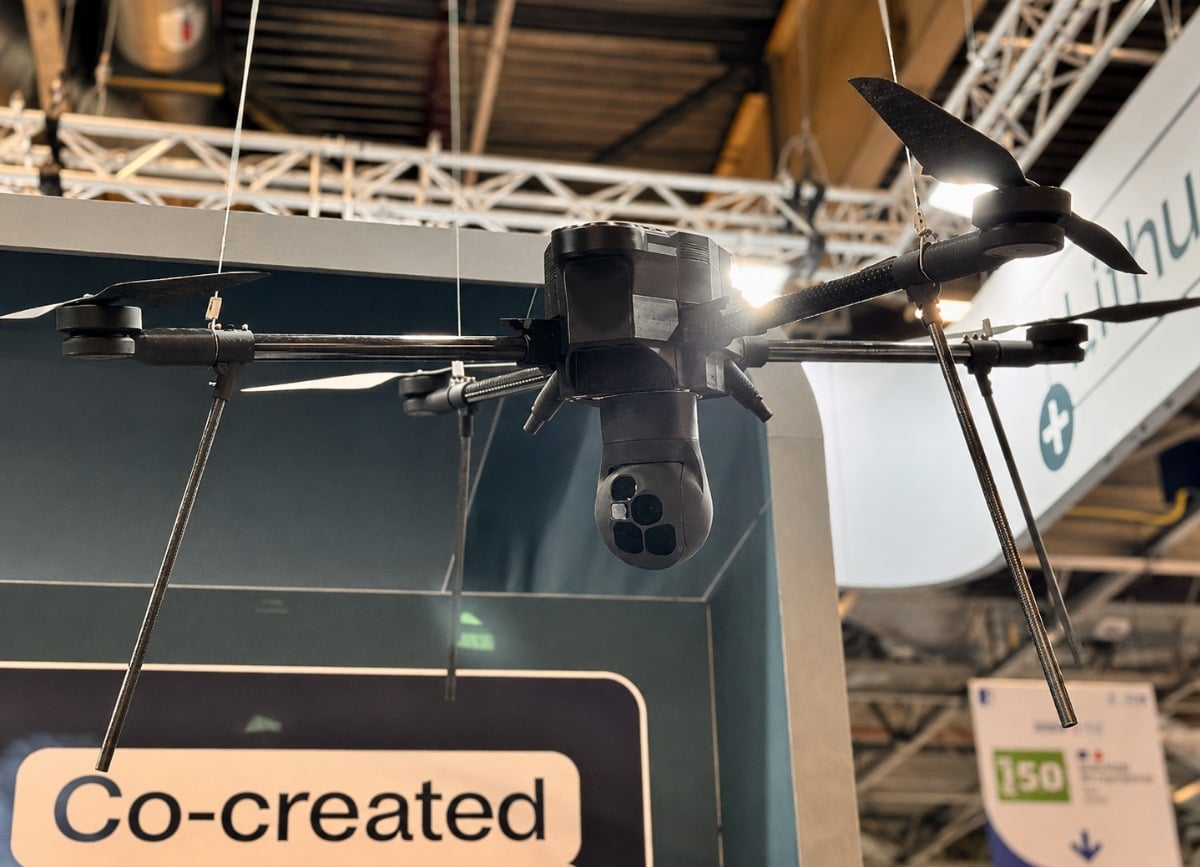
The systematic deployment of electronic warfare along the lines of contact in contemporary theaters has invalidated the core assumption of civilian derived drone engineering: that satellite positioning is a reliable utility. Active signal spoofing and high power noise jamming from systems operating up to 450 kilometers from their origin points have effectively neutralized standard Global Navigation Satellite Systems (GNSS) within tactical airspace. To maintain strike efficacy without escalating the baseline unit cost of expendable systems to the level of traditional cruise missiles, unmanned aerial vehicle (UAV) design must transition from external signal dependence to closed-loop onboard localization and mechanical actuation.
The operational reality of unguided or basic FPV drone munitions reveals an optimization bottleneck. To ensure a high probability of kill, operators must fly at low altitudes—frequently below 100 meters—to reduce the compounding geometric error introduced by wind drift, thermal currents, and atmospheric variance during a gravity drop. Flying at these lower altitudes exposes the launch platform to kinetic counter-measures, small arms fire, and localized radio horizon limitations. Solving this vulnerability requires decoupling targeting precision from altitude constraints, a technical objective achieved by decoupling the payload from reliance on external satellite telemetry.
The Tri-Component System Framework of Modern Guided Munitions
To construct an autonomous, signal-independent guidance system within a restricted budget and material profile, engineering firms must integrate three distinct subsystems into a single platform-agnostic architecture. This configuration must operate independently of human pilot corrections or external positioning networks.
       [Onboard Sensor Array: Electro-Optics / INS]
                             |
                             v
               [Edge Computing & Estimation]
                             |
                             v
       [Mechanical Actuation & Aero-Control Surfaces]
1. Onboard Sensor Array and State Estimation
The foundational layer relies on a combination of micro-electromechanical inertial navigation systems (MEMS INS) and optical sensors. Standard MEMS accelerometers and gyroscopes suffer from deterministic and stochastic errors that accumulate rapidly over time, a phenomenon known as sensor drift. Left uncorrected, an unassisted INS introduces exponential position error.
To arrest this error propagation without utilizing GNSS, the platform integrates computer vision and electro-optical edge processing. The system executes optical flow algorithms and terrain matching, measuring the relative motion of ground features across successive camera frames to calculate ground speed and vector trajectory. When approaching a predefined target zone, terminal guidance software assumes control, utilizing edge-processed neural networks to isolate, track, and lock onto physical assets based on structural contours and contrast profiles.
2. Edge Computing and Actuation Kinematics
Once the state estimation layer determines the current vector and the deviation from the target coordinate, the processor must translate this error into mechanical adjustments. The guidance computer computes the required flight path corrections using closed-loop proportional-integral-derivative (PID) control loops. These instructions are sent directly to localized servo actuators.
The actuation hardware alters the aerodynamic profile of the munition via control fins or surfaces. Because these kits are engineered to convert standard gravity bombs or unguided payloads into precision weapons, the mechanical interface must be universal. The system employs a clamp-on, self-contained shell that houses the battery, control surfaces, and processors, avoiding the need to modify the internal circuitry or physical frame of the host drone platform.
3. The Low SWaP-C Optimization Constraint
Military acquisition frameworks for tactical operations prioritize low Size, Weight, Power, and Cost (SWaP-C). Traditional military guidance units, such as those used in Joint Direct Attack Munitions (JDAM), are too heavy, power-hungry, and expensive for multi-rotor or light reconnaissance drones.
- Size: The kit must not alter the center of gravity of standard quadcopter or bomber-class drone platforms beyond their flight controller adjustment margins.
- Weight: Excess mass directly penalizes flight endurance. The guidance package must remain lightweight to preserve the original range profile of the aircraft.
- Power: Operating complex vision algorithms at the edge requires significant processing capability. The system must run on dedicated, low-power microcontrollers or high-efficiency edge accelerators that do not deplete the main propulsion battery.
- Cost: If a precision guidance module increases the total unit cost past the point of economic asymmetry, it defeats the tactical purpose of using low-cost drones. The engineering objective is to achieve sub-metric accuracy at a fraction of the cost of legacy guided missiles.
The Altitude Error Function and Aerodynamic Mechanics
The primary tactical limitation of unguided munitions dropped from UAVs is the relationship between drop altitude and CEP (Circular Error Probable). The physics governing a free-falling, unguided payload demonstrate why legacy tactics fail in contested environments.
An unguided munition dropped from a hovering or moving drone is subject to an array of external forces:
$$F_{total} = F_{gravity} + F_{drag} + F_{wind}$$
Where the wind force ($F_{wind}$) acts as a highly variable vector depending on altitude layers. As drop altitude ($h$) increases, the time of flight ($t_{flight}$) increases non-linearly due to aerodynamic drag forces balancing gravitational acceleration. The cumulative deviation from the intended impact point ($\Delta x$) is expressed as a function of wind velocity ($v_{wind}$) over time:
$$\Delta x = \int_{0}^{t_{flight}} v_{wind}(z) , dt$$
Because wind velocity vectors ($v_{wind}(z)$) vary at different altitude strata ($z$), an unguided drop from 700 meters results in a high CEP, making it ineffective against point targets like armored vehicles or fortified positions.
The implementation of an active guidance kit changes this equation. By introducing control surfaces, the system generates aerodynamic lift and drag variations to actively counteract atmospheric drift. The guidance computer continually solves the equations of motion, adjusting the fin angles to minimize $\Delta x$ in real time.
This mechanical correction allows the drone to operate up to 700 meters above the target zone—roughly six times higher than unguided operational caps—while maintaining terminal accuracy. This altitude buffer removes the host drone from the detection envelope of acoustic sensors and low-altitude kinetic systems, directly increasing asset survivability.
Supply Chain Interoperability and Western Defense Architecture
The scaling of tactical hardware from battlefield validation to formal procurement across Western defense structures requires meeting strict regulatory, manufacturing, and technical criteria. The transition from ad-hoc field modifications to standardized components involves navigating deep operational hurdles.
Platform Agnostic Hardware Integration
For a technology to scale across diverse military organizations, it cannot be tied to a single drone manufacturer. The system must employ standard communication protocols, such as MAVLink, alongside modular physical interfaces. This allows Western forces to deploy the same guidance technology across varied fleets, including domestic multi-rotors, fixed-wing loitering platforms, or heavy bomber UAVs.
This modularity is demonstrated through strategic technical deployments, such as integrating guidance components directly into heavy multi-rotor platforms like those developed by Bavovna.ai, or testing compatibility with European platforms via partnerships with manufacturers like Italy's SiraLab.
Regulatory and Technical Hurdles in NATO Supply Chains
Moving defensive technologies into formal NATO supply frameworks introduces distinct structural challenges:
- Component Origin Restrictions: Systems must eliminate components sourced from adversarial nations, requiring a transition to completely Western-allied or domestic semiconductor and sensor pipelines.
- Environmental and Ruggedization Standards: Hardware must pass rigorous environmental testing, ensuring operational compliance across extreme temperature variations, moisture levels, and high-vibration environments.
- Software and Firmware Security: Firmware must feature robust encryption protocols to prevent reverse engineering or malicious takeover if a unit is captured by adversarial forces.
Strategic Forecast for Autonomous Tactical Airspace
The integration of signal-independent precision kits marks a clear shift in tactical air operations. As electronic warfare capabilities continue to decentralize, the deployment of unguided or signal-dependent tactical assets will become cost-prohibitive due to low mission success rates.
The future configuration of tactical strike networks will likely follow a dual-layered operational model:
- Reconnaissance and Command Layer: Higher-altitude autonomous drone platforms equipped with optical and radar capabilities map terrain features and identify target coordinates while ignoring electronic countermeasures.
- Kinetic Execution Layer: Low-cost, mass-manufactured strike munitions equipped with onboard edge-vision and mechanical guidance kits execute high-altitude drops or loitering profiles, using local processing to secure terminal impact.
By focusing on local edge processing and mechanical adaptation rather than raw electronic power, defense infrastructure can maintain cost-effective precision strikes even when satellite navigation networks are completely compromised.