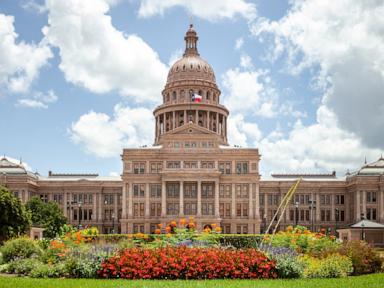
The heavy oak gavel fell inside the William B. Travis State Office Building in Austin. It made a sharp, final sound. With that single strike, the Texas State Board of Education rewrote the rules for how five million children will learn to read.
It is a hot Friday afternoon. Outside, the Texas heat bakes the asphalt. Inside, the air conditioning hums, a low background noise to a decision that will ripple through living rooms and school corridors for decades. On a nine-to-four party-line vote, the Republican-controlled board passed a mandatory statewide reading list. For the first time in recent history, public school students from kindergarten through high school will be required to read passages from the Bible.
This is not a suggestion. It is a mandate.
Consider a hypothetical six-year-old child entering a first-grade classroom a few years from now. Under the new guidelines, which take effect in the 2030–2031 school year, that child will open a picture book. They will look at illustrations of Daniel in the lion’s den or David facing Goliath. By the fourth grade, the texts shift to the New Testament, introducing the life of Jesus. In middle school, students will study the Sermon on the Mount. By high school, teenagers reading Jane Austen’s Pride and Prejudice or Charles Dickens’ Great Expectations will be required to analyze specific biblical passages alongside those literary classics.
To understand why this matters, you have to look past the political theater and sit in the back row of a public school classroom.
The Teacher’s Desk
For decades, the American public school teacher has held a quiet kind of sovereignty. Teachers decided which books matched the faces in front of them. They knew who needed a story about resilience and who needed a fable about kindness.
Now, that choice belongs to the state.
Imagine an experienced educator in Houston or El Paso. Let us call her Elena, a composite of the teachers who spent hours testifying before the board. Elena has spent fifteen years building a classroom library that reflects the complex reality of her students. Her class includes children whose parents immigrated from Vietnam, children who attend local synagogues, children of devout Baptist families, and children whose families claim no faith at all.
Elena’s job has always been to build bridges. She uses stories to find common ground. Under the new statewide mandate, she is handed a rigid list of roughly 200 required texts. The freedom to steer her own classroom has narrowed.
Proponents of the law argue that this change provides a necessary foundation. They say that the Bible is the bedrock of Western literature. How can a student truly understand Dickens, they ask, without understanding the scriptural cadence that influenced his writing? Jake Kobersky, speaking for the Texas Education Agency, noted that the list supports a common canon of literature. The argument is rooted in cultural literacy: to understand the American experiment, you must understand the text that shaped its founders.
But the real problem lies elsewhere. It rests in the delicate relationship between a student and a text.
The Weight of the Written Word
Reading is never a purely academic exercise for a child. When a seven-year-old reads a story in school, the classroom setting gives that story an stamp of absolute authority. The school says: this is what matters.
For families who do not share the Christian faith, this creates a profound sense of isolation. Elva Mendoza of the Texas Freedom Network expressed this vulnerability clearly during the public debates. She argued that the policy sends a clear signal to children of minority faiths—or no faith—that their own heritage is secondary.
The curriculum relies heavily on the King James Bible and evangelical translations. Critics point out that even Jewish translations of Old Testament verses were bypassed in favor of Christian interpretations. The lack of corresponding texts from the Quran, the Torah, or Buddhist scriptures leaves a singular, specific footprint on the chalkboard.
Consider what happens next when the state steps into the role of the theologian. The line between analyzing literature and teaching faith begins to blur. A teacher is no longer just explaining a metaphor; they are navigating sacred ground. If a student asks a deep, searching question about the Sermon on the Mount, the teacher must walk a terrifying tightrope between public instruction and religious indoctrination.
A Broader Horizon
Texas does not move in a vacuum. The state educates one in ten of the nation's public school students. What happens in Austin quickly becomes a blueprint for school boards across the country.
This reading list is only the latest brick in a rapidly rising wall. Over the past few years, the state has allowed public schools to hire religious chaplains for student counseling. It passed legislation requiring the Ten Commandments to be displayed prominently in every single classroom. The state-mandated reading list is the culmination of a deliberate, sustained effort to bring Christian teachings back into the center of public life.
To supporters, this is a homecoming. They see it as a restoration of values that have been stripped away by decades of secularism. Brooke Mazel, a grandmother from Lubbock who traveled to Austin to support the list, spoke of her desire to see her grandchildren raised with strong faith and family values. For her, the vote was a victory for an America that started as a nation of unwavering Christian values.
Yet, for others, the victory feels like an exclusion.
The human cost of this debate is not measured in policy papers or court filings. It is measured in the quiet anxieties of a secular parent wondering how to decompress their child after a school day. It is measured in the frustration of a teacher who feels their professional judgment has been replaced by political consensus. It is measured in the confusion of a ten-year-old child who suddenly realizes that the faith they practice at home is not the one recognized by the state.
The bell will ring in September 2030, and the new books will be distributed. The children will sit at their desks, opening pages that have caused empires to rise and fall. They will read about giants and lions, about kings and sermons. And in the quiet spaces between the words, five million children will begin to learn exactly where they fit in the state of Texas.