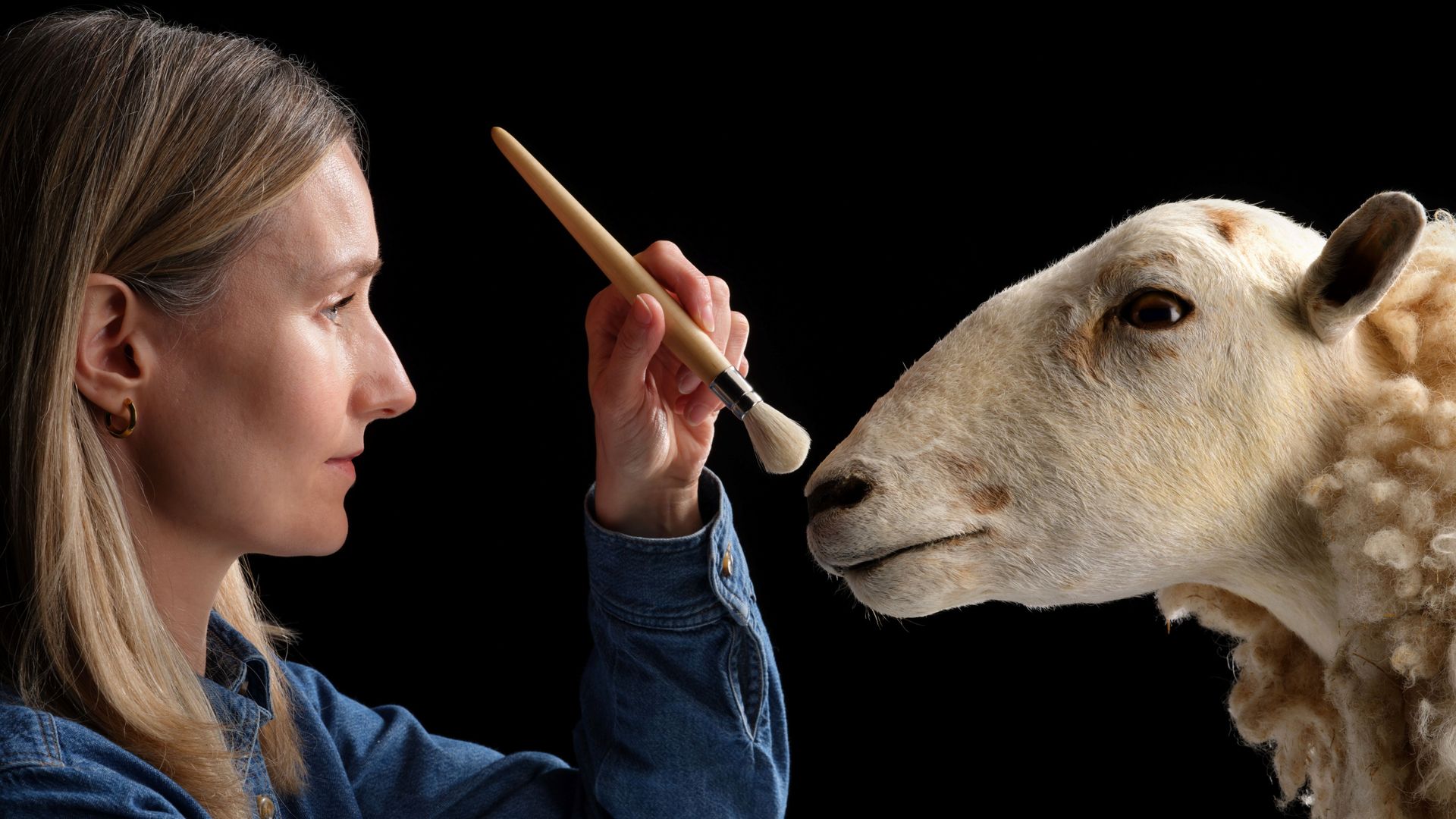
The public display of a cloned sheep—specifically a predecessor or contemporary to the Dolly lineage—serves as more than a museum curiosity; it is a physical audit of the efficiency and scalability of Somatic Cell Nuclear Transfer (SCNT). While mainstream narratives focus on the "miracle" of biological replication, a rigorous analysis must focus on the mechanical bottlenecks of the SCNT process, the statistical improbability of viable offspring during the late 20th century, and the long-term data regarding the cellular aging of these organisms.
To understand the magnitude of this display, one must quantify the success rate of the era. The production of a single viable clone required hundreds of attempts. This creates a high-cost, low-yield production function where the "inputs" are oocytes and donor nuclei, and the "output" is a genetically identical phenotype.
The Three Pillars of SCNT Viability
The success of the Dolly experiments and her successors rests on three distinct biological and technical variables. If any of these variables fall below a specific threshold, the entire process terminates in developmental arrest or epigenetic failure.
- Nuclear Reprogramming Efficiency: The donor nucleus, taken from an adult cell (e.g., mammary gland or skin), must be "tricked" back into an embryonic state. This involves stripping the DNA of its specialized epigenetic markers. Failure here results in a "leaky" genome where the clone attempts to function as a mature cell while still inside an embryo.
- Oocyte Competence: The quality of the egg cell—the vessel—is the primary driver of success. Any mitochondrial DNA mutations or cytoplasmic deficiencies in the recipient egg cell create a baseline of biological debt that the clone can never repay.
- Synchronization of the Cell Cycle: The donor nucleus and the recipient oocyte must be in the exact same phase of the cell cycle, typically G0 or quiescent phase. If this alignment is missed by even a few hours, the DNA replication process results in chromosomal fragmentation.
The Cost Function of Genetic Preservation
The physical display of these sheep is a logistical testament to the "high-burn" nature of pioneering genetic science. From an operational standpoint, the cost of producing these animals was not measured in financial currency alone, but in the massive biological overhead required to achieve a single success.
One must account for the Bio-Technical Bottleneck:
- Initial Input (Oocytes): 277 fused cells.
- Mid-Stage Output (Embryos): 29 embryos implanted into surrogate ewes.
- Final Yield (Viable Offspring): 1.
This yield rate of 0.36% represents a massive failure rate that would be unacceptable in any other industrial or biological production system. However, the purpose of these displays is to prove that the "zero-to-one" barrier was broken. The sheep on display are not just animals; they are the survivors of a statistical gauntlet.
The Mechanism of Epigenetic Memory
A critical oversight in early cloning discourse was the assumption of a "blank slate" genome. The sheep currently on display are physical evidence of the struggle against epigenetic memory.
When a somatic cell is transferred into an enucleated egg, it carries the "scars" of its previous life—chemical tags known as methyl groups. These tags tell the cell it is a skin cell or a lung cell. If the reprogramming process is incomplete, the clone will express genes at the wrong time or in the wrong tissue. This phenomenon explains why many early clones suffered from Large Offspring Syndrome (LOS), where the fetus grows too fast for the surrogate mother, leading to respiratory failure and metabolic collapse.
The sheep in the Dolly lineage that reached adulthood represent the rare instances where epigenetic erasure was sufficiently complete to allow for functional homeostasis.
The Telomere Obsolescence Hypothesis
One of the most persistent debates surrounding the display of these early clones is the "premature aging" of the specimens. This can be quantified through the study of telomeres—the protective caps on the ends of chromosomes.
In a standard biological life cycle, telomeres shorten as a cell divides. When a clone is created from an adult cell, the donor nucleus already possesses shortened telomeres. This creates a "biological age" that exceeds the "chronological age" of the organism.
Let the chronological age be $T_{c}$ and the biological age be $T_{b}$. In a clone, $T_{b} = T_{c} + T_{donor}$.
While Dolly eventually succumbed to a common ovine lung disease (Jaagsiekte sheep retrovirus), her shortened telomeres suggested that her cellular machinery was operating on an accelerated timeline. The sheep on display are, therefore, a snapshot of the limits of cellular longevity. They are biological machines running on borrowed time, illustrating the fundamental friction between the "software" of the DNA and the "hardware" of the cell.
Strategic Infrastructure of Public Genetic Displays
The decision to put these animals on display—taxidermied and preserved—is a move in the broader strategy of scientific communication and funding. By making the "clone" tangible, research institutions transition from theoretical science to a "proof of concept" phase.
This creates a Feedback Loop of Institutional Credibility:
- Physical Evidence: The sheep provides a concrete focal point for public interest.
- Resource Attraction: Increased visibility leads to higher private and public grants for regenerative medicine.
- Standardization of Protocols: The display of the lineage allows for a comparative analysis of SCNT progress over the last three decades.
The historical value of these specimens is rooted in their status as the first "living" prototypes of a technology that now powers the production of transgenic animals for human medicine (e.g., sheep that produce human proteins in their milk).
The Bottleneck of Scaling SCNT
Despite the success of the Dolly lineage, SCNT remains a localized, high-touch process. It has not scaled into a "mass production" model for three primary reasons:
- Manual Dexterity Requirements: The micro-injection of a nucleus into an oocyte is still largely a manual task performed by highly trained technicians. This limits the "throughput" of the technology.
- Surrogate Dependency: Clones still require a biological womb for gestation. Until "artificial wombs" reach a level of technological maturity, cloning is limited by the availability and health of surrogate populations.
- Regulatory Friction: The ethical debate surrounding cloning creates a fragmented regulatory environment. Different jurisdictions have vastly different rules for the labeling and use of cloned livestock products, which disincentivizes large-scale capital investment.
Technical Limitations of the Display Specimens
It is necessary to acknowledge that the specimens on display are often not "perfect" clones in the way the public imagines. Because they were created using oocytes from different breeds (e.g., a Blackface ewe egg and a Finn Dorset nucleus), the clones are Chimeric Organisms. Their nuclear DNA is a clone of the donor, but their mitochondrial DNA—the energy-producing "batteries" of the cell—comes from the egg donor.
This distinction is vital. These sheep are not 100% identical to their predecessors. They are biological hybrids. This mitochondrial mismatch is a significant variable in why some clones thrive while others fail. It creates a "mito-nuclear conflict" where the nuclear DNA and the mitochondrial DNA are not optimized to work together.
Strategic Play: The Shift to CRISPR-SCNT Integration
The next phase of this technology, moving beyond the era of the sheep on display, is the integration of SCNT with CRISPR-Cas9 gene editing. The old model was simple "copy-paste." The new model is "edit-then-copy."
This involves a three-step strategic maneuver:
- Genetic Optimization: Edit the somatic cell of a donor to remove disease-prone sequences or to add beneficial traits (e.g., heat resistance or higher protein yield).
- Expansion: Culture the edited cells to create a massive bank of identical "blueprints."
- SCNT Execution: Use these optimized cells as the nuclei for the cloning process.
This shift moves cloning from a purely reproductive technology to a sophisticated bio-engineering tool. The sheep currently on display represent the "mainframe" era of this technology—bulky, inefficient, but ground-breaking. We are currently moving into the "personal computer" era, where genetic precision is becoming a standardized commodity.
To capitalize on the current trajectory of SCNT and the data provided by these historical lineages, focus investment on automated enucleation systems and synthetic oocyte development. The current dependence on high-skill manual labor and biological egg donors is the single greatest barrier to the commercialization of genetic replication. Companies that can automate the fusion of donor nuclei with synthetic or mass-produced oocytes will control the next generation of the global bio-economy.


