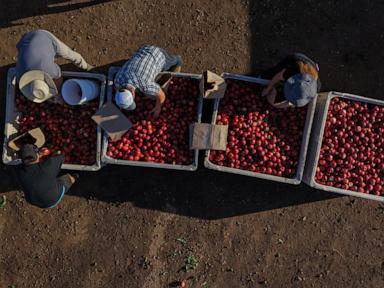
The sound is what breaks a farmer first. It is not the rumble of diesel engines or the early morning ring of an alarm clock. It is the rhythmic, heavy thud of ripe fruit dropping onto sun-baked dirt. Thump. Thump. Each sound represents a year of meticulous labor, hundreds of gallons of water, and a fraction of a family’s livelihood dissolving into the California soil.
For Cesar Mora, a third-generation farmer in the agricultural hub of Reedley, California, that sound became an unbearable soundtrack. His orchard was heavy with Monalise white nectarines, a specialized variety prized for its exceptionally sweet flavor and low acidity. Yet, under the blistering Central Valley sun, tens of thousands of pounds of this premium fruit were on the verge of rotting. You might also find this related story interesting: The Great American Higher Education Heist: Why Indian Students Are Buying a Devalued Dream.
Mora was caught in a legal chokehold. He was forbidden from selling his own harvest.
Instead of watching a spectacular crop turn to waste for a consecutive season, Mora opened his gates to the public. He invited anyone and everyone to come and take the fruit for free. Within days, thousands of people descended upon his farm, carrying boxes, bags, and buckets. Locals donned T-shirts reading “No Nectarines Wasted,” turning a legal standoff into a community rescue mission. Mora gave away more than 100,000 pounds of fruit in a single week. As reported in recent reports by The Wall Street Journal, the results are widespread.
It was a beautiful, heartwarming scene that masked a cold, corporate war.
The Illusion of Ownership
The crisis in Reedley is the latest eruption in a quiet revolution transforming American agriculture. For generations, farming relied on a simple premise: you buy a seed or a tree, you plant it, you tend it, and whatever grows belongs to you to sell.
That premise is dead.
Today, the fruit in the supermarket produce aisle is increasingly governed by complex intellectual property laws. Agriculture has collided with corporate patent law, transforming orchards into proprietary manufacturing plants. When a university or a private company spends a decade breeding a new fruit variety, they do not just sell the plants; they patent them.
Consider how we reached this point. In the mid-twentieth century, iconic varieties like the Rainier cherry were developed by public institutions and eventually released into the public domain. Anyone could plant a Rainier cherry tree and sell the fruit without owing a dime to a middleman. The same happened with the beloved Honeycrisp apple in the 1990s.
But the economic model shifted. Plant breeders realized that immense wealth lay not in selling the initial tree, but in controlling the entire supply chain. Under modern sublicensing structures, a farmer does not truly own their orchard. They lease the right to manage it.
The Cost of a Corporate Dream
Mora’s journey into this modern agricultural trap began in 2017. Giumarra Brothers Fruit Co., one of the largest produce corporations in the United States, recruited him to grow the Monalise white nectarine. The intellectual property rights for the variety belonged to a French company named Star Fruits Diffusion, and Giumarra held the exclusive rights to market and distribute the fruit in North America.
The corporate recruiters painted a dazzling picture. They sold a dream of exclusivity, promising that because the Monalise was tightly controlled, it would command top dollar in the market. Mora signed a sublicensing agreement.
The financial terms were steep. Mora had to pay an initial royalty of $2.50 for every single tree he planted. On top of that, he agreed to a 4% production royalty taken directly from the gross sales of the fruit, alongside standard sales commissions. A couple of years later, he signed a marketing agreement mandating that every single Monalise nectarine he grew had to be packed and sold exclusively through Giumarra.
The trap was set.
Trouble surfaced quickly. By 2020, Mora claimed that up to half of the pristine nectarines he delivered to Giumarra were simply discarded by the company, wiping out his expected profits. The company disputed the claim, and a judge later ruled the statute of limitations on that specific grievance had expired. By 2022, Mora discovered his nectarines were being exported to Taiwan, which he alleged violated a contract specifying the fruit was only to be sold within the United States and Canada.
Frustrated and watching his margins evaporate, Mora attempted to sever ties. In 2023, he bypassed Giumarra and delivered his white nectarines to an independent fruit packer.
The corporate response was swift and merciless. Giumarra slapped the third-generation farmer with a massive lawsuit for breach of contract.
The Invisible Stakes of the Courtroom
When a multi-million-dollar produce distributor sues an independent farmer, time is the distributor's greatest weapon. A corporation can survive a multi-year legal battle. A farmer cannot.
Because Giumarra claims exclusive rights over the fruit, the legal dispute completely froze Mora’s ability to market his crop. He could not sell to grocery stores, wholesalers, or local markets. The courts became the ultimate arbiter of the harvest, while the trees kept doing what trees do: producing fruit that demands to be picked.
Giumarra’s legal team maintains that the dispute is simple. It is a matter of two signed contracts, and they argue the legal system is the correct venue to resolve the breach. A Fresno County Superior Court judge allowed the breach of contract claim to move forward, noting that the agreements Mora signed remain legally binding regardless of whether the Monalise variety holds an official U.S. plant patent.
Mora’s defense team argues that Giumarra committed fraud by misrepresenting their legal rights and failing to produce clear documentation regarding their international license. But while attorneys file extensions and judges review motions, the seasons change. The fruit ripens.
The financial damage to Mora is severe. While he continues to cultivate peaches and plums that are free from corporate contracts, the loss of his nectarine revenue wiped out a staggering 25% of his total income. Yet, he still had to pay workers to pick the nectarines, if only to clear the trees and prevent pests from overtaking his land.
A Quiet Resignation on the Land
There is a deep psychological toll to this new era of farming. When the act of growing food becomes a legal liability, the joy of the profession curdles. Mora admitted that the years of endless litigation left him feeling utterly defenseless, eroding the very desire to step foot out into his fields.
Farming is inherently a gamble against nature. Growers accept the risks of unexpected frosts, scorching heatwaves, and unpredictable droughts. They prepare for those fights. What they are entirely unequipped for is a battle against a team of corporate lawyers holding a contract that turns a bountiful harvest into a legal violation.
The crowds that filled Mora’s orchard provided a fleeting moment of catharsis. Seeing families smile as they bit into the sweet white flesh of a fruit that took years to cultivate offered a brief antidote to the clinical coldness of a legal deposition. But charity does not pay the mortgage on an orchard. It does not pay for the diesel fuel, the property taxes, or the irrigation water.
The modern agricultural landscape is forcing a generation of independent growers to ask a terrifying question. If you do not own the rights to the genetic code of the crop you tend, do you truly own your farm?
The bins in Reedley are empty now, the crowds have gone home, and the remaining fruit on the ground is melting back into the earth. The litigation marches on toward a trial, serving as a stark warning to every independent grower across the valleys of America. In the modern food economy, the sweetest fruit can quickly leave the most bitter taste.