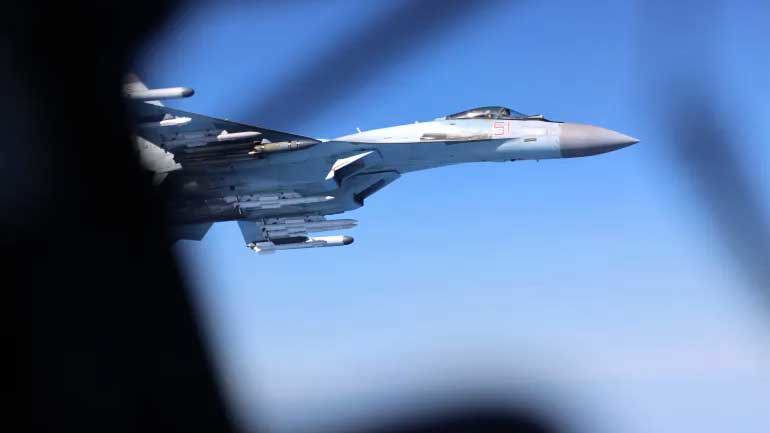
The media wants a dogfight. Whenever a Russian Su-27 flirts with the wingtips of a British RC-135 Rivet Joint over the Black Sea, the headlines roll out the same tired vocabulary. "Near-miss." "Provocation." "Brink of conflict."
It is standard theater. It is also completely wrong.
What the public witnesses in these international airspace encounters is not a series of reckless, adrenaline-fueled blunders by rogue pilots. It is a highly choreographed, cold-blooded corporate negotiation carried out at Mach 0.8. The lazy consensus insists that Western reconnaissance flights are passive observation missions and Russian scrambles are erratic acts of aggression. In reality, both sides are executing deeply calculated, predictable, and legally cooperative maneuvers designed to test electronic signatures and signal sovereign limits without ever firing a shot.
If you view these incidents through the lens of imminent World War III, you miss the actual mechanics of modern electronic warfare.
The Myth of the Reckless Russian Pilot
The prevailing narrative treats Russian fighter pilots as unstable actors behaving like teenagers in stolen cars. When a missile is accidentally discharged—as occurred in the well-documented September 2022 incident where a Russian pilot misunderstood a ground control command and fired at a British spy plane—the press screams "act of war."
Let us correct the premise. Air forces operating in international airspace do not want a shoot-down. A shoot-down is a failure of communication.
In my years analyzing strategic airspace movements and electronic intelligence (ELINT) profiles, the pattern is clear: these interactions are rigidly bounded by unspoken rules. The Cold War gave us the 1972 Incidents at Sea Agreement, and while the explicit text covers naval vessels, the operational culture extended directly into the air.
When a British RC-135 Rivet Joint flies off the coast of Crimea, it is not just taking pictures. It is a flying vacuum cleaner for data. It vacuums up radar frequencies, communications logs, and air defense response times.
The Russian response—scrambling a pair of Flankers to sit on its wing—is the tax required to play the game. The Su-27 pilots are not trying to crash. They are performing a physical interception to show that the door is locked, while simultaneously attempting to avoid illuminating themselves too brightly with their own targeting radars, which the British plane would immediately record and catalog for future targeting profiles.
Why the Royal Air Force Wants to Be Intercepted
Here is the counter-intuitive truth that defense ministries will never say out loud: Western reconnaissance missions want the Russians to scramble.
An unintercepted spy flight is a wasted sortie. If a Rivet Joint flies along the edge of forbidden airspace and the adversary does not respond, the mission yields zero actionable electronic data. The entire objective of a probing flight is to force the adversary to turn on their high-power air defense radars—such as the S-400 systems stationed throughout the Black Sea region.
- The Bait: The RC-135 acts as a high-visibility target, explicitly broadcasting its presence via standard transponders or unmistakable radar signatures.
- The Reaction: Russian command centers panic or follow protocol, activating tracking systems, locking radars, and scrambling interceptors.
- The Catch: The operators inside the British aircraft record the exact frequencies, pulse repetition intervals, and geographic locations of those active radar sites.
To call a close intercept a "near-miss" or a "dangerous provocation" ignores the fact that both parties got exactly what they came for. The British got the latest electronic signatures of Russia's frontline air defense network. The Russians demonstrated their domestic audience-facing resolve and collected optical and electronic data on the Western asset.
It is a transaction. Not an accident.
Dismantling the Safe Distance Fallacy
People often ask: "Why can't they just keep a safe distance of five miles apart?"
The question itself reveals a fundamental misunderstanding of aerial interception. In international airspace, there is no legal definition of a "safe distance." The sky is an open market. If an aircraft remains in international airspace, it has a legal right to be there, and an intercepting aircraft has an equal right to fly as close as aerodynamically stable flight allows.
Furthermore, a five-mile buffer achieves nothing for the intercepting party. To visually identify an aircraft, verify its configuration, read its tail number, and demonstrate a physical presence that forces a route alteration, you must get close. Professional military pilots on both sides are trained to fly in tight formation. What looks terrifying on a smartphone video shot through a porthole is standard formation flying for an experienced fighter pilot.
The danger does not stem from proximity. It stems from miscalculation in communication.
The True Cost of the Escalation Narrative
There is a downside to this contrarian view, and we must be honest about it. The risk is not that a Russian pilot loses control and clips a wing. The risk is that political leaders, fed a constant diet of sensationalized "near-miss" headlines by media outlets looking for clicks, feel compelled to react politically to a routine military event.
When a government is forced by public outrage to turn a standard geopolitical transaction into a red-line crisis, the room for quiet diplomacy shrinks. After the 2022 missile discharge incident, the UK did not declare war. Why? Because the professional military apparatus immediately recognized the difference between a systemic breakdown in Russian radio discipline and an intentional strategic attack. They quietly adjusted protocol—attaching Typhoon fighter escorts to subsequent missions—to change the economic calculation of the next Russian scramble, not to initiate a shooting war.
Stop reading the breathless reports of aerial chicken. The pilots in the Black Sea know exactly where the line is. The only people who seem lost are the ones watching from the ground.



