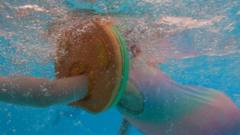
The chlorine hits you before you even see the water. It is a sharp, medicinal scent that stays in the back of your throat long after you wash your hair. For millions of children, that smell is the backdrop to the loudest, most chaotic hour of their week.
But then there is the other sound.
It is the sudden, heavy silence that happens when a child slips beneath the surface without a splash. No thrashing. No waving hands. Movies get it wrong. Drowning is not a loud, dramatic cry for help. It is entirely quiet. The lungs are trying to breathe, not speak.
Local swim clubs are watching this silence grow. Across the country, clubs are noticing a troubling trend: children are arriving at community pools without the most basic understanding of how to stay afloat. They cannot tread water. They do not know how to roll onto their backs to breathe. A routine school trip to the beach or a backyard pool party can turn from a milestone memory into an absolute disaster in less than sixty seconds.
The message from coaches and safety advocates is clear. We cannot treat swimming as an optional extracurricular activity anymore. It is a fundamental life skill, and it needs a permanent place in the school curriculum.
The Gap in the Fast Lane
Consider a hypothetical ten-year-old named Maya. She represents thousands of kids who fall through the cracks of our current educational priorities. Maya excels in math. She plays soccer. She can navigate a tablet with her eyes closed. But Maya has never been in water deeper than her chest.
When Maya’s school schedules a year-end trip to a recreational lake, her parents sign the permission slip. They assume she will be safe because there are lifeguards. Maya assumes she will be safe because her friends are going.
But water does not care about assumptions.
When a stray beach ball drifts too far out, Maya steps off an unexpected underwater ledge. The drop-off is only two feet, but suddenly the ground is gone. Panic is an instant, physical reaction. Her heart races. Her limbs freeze. Without the muscle memory of water competency, her brain defaults to a desperate vertical climb that only pushes her further under.
This scenario is not a scare tactic. It is a statistical reality played out in community health data every year. Swim clubs see the raw data before it becomes a headline. They are the ones testing kids who join summer camps, only to realize that half the group cannot swim a single lap without touching the bottom.
The current system relies entirely on privilege. Parents who have the time, the money, and the transportation enroll their toddlers in private weekend lessons. Parents working multiple shifts or living in areas without public transit are forced to skip it. This creates a stark, dangerous divide. Survival becomes a luxury item.
Redefining What It Means to Swim
Part of the problem lies in how we define water literacy. Many people think that if a child can doggy-paddle across a backyard pool, they know how to swim.
They do not.
True water safety is not about mastering a perfect Olympic butterfly stroke. It is about respect for the environment and basic self-preservation. Swim clubs are pushing for a standardized curriculum in schools that focuses on foundational survival skills.
- The Cold Water Shock Response: Understanding how the body automatically gasps when hitting cold water, and how to control that panic.
- The Survival Float: Learning how to conserve energy by resting on the back, keeping the airway clear without burning calories.
- Distance Competency: The ability to move fifty meters to safety without a flotation device.
- Assisted Rescue Knowledge: Knowing how to throw a line or extend a branch to a friend in trouble instead of jumping in and becoming a second victim.
These are not advanced athletic skills. They are basic physical literacy concepts, no different than teaching a child to look both ways before crossing a street or how to stop, drop, and roll. Yet, we routinely send children into the world without them.
But the real problem lies elsewhere. Schools are already stretched thin. Teachers are burned out, budgets are tight, and logistically, moving thirty children to a local pool requires buses, permission slips, and strict chaperone ratios. It is a logistical nightmare for administrators.
Consider what happens next if we do nothing. The gap widens. Public pools face lifeguard shortages because fewer teenagers grow up with the skills required to take the certification courses. Community spaces close down. The relationship between people and natural waterways becomes dictated by fear rather than respect and enjoyment.
The Cost of the Lifeline
Whenever advocates call for mandatory school swimming lessons, the immediate pushback is fiscal. Who pays for the fuel? Who pays for the lane rentals? Who covers the insurance?
These are valid, heavy questions. But they ignore the alternative ledger. The financial cost of an emergency response, an intensive care stay, or the permanent loss of a young life carries a weight that cannot be measured in a school district's annual budget.
We find space for physical education inside a gymnasium because we acknowledge that cardiovascular health matters. We build computer labs because we know the digital world is inescapable. Water covers more than seventy percent of the planet, and it sits in rivers, lakes, and reservoirs just miles from every school entrance. We cannot build walls high enough to keep children away from it forever.
Some innovative districts are finding ways to bridge the gap without breaking their budgets. They partner with local swim clubs during off-peak morning hours when commercial pools are empty. They utilize high school students training for coaching certificates to help supervise elementary classes. They treat water safety as a concentrated two-week block rather than an expensive year-long logistical burden.
It takes effort. It requires rewriting schedules and stepping outside the traditional classroom walls.
A child stands on the edge of a municipal pool, toes curled over the blue tile. The water reflects the harsh fluorescent lights of the ceiling. To an adult, it is just a rectangular tank of treated water. To that child, looking down into the deep end, it is an immense, unpredictable universe.
They look back at their teacher. They look at their classmates. Then, they take a breath, step forward, and wait for the splash. Whether they sink or rise depends entirely on what we chose to teach them before they stepped onto the deck.