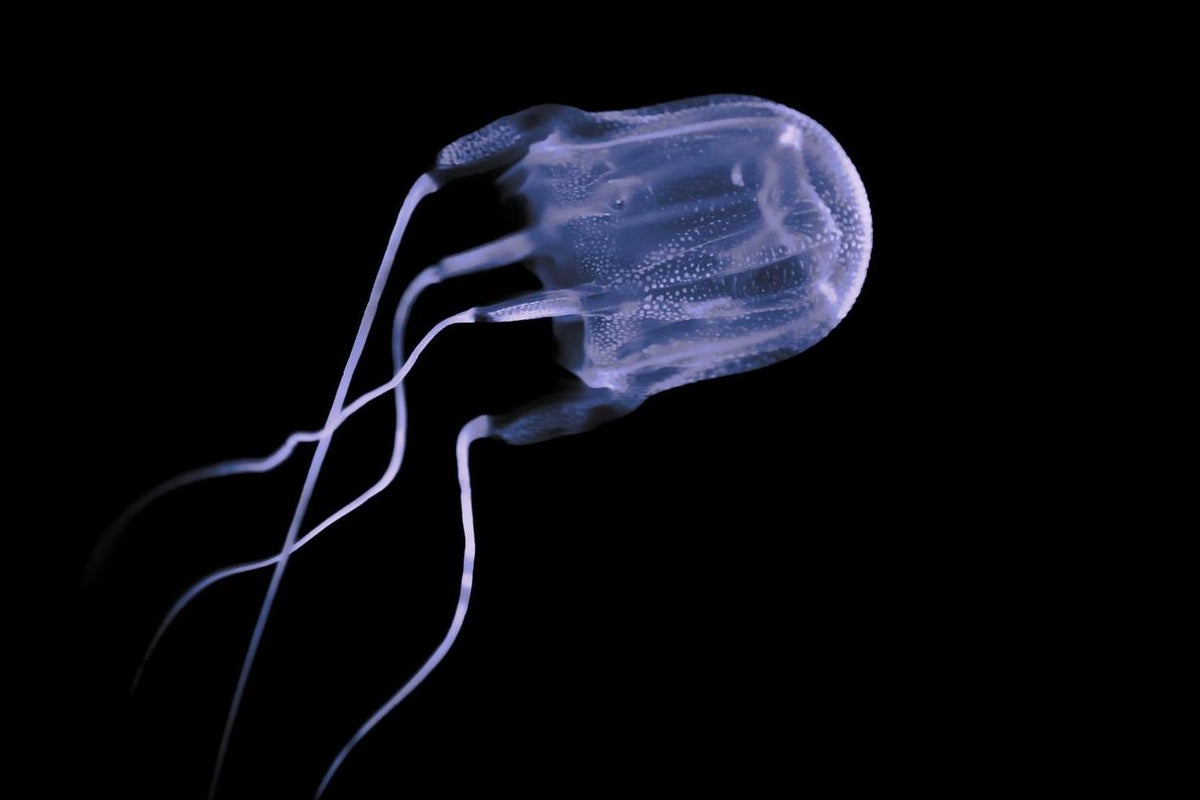
Stop clutching your pearls over the "swarm" in Western Australia. The headlines are screaming about a massive influx of a new box jellyfish species as if it’s an alien invasion scripted for a low-budget horror flick. It isn't. This isn't a sign of the ecological apocalypse, and it certainly isn't a reason to shutter the beaches of Ningaloo.
The media loves a monster. They’ve spent the last week painting Chiropsalmus and its cousins as the ocean’s tactical strike force. They want you to believe that "unprecedented numbers" mean the ocean is broken. In reality, our ignorance is the only thing that’s unprecedented. We are finally noticing what has been there for millennia, and we’re mistaking our new spectacles for a new reality.
The Myth of the Sudden Swarm
The "lazy consensus" among armchair environmentalists is that climate change has flipped a switch, causing jellyfish to suddenly colonize the coast. This is a fundamental misunderstanding of marine biology and population dynamics.
Jellyfish populations don’t operate on a linear scale. They operate on a boom-and-bust cycle that makes the crypto market look stable. These are "pulse" events. To claim a "new" species has suddenly appeared is often a confession of past data poverty rather than a report on current biological expansion. Taxonomists have been playing catch-up with the Irukandji and box jellyfish families for decades.
When you hear "new species," don't think "evolutionary mutation." Think "human error corrected." We didn't have the DNA sequencing or the remote-operated vehicles (ROVs) to identify these creatures ten years ago. We are documenting the existing inventory of the ocean, not witnessing a fresh invasion.
Marine Biology has a Data Problem
I have watched research budgets get poured into charismatic megafauna—whales, turtles, sharks—while the gelatinous macroplankton that actually drive the trophic scales are ignored. This "swarm" is simply what happens when the wind, tide, and nutrient levels align.
- The Physics of the Pulse: The appearance of a swarm is rarely about birth rates. It’s about fluid dynamics. A slight shift in the Leeuwin Current can funnel thousands of individuals into a single bay.
- The Sampling Bias: We find more jellyfish because we are looking for them more. With the rise of citizen science and high-definition underwater photography, every beachgoer is now a mobile sensor.
If you look at the data from the Global Jellyfish Database (JEDI), you see a messy, oscillating picture, not a straight line up. The panic over Western Australian sightings ignores the fact that these species have likely been pulsing in and out of these waters since before we had a name for the continent.
Why the Toxins are Overhyped
Yes, the Cubozoa class contains some of the most venomous animals on earth. If you get hit by Chironex fleckeri, you’re having a very bad day—or your last one. But the obsession with "lethality" obscures the actual biological reality.
Venom is expensive. From a metabolic standpoint, creating complex proteins to kill a human—an animal that isn't even on the jellyfish's menu—is a waste of energy. The venom is designed to instantly paralyze small fish and crustaceans so they don't tear the jellyfish's fragile bells while struggling.
The "terror" we feel is a biological accident. We are collateral damage in a microscopic chemical war that has nothing to do with us.
The Real Danger: Media Sensationalism
The danger isn't the sting; it's the policy reaction. When we freak out over a "swarm," we trigger knee-jerk reactions from local councils:
- Expensive, Useless Netting: These nets kill turtles and sharks while allowing the smaller, equally toxic Irukandji species to drift right through.
- Chemical Deterrents: There have been "innovative" suggestions to use surfactants to break the surface tension or kill polyps. This is ecological arson.
- Tourism Sabotage: We scare people away from the water based on a seasonal pulse that is a natural part of a healthy ecosystem.
Stop Trying to "Fix" the Ocean
The most common question people ask is: "How do we stop the jellyfish from taking over?"
The question is wrong. You don't "stop" jellyfish. They are the ultimate survivors. They have seen five mass extinction events. They outlived the dinosaurs. They will outlive your coastal villa.
If we want to address the actual increase in jellyfish biomass in certain regions, we have to look at what we've removed, not what has arrived. We have decimated the predators—the green sea turtles and the sunfish (Mola mola). We have created "dead zones" through nitrogen runoff where jellyfish thrive because they can survive in low-oxygen environments that suffocate fish.
The Inconvenient Truth of Ocean Structures
We are building their nurseries. Every pier, every oil rig, and every wind turbine base in the ocean provides the perfect hard substrate for jellyfish polyps to attach to. If you want fewer jellyfish, stop giving them luxury high-rise apartments in the form of coastal infrastructure.
The Economic Opportunity Everyone Misses
While the news screams about "menace," they miss the industrial potential. In Asia, jellyfish are a multi-million dollar industry. In the West, we treat them like a nuisance.
- Collagen Harvesting: Jellyfish are a goldmine for high-quality collagen used in reconstructive surgery and cosmetics.
- Microplastic Filtration: Research from the GoJelly project has shown that jellyfish mucus can be used to trap microplastics in wastewater treatment plants.
- Nutritional Density: We are facing a global protein crisis, and we’re ignoring a self-replenishing, low-carbon-footprint food source because it looks "gross" on a beach.
We are literally tripping over a resource and calling it a catastrophe.
Nature Doesn't Care About Your Vacation
The "swarm" off Western Australia is a reminder that the ocean is not a swimming pool. It is a wild, volatile, and indifferent system.
The box jellyfish isn't "invading" the coast. It is returning to its playground. The fact that we find this inconvenient is a "us" problem, not a "nature" problem. We have spent the last century trying to sanitize the wilderness, and we get indignant when the wilderness bites back.
If you see a swarm, don't call the news. Don't demand the government "do something." Take a photo, stay out of the water, and appreciate the fact that there is still something in this world that we haven't managed to domesticate or destroy.
The jellyfish aren't winning. They’ve already won. They’ve been winning for 500 million years. You’re just finally noticing the score.