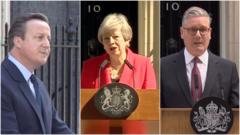
Downing Street has a revolving door that just won't stop spinning. With Keir Starmer's shocking decision to step down, Britain has just witnessed its sixth prime minister leave office in a single decade. It's a dizzying rate of political turnover that turns traditional notions of British stability completely on its head.
We used to think of British prime ministers as fixtures who stayed in power for the better part of a decade. Think Margaret Thatcher or Tony Blair. Not anymore. Today, the office resembles a high-stakes survival game where the contestants rarely last long enough to unpack their bags. The sheer volume of British PM resignations since 2016 points to a political system that is fundamentally fractured.
If you want to understand why Britain keeps chewing up and spitting out its leaders, you have to look at the specific failures, backstabbing, and economic shocks that brought down each of the six individuals who occupied Number 10 over the last ten years.
David Cameron Started the Fire in 2016
David Cameron thought he could play poker with his own party and win. He was wrong. Facing intense pressure from the eurosceptic wing of the Conservative Party and the rising threat of UKIP, Cameron called the 2016 Brexit referendum. It was a tactical gamble designed to silence his critics forever. He campaigned fiercely for the UK to remain in the European Union, confident that the British public would back his vision.
They didn't. When the final votes came in on June 23, 2016, with 52 percent choosing to leave, Cameron's authority vanished overnight.
The very next morning, he stood outside the iconic black door of Number 10 and announced his resignation. He admitted that the country required fresh leadership to navigate the upcoming exit. He walked away from the massive political chaos he helped unleash, leaving his successor to figure out how to actually execute the divorce from Europe. It was the first domino to fall.
Theresa May and the Impossible Task
Theresa May stepped into the vacuum left by Cameron. She didn't want a soft Brexit. She wanted to deliver exactly what the voters asked for, coining the phrase "Brexit means Brexit." But she inherited an impossible math problem in Parliament. Her decision to call a snap election in 2017 backfired spectacularly, costing her party its outright majority and forcing her to rely on the Democratic Unionist Party to stay in power.
Every single deal May negotiated with Brussels was dead on arrival in London.
The House of Commons rejected her withdrawal agreement three separate times. She faced a brutal civil war within her own ranks. Hardline Brexit supporters thought her deal kept Britain tied too closely to Europe, while pro-EU lawmakers wanted to reverse the decision entirely. By May 2019, exhausted, isolated, and completely out of options, she gave up. Her tearful resignation speech on the steps of Downing Street showed the world just how merciless the British political machine had become.
Boris Johnson Undone by Self Inflicted Drama
Boris Johnson won a commanding 80-seat majority in late 2019 with a simple, punchy slogan: "Get Brexit Done." He had the political capital to break the gridlock, and he did. He officially pulled Britain out of the EU, then had to steer the nation through the unprecedented crisis of the COVID-19 pandemic. For a while, his grip on power looked unshakeable.
Then came the scandals.
What broke Johnson wasn't his policy platform. It was his casual disregard for the rules he expected everyone else to follow. The "partygate" scandal exposed a culture of illegal, booze-fueled gatherings at Downing Street while the rest of the country was locked down, unable to visit dying relatives. The public was furious. He survived a vote of no confidence, but his reputation was fatally wounded. The final straw came in July 2022 when he mishandled allegations against a senior colleague accused of sexual misconduct. Within 48 hours, over 50 government ministers and aides resigned from their posts. Johnson was left completely alone. He had no choice but to fold.
Liz Truss and the Forty Five Day Nightmare
You can't discuss British PM resignations without talking about the supermarket vegetable that outlasted a prime minister. Liz Truss won the Conservative leadership race in September 2022 by promising radical, free-market economic policies. She wanted to kickstart growth through massive, unfunded tax cuts aimed at corporations and high earners.
It took less than a week for her plan to trigger an absolute meltdown.
The financial markets panicked. The value of the pound crashed to historic lows against the dollar. Mortgage rates surged instantly, putting millions of ordinary citizens in financial peril. The Bank of England had to step in with billions of pounds to prevent pension funds from collapsing. It was an unprecedented economic self-injury. Her political support vanished in days. Recognizing she had lost all credibility with her party and the public, she resigned after just 45 days. It was the shortest tenure in British history.
Rishi Sunak and the Long Slow Defeat
Rishi Sunak arrived in late 2022 as the technocrat meant to steady the ship. He was supposed to be the adult in the room after the chaotic experiments of Johnson and Truss. Sunak focused on lowering inflation, managing the public finances, and trying to repair the deep divisions within the Tory party.
He inherited a poisoned chalice.
The British public was simply exhausted after 14 years of Conservative rule. The economy was stagnant, public services like the National Health Service were visibly crumbling, and a massive 9 percent inflation rate squeezed household budgets to the breaking point. Sunak tried to find momentum but kept stumbling over unforced errors, like his poorly calculated decision to leave a D-Day commemoration early. When he called an election for July 2024, the voters delivered their verdict. The Labour Party won a landslide victory, and Sunak resigned the next morning. His exit marked the end of an era, but it didn't end the instability.
Keir Starmer Proves Nobody Is Safe
Everyone thought Keir Starmer would break the curse. He marched into Downing Street in July 2024 with a towering majority of 411 seats. His entire brand was built on being boring, methodical, and stable. He promised to restore trust and end the political soap opera of the previous decade.
The calm lasted barely two years.
Starmer's downfall happened fast. It started with damaging headlines about accepting thousands of pounds in free gifts, luxury clothing, and concert tickets, which instantly punctured his image as a clean-cut alternative to Tory sleaze. Then came highly unpopular domestic policy choices, including cutting winter fuel payments for pensioners. His base grew restless.
The terminal blow arrived with his appointment of veteran political operator Lord Peter Mandelson as Britain’s ambassador to Washington. It was meant to be a clever strategic play to handle the administration of Donald Trump. Instead, it triggered a full-scale crisis when leaked documents exposed the true extent of Mandelson's past ties to Jeffrey Epstein. When it came to light that Mandelson had been appointed to the sensitive diplomatic post despite failing standard security clearances, Starmer's claims of ignorance crumbled. His popularity tanked to historic lows. Recognizing he no longer held the confidence of his own MPs to lead them into the next election, Starmer stepped up to the microphone outside Number 10 today and quit.
The Broken System Inside Westminster
The mistake most people make is looking at these six departures as isolated incidents of personal failure. They aren't. They are symptoms of a systemic failure within the structure of British governance. The combination of structural economic pressures, 24-hour media scrutiny, and hyper-factional political parties has made the role of prime minister almost impossible to sustain.
Take a look at how the timeline shook out for these leaders:
- David Cameron: Term ended by a high-stakes referendum gamble.
- Theresa May: Brought down by an gridlocked, angry Parliament.
- Boris Johnson: Ousted by a mass rebellion of his own ministers over ethics.
- Liz Truss: Evicted by global financial markets in less than two weeks.
- Rishi Sunak: Crushed by an electorate desperate for a complete change.
- Keir Starmer: Forced out by internal party panic and vetting scandals.
The institutional memory of British politics has been completely wiped out by this constant churn. Civil servants spend all their time preparing for new bosses rather than executing long-term strategies. Foreign allies look at London and wonder if the person they are negotiating with will even be in office by next month.
If the next leader expects a large parliamentary majority or a fresh mandate to act as a shield against this level of volatility, they are deeply mistaken. The British electorate and backbench MPs have grown impatient. The threshold for rebellion has never been lower. To break this endless loop of resignations, the incoming administration will have to look beyond quick political fixes and address the deep-seated economic stagnation and institutional decay that turned Downing Street into a temporary workspace.


