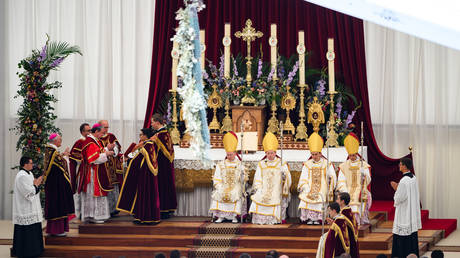
The incense in the small, makeshift chapel did not drift toward the vaulted ceilings of a grand cathedral. It clung to the low rafters of a converted basement, thick and heavy with the scent of beeswax and old wood. Outside, the rain slicked the cobblestones of a quiet European suburb, but inside, the air felt frozen in a different century.
A priest stood before a temporary altar. His back was turned to the tiny congregation of two dozen people. He spoke in low, rhythmic Latin, his voice steady but carrying an undercurrent of defiance. Among those kneeling on the hard linoleum was a woman we will call Maria. She is not a radical or a political operative. She is a grandmother who simply wanted the faith of her childhood. But on this Sunday, by crossing this threshold, Maria had stepped over an invisible line.
She had just joined a schism.
Mainstream news outlets reported the event with dry, clinical detachment. They used headlines like "Hardline group triggers new schism in Catholic Church." They spoke of canonical law, papal decrees, and organizational friction. They treated a profound rupture of the human spirit like a corporate restructuring gone wrong.
They missed the point entirely.
To understand a schism, you cannot just look at the men in red robes arguing in Rome. You have to look at the fracture line running straight through the hearts of ordinary people.
The Architecture of a Fractured Faith
For two millennia, the Roman Catholic Church has operated on a foundational promise: unity. It is an institution built to withstand empires, plagues, and wars by anchoring itself to a single, unbroken chain of authority stretching back to Saint Peter. When that chain snaps, the noise is deafening to those who rely on it.
The current fracture involves a hardline traditionalist faction that has effectively severed ties with the Vatican. The root of the argument appears theological—disagreements over liturgical language, the modernizing reforms of the Second Vatican Council, and the authority of the current Pope. But theology is merely the language used to articulate a much deeper, more volatile human emotion.
Fear.
Consider the world outside that basement chapel. It is fast, chaotic, and increasingly secular. For a specific segment of the faithful, the modern Church’s attempts to adapt to this world feel less like evolution and more like capitulation. They look at a society in flux and crave an immovable object. When the Vatican suggests that some traditions can bend, these believers do not see progress. They see a betrayal of the absolute.
This is where the hardline leadership found its leverage. By framing the modern Church as compromised, they offered an intoxicating alternative: total certainty. They promised a return to a pure, unadulterated past, free from the compromises of the twenty-first century.
But certainty comes with a steep price tag.
The Invisible Stakes of Excommunication
To a secular observer, a schism looks like a minor theological dispute, a debate over policy. If you do not like the rules of your club, you leave and start a new one.
Religion does not work that way.
For a devout Catholic, the stakes are not social; they are eternal. The Church teaches that it holds the keys to the sacraments—the literal conduits of God's grace necessary for the salvation of the soul. When an individual or a group moves into formal schism, they risk excommunication.
Excommunication is a terrifying word. It is the spiritual equivalent of being cast into the wilderness. It means you can no longer receive the Eucharist. It means, in the traditional understanding, that you have cut yourself off from the body of Christ.
Imagine the psychological weight of that choice. Maria did not walk into that basement because she wanted to rebel against the Pope. She walked in because she genuinely believed that the modern parish down the street had lost its way, and that staying there put her soul in jeopardy. The tragedy of the schism is that in her pursuit of spiritual safety, she stepped into the very isolation she feared.
The leaders of these hardline movements understand this anxiety. They use it as a tool for consolidation. They convince their followers that the wilderness inside their tent is safer than the corruption outside it. They create a siege mentality. It is us against the world, and the world includes Rome.
The Echoes of History
This is not the first time the ground has shifted beneath the Vatican, and it will not be the last. History is littered with the remnants of movements that believed they were the sole keepers of the true flame.
Four hundred years ago, Jansenists in France claimed a rigorous, uncompromising purity that eventually alienated them from the broader Church. In the nineteenth century, the Old Catholics split away after the First Vatican Council refused to accept the dogma of papal infallibility. In the 1970s, Archbishop Marcel Lefebvre founded the Society of Saint Pius X, rejecting the modernizing reforms of Vatican II and setting the stage for the modern traditionalist fractures we see today.
Every single one of these movements followed the exact same trajectory.
It begins with a critique of perceived laxity or corruption. It moves to a defense of tradition. It ends in absolute isolation. What starts as a desire to preserve the faith invariably becomes a mechanism for fracturing it.
The mechanism relies on an ancient behavioral pattern. When humans feel threatened by change, our instinct is to radicalize our identity. We double down on the markers that set us apart. We make the rules stricter. We make the boundaries sharper. We turn our faith into a fortress, forgetting that a fortress is also a prison.
The Cost at the Dinner Table
The true damage of a schism is rarely measured in the halls of the Vatican. It is measured at Sunday dinners.
Behind every news report of a theological split are families that have been quietly torn apart. I know a family where the son, influenced by online traditionalist influencers and radicalized clergy, now refuses to attend Mass with his parents because their local parish uses guitars in the liturgy. He views his parents' faith as invalid, a compromised imitation of the truth. His mother weeps in the kitchen because her son looks at her not as a parent, but as a heretic.
The hardline group that triggered this latest schism did not just break canonical law. They broke trust. They weaponized the sacred to divide the ordinary.
They created a environment where nuance is treated as cowardice and compromise is viewed as sin. In their pursuit of a flawless, pristine Church, they forgot that the institution was founded for the flawed and the broken.
The priest in the basement finished his sermon. He spoke of endurance, of holding the line, of being the remnant of the true faith in a darkened world. The words were beautiful, in a tragic, martial sort of way. They made the people in the pews feel important. They made them feel like soldiers.
But as the congregation filed out into the gray afternoon, there was no joy on their faces. There was only a grim, heavy determination. They had chosen their hill, and they were prepared to die on it, even if it meant dying alone.
The rain continued to fall, washing over the ancient stones of a town that had seen empires rise and fall, heresies come and go, and schisms tear at the fabric of life until nothing was left but dust and old arguments. The Vatican remains where it has always been, its doors open to a messy, complicated world. The basement chapel remains dark, its doors locked against that same world, guarding a purity that has no room for the people it was meant to save.