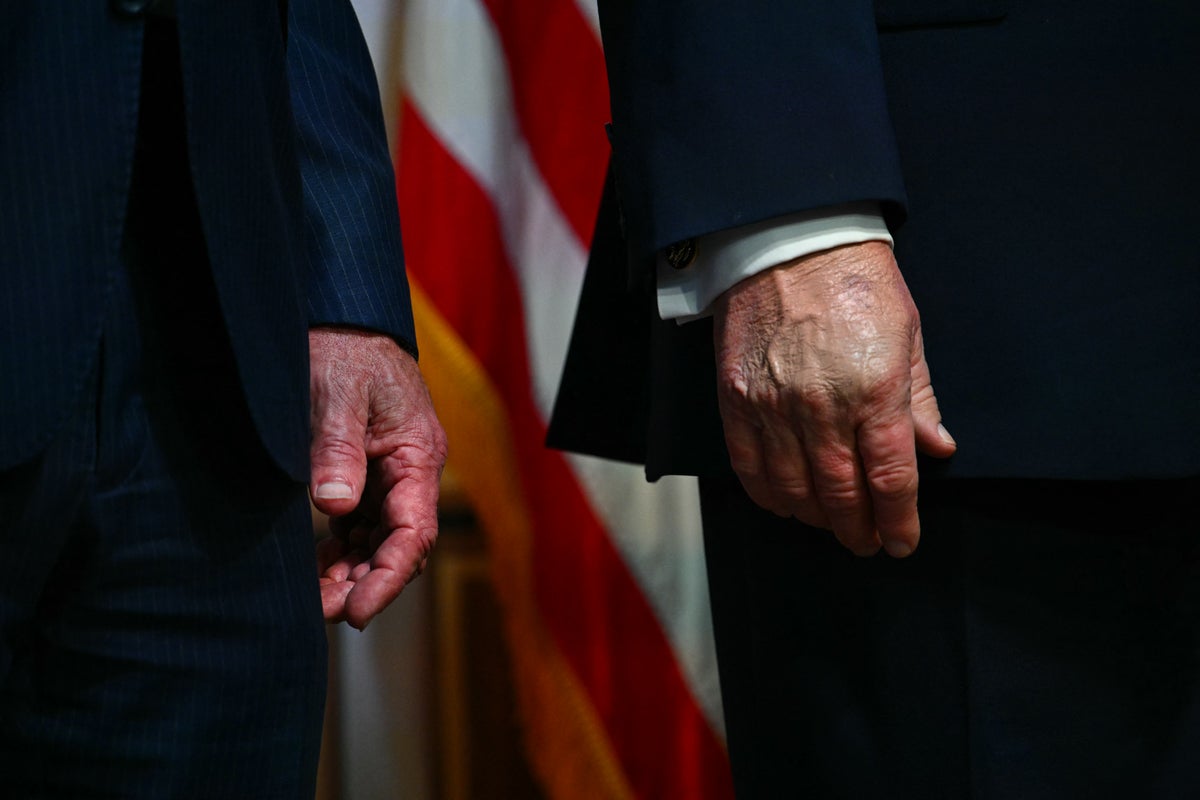
The mainstream political press has officially run out of ideas. When Donald Trump and Robert F. Kennedy Jr. both appear in public with matching, unexplained bruises on the backs of their hands, the collective media apparatus reacts with the predictable, shallow reflex of a high school gossip column. They hint at secret medical crises. They speculate about frailties. They mock it as a bizarre coincidence of aging alpha males trying to look tough.
They are entirely missing the point.
The lazy consensus views these physical marks through the lens of optics or pathology. Commentators track the timeline of Trump’s hand discoloration, compare it to RFK Jr.’s recent public appearances, and conclude that it is either a sign of behind-the-scenes medical interventions—like intravenous drips or routine blood draws—or a strange, desperate attempt at mirroring. This analysis is not just superficial; it is completely blind to how modern populist movements actually communicate.
Those marks are not vulnerabilities. In the hyper-visual, anti-establishment arena of modern politics, those bruises function as an unspoken, powerful dialect of authenticity and shared tribulation.
The Myth of the Flawless Politician
For decades, the standard playbook for political survival dictated absolute physical perfection. Every hair coiffed. Every blemish concealed by heavy studio makeup. The traditional politician is an engineered product, designed to project an image of untouchable stability. Think of the classic Washington archetype: polished, sanitized, and completely detached from the physical realities of the average citizen.
When the media points a camera at a bruise on a populist leader's hand and says, "Look, they are flawed," they think they are scoring a point. They do not realize they are validating the exact narrative these leaders want to project.
In a political environment defined by deep institutional distrust, physical perfection equals dishonesty. Flawless skin suggests a life spent sitting in climate-controlled green rooms, protected by handlers, and entirely removed from conflict. Conversely, a visible mark—a bruise, a scratch, a bandage—signals someone who is in the arena. It implies physical consequence. It says, I am taking hits so you don’t have to.
The Subconscious Mechanics of Mirroring
Political analysts love to accuse RFK Jr. of riding Trump's coattails, viewing his matching hand discoloration as a clumsy attempt at stylistic mimicry. This misinterprets the psychological mechanics of populist alignment.
When leaders within a specific political ecosystem begin to exhibit shared physical traits or behaviors, it is rarely a conscious marketing decision made in a boardroom. It is an organic alignment of branding.
Imagine a scenario where corporate executives all start wearing the exact same shade of blue silicone wristband. The legacy media would look for the specific vendor who sold them. The actual story is the tribal signaling. The band is a shorthand code that communicates membership in an exclusive, high-stakes club without requiring a single word to be spoken.
For Trump and RFK Jr., the shared "battered warrior" aesthetic acts as a powerful unifier for their respective bases. It bridges the gap between MAGA nationalism and the anti-establishment health movement. It creates a visual synergy that suggests they are fighting the same unseen enemies, enduring the same systemic pressures, and emerging with the same physical scars.
The Medicalization of Political Coverage
The press loves to play armchair physician. Every stumble on a staircase, every cough at a podium, and every mark on a hand is scrutinized by talking heads who suddenly possess online medical degrees. They scream about IV bruising, hinting at hidden frailty or secretive treatments.
Let’s dismantle the premise of that obsession.
Even if these bruises are the result of routine medical procedures, intravenous hydration, or age-related vascular fragility, the assumption that voters will see this as a disqualifying weakness is fundamentally flawed. The modern electorate does not expect its champions to be immortal deities. They expect them to be fighters who are weathering the storm.
When you treat a politician’s minor physical ailment as a massive scandal, you alienate the millions of everyday citizens who also have bruises, who also need medical treatments, and who also feel the physical toll of aging and stress. The media’s attempt to weaponize these marks completely backfires by transforming ordinary physical realities into points of deep personal connection between the candidate and the voter.
The Actionable Reality of the New Visual Order
If you are trying to understand the trajectory of modern political influence, you have to stop reading the transcripts of press briefings and start analyzing the non-verbal, raw visual cues that dominate digital media.
The traditional rules of public relations are dead. The public has developed a profound immunity to polished corporate messaging and perfectly staged photo opportunities. If your public image is too clean, it triggers immediate suspicion.
To survive in the current cultural landscape, leaders, creators, and public figures must understand the value of the unpolished edge.
- Stop hiding the friction: If your organization or your campaign is going through a chaotic period, leaning into that intensity is far more effective than pretending everything is smooth sailing.
- Ditch the studio sheen: Audiences respond to high-stakes reality, not high-production assets. The less engineered your presentation feels, the more weight your message carries.
- Own the scars: Whether literal or metaphorical, the setbacks and physical tolls of your work are your strongest assets for building trust.
The legacy media will continue to write panicked articles tracking the lifecycle of a politician's bruise, treating it like a foreign object in a pristine lab. They will keep asking the wrong questions, wondering what it means for a candidate’s health insurance or their poll numbers in a specific demographic.
They cannot see that the rules of engagement have shifted entirely under their feet. The bruise is not a sign of decay. It is the new badge of entry into the populist vanguard, and the public is already sold on the brand. Stop looking for the makeup kit to hide the damage and start realizing that in the modern arena, the damage is the message.


