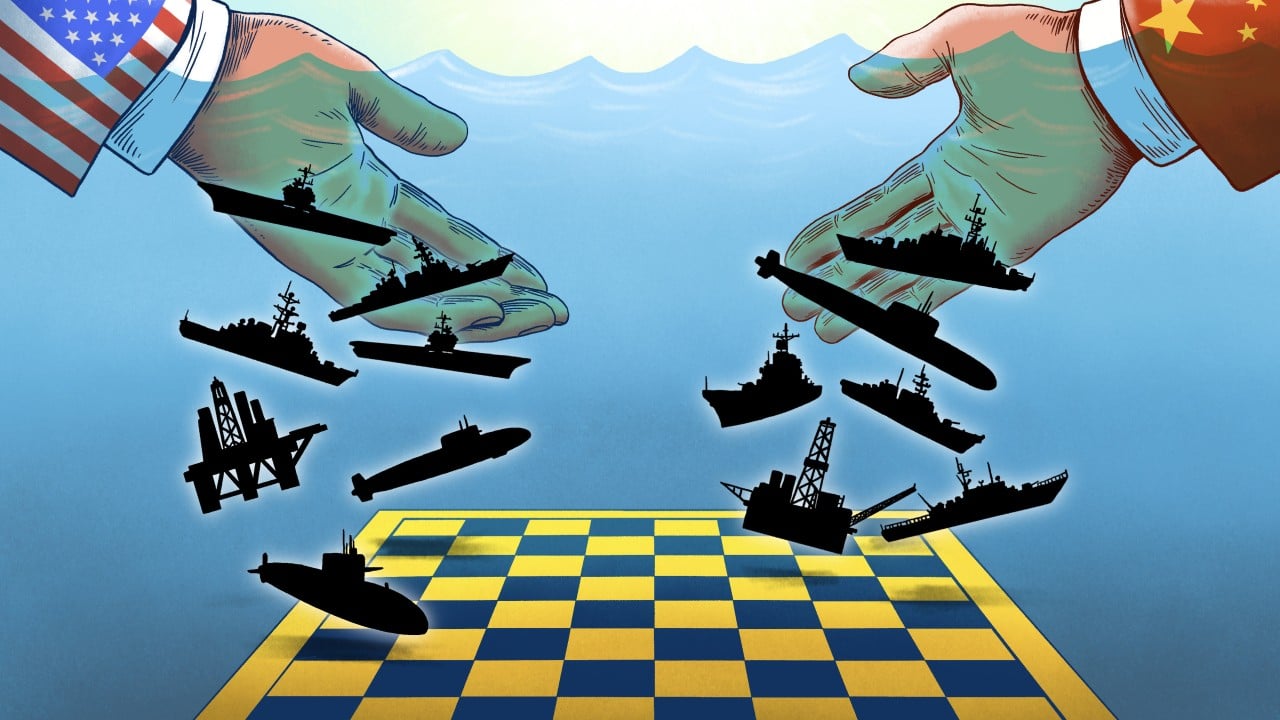
The seabed is no longer a silent abyss. It has become the most contested piece of real estate on the planet. While the public focuses on trade tariffs and semiconductor bans, a much more consequential struggle is unfolding miles beneath the waves. The United States and China are locked in a race to control two specific underwater assets: the fiber-optic cables that carry 99% of international data and the vast deposits of critical minerals required to power the green energy transition. This is not just a diplomatic spat. It is a fundamental fight for the physical substrate of the modern economy.
Control of the deep sea means control of global communication and the future of industrial manufacturing. Beijing currently dominates the processing of rare earth elements, but the Clarion-Clipperton Zone (CCZ) in the Pacific Ocean holds more cobalt, nickel, and manganese than all terrestrial deposits combined. Simultaneously, Washington is actively intervening to prevent Chinese firms like HMN Tech from winning subsea cable contracts, fearing that these arteries of information could become tools for espionage or be severed during a conflict. The winner of this race dictates who stays connected and who has the raw materials to build the next generation of hardware. Don't forget to check out our earlier coverage on this related article.
The Invisible Infrastructure War
Most people assume satellites handle our global data. They are wrong. Thousands of miles of hair-thin glass fibers resting on the ocean floor transmit everything from bank transfers to military commands. If these lines are cut, modern civilization stops.
Washington has shifted from a passive observer to an aggressive gatekeeper of these networks. Through the Team Telecom interagency committee, the U.S. government has effectively blocked several high-profile cable projects from landing in Hong Kong or using Chinese components. The 12,000-kilometer Pacific Light Cable Network, backed by Google and Meta, was forced to bypass Hong Kong entirely in favor of Taiwan and the Philippines after the Department of Justice raised national security concerns. To read more about the background of this, Business Insider provides an informative summary.
China is not sitting still. It is building its own parallel internet. By subsidized financing through the Belt and Road Initiative, Beijing is laying cables across Southeast Asia, Africa, and into Europe. This is creating a "splinternet" at the physical level. We are moving toward a world where data packets may never cross into "enemy" hardware, depending on their point of origin and destination. The risk here isn't just surveillance; it is the potential for a total blackout in the event of a naval blockade.
The Mining Gambit
If data is the blood of the modern world, then minerals are the bone. The transition to electric vehicles and renewable energy requires an astronomical amount of metal. Cobalt, for instance, is essential for lithium-ion batteries. Currently, the Democratic Republic of the Congo produces about 70% of the world's cobalt, and Chinese companies own or have stakes in most of those mines.
The seabed offers a way out of this terrestrial monopoly. Polymetallic nodules—potato-sized rocks rich in manganese, nickel, cobalt, and copper—litter the abyssal plains.
The Clarion-Clipperton Prize
The CCZ, a fracture zone in the Pacific, is the primary target. It contains an estimated 21 billion tons of these nodules. To put that in perspective, the amount of nickel in this single zone could power 280 million electric vehicles.
- The U.S. Dilemma: The United States has not ratified the United Nations Convention on the Law of the Sea (UNCLOS). Because of this, American companies cannot secure mining licenses from the International Seabed Authority (ISA). They are effectively locked out of the international waters where the richest deposits lie.
- The Chinese Advantage: China holds five of the thirty exploration contracts issued by the ISA, more than any other nation. They are spending billions on deep-sea robotics and specialized dredging vessels. They are playing the long game while the U.S. is legally sidelined.
This disparity creates a massive strategic vacuum. While American environmental groups successfully lobby for a moratorium on deep-sea mining due to potential biodiversity loss, Chinese state-owned enterprises are refining the technology to extract these riches. If the U.S. does not find a way to join the hunt, it will remain dependent on a supply chain that Beijing controls from start to finish.
Security Threats and Underwater Drones
The physical security of this infrastructure is terrifyingly fragile. Underwater cables are often no thicker than a garden hose. In 2022, the Nord Stream pipeline sabotage proved how vulnerable subsea assets are to state-sponsored actors.
Both superpowers are now deploying Uncrewed Underwater Vehicles (UUVs). These are not the bulky, tethered submersibles of the past. They are autonomous, long-range hunters designed to map the seabed, monitor cable lines, and, if necessary, disable them. The U.S. Navy’s "Snakehead" program and China’s HSU-001 large-scale UUV represent a new class of naval warfare.
The ocean floor provides the perfect cover for "gray zone" aggression. If a cable is severed in the middle of the Indian Ocean, proving who did it is nearly impossible. This ambiguity makes the seabed the ideal theater for sabotage that stops short of open war but achieves the same disruptive ends.
The Environmental Deadlock
There is a fierce debate over whether we should be touching the seabed at all. Critics argue that deep-sea mining will kick up sediment plumes that choke marine life and destroy ecosystems we haven't even fully mapped yet. These are valid concerns. The deep ocean is a carbon sink; disturbing it could have unforeseen consequences for the global climate.
However, the "green" argument has a counter-point. Terrestrial mining is devastating. In places like the DRC or Indonesia, mining involves massive deforestation, child labor, and toxic runoff into local water supplies. Proponents of seabed mining argue that picking up rocks from a barren, muddy plain at 4,000 meters is ethically and environmentally superior to tearing down rainforests.
This tension creates a policy paralysis in the West. China does not have this problem. Its centralized decision-making allows it to prioritize resource security over environmental activism. For every year the West spends debating the ethics of the seabed, Beijing moves closer to a total monopoly on the materials needed for the 21st-century economy.
Mapping the New Frontier
Accurate maps are the currency of this conflict. You cannot defend a cable or mine a nodule if you don't know the exact topography of the floor. Currently, we have better maps of the surface of Mars than we do of our own ocean floor.
The "Seabed 2030" project aims to map the entire ocean floor, but much of the most critical data is being kept classified by national navies. Hydrographic surveying has become a form of reconnaissance. When a Chinese "research vessel" spends weeks lingering over a specific patch of the Pacific, it isn't just looking at fish migrations. It is identifying "choke points" where cables converge or looking for acoustic signatures that could hide submarines.
The Economics of Dominance
The cost of entry into this race is staggering. Developing a single deep-sea mining site can cost upwards of $2.5 billion. Laying a trans-Pacific cable costs roughly $300 million to $500 million.
Private capital in the West is hesitant. The lack of a clear legal framework for American companies in international waters makes the risk-to-reward ratio look ugly. This is where the Chinese model of state-directed capitalism has a clear edge. They aren't looking for a quarterly return; they are looking for a thirty-year strategic advantage.
We are seeing the emergence of a new mercantilism. In the 18th century, empires fought over spice routes. Today, they fight over the silt and glass that facilitate the digital age. The U.S. strategy of "friend-shoring"—trying to build supply chains only with allied nations—is a desperate attempt to catch up. But you cannot friend-shore the ocean floor. It is a "first come, first served" environment, and right now, the U.S. is still putting on its boots while China is already miles offshore.
The assumption that the high seas belong to everyone is a comforting fiction. In reality, they belong to whoever has the technology to reach the bottom and the nerve to stay there. If the U.S. continues to rely on 20th-century treaties to solve 21st-century resource shortages, it will find itself disconnected and depleted.
The strategy must shift toward rapid technological deployment and a pragmatic legal path to the seabed. Ignoring the riches and the risks of the deep ocean won't make the competition go away; it will only ensure the final terms are dictated by Beijing. Establish a domestic framework for seabed extraction now, or prepare to buy your "green" future from a competitor who didn't wait for permission.