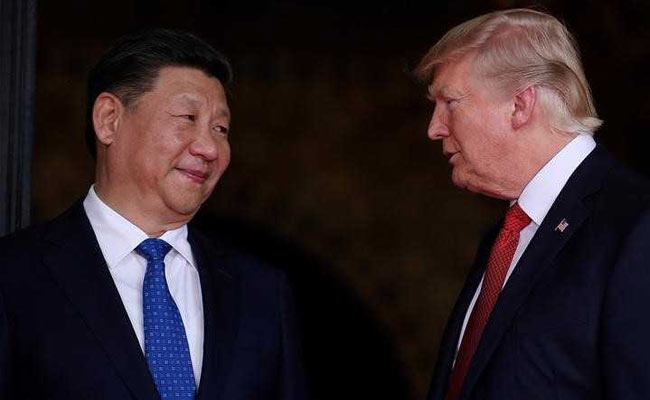
The recent face-to-face between Donald Trump and Xi Jinping was never about a "grand bargain" or a return to the integrated globalism of the 1990s. It was a cold assessment of leverage. While many international analysts have spent the last several years polishing their eulogies for American hegemony, the summit in Florida proved that the reports of the death of the U.S. economy have been greatly exaggerated. China is currently grappling with a structural slowdown, a demographic collapse, and a property sector that resembles a slow-motion demolition. Meanwhile, the United States has weaponized its control over the global financial plumbing and high-end semiconductor supply chains to a degree that Beijing cannot yet replicate.
The core premise of the current geopolitical tension is simple. Beijing needs the American consumer to keep their factories humming, but Washington no longer views that trade-off as worth the long-term security risk. This meeting wasn't a peace treaty; it was a boundary-setting exercise where the U.S. made it clear that the era of "unrestricted engagement" is buried.
The Leverage Gap Beijing Cannot Ignore
For a decade, the narrative has been that China’s rise was inevitable and America’s decline was a choice. But the data tells a different story. If you look at the capital flows from the last eighteen months, money isn't flooding into the Shanghai Composite. It is fleeing to the safety of the U.S. dollar. During the summit, Xi Jinping had to play a delicate hand. He needs to project strength to his domestic audience while simultaneously signaling to American CEOs that China is still "open for business."
The problem for Xi is that the definition of "business" has changed. American firms are no longer just worried about labor costs. They are worried about exit strategies. The U.S. delegation leaned heavily on the fact that the American economy has remained surprisingly resilient, outperforming almost every other G7 nation in post-pandemic recovery. This resilience gives Washington the "burn room" to implement aggressive tariffs and export controls without immediately cratering its own middle class.
The Semiconductor Chokehold
The most significant tension in the room wasn't about Taiwan or the South China Sea—though those were discussed in the usual scripted tones. The real battle is over silicon. The U.S. has effectively walled off China from the most advanced lithography machines and AI training chips. This isn't just a trade spat. It is a generational effort to ensure that the next industrial revolution happens in English, not Mandarin.
China’s attempt to achieve "self-reliance" in chips has seen billions of dollars poured into state-backed firms, yet they still lag years behind the leading edge. You cannot simply command a breakthrough in quantum physics or extreme ultraviolet lithography by throwing money at a committee. It requires an ecosystem of talent that, for now, still views the U.S. as the primary destination.
The Myth of the BRICS Alternative
Much has been made of the BRICS nations and their supposed plan to "de-dollarize" the world economy. It makes for great headlines and terrifying YouTube thumbnails. However, when you look at the actual mechanics of global trade, the dollar remains the only game in town.
During these negotiations, the U.S. Treasury officials weren't acting like representatives of a fading power. They were acting like the managers of the world’s only essential utility. China’s own banks are still terrified of secondary U.S. sanctions. If the dollar were truly dying, Beijing wouldn't be holding nearly $800 billion in U.S. Treasuries. They hold them because there is no other market deep enough or transparent enough to absorb that kind of volume.
Industrial Policy and the New Protectionism
The U.S. has undergone a quiet but massive shift toward its own version of state-led industrial policy. Between the CHIPS Act and the Inflation Reduction Act, the American government is subsidizing domestic manufacturing at a level not seen since the Cold War. This has neutralized one of China’s long-standing advantages. For years, China won because it was the only player willing to use the state's balance sheet to win market share. Now, the U.S. is doing the same, and it has a larger balance sheet.
This "America First" 2.0 isn't just a political slogan. It is a fundamental rewiring of the global supply chain. The goal is "friend-shoring"—moving critical production to nations like Mexico, Vietnam, or back home to Ohio. Xi knows that every factory that moves from Shenzhen to Monterrey is a permanent loss of influence for the Chinese Communist Party.
Why Dismissing America is a High Risk Gamble
Betting against the United States is a trade that has bankrupted many people over the last century. The American system has a unique, messy ability to self-correct. It looks chaotic from the outside. There are protests, heated elections, and constant legislative gridlock. But this chaos is a feature, not a bug. It allows for the venting of social pressure and the rapid reallocation of capital from failing industries to new ones.
China’s system is the opposite. It is rigid. It looks stable until it shatters. When the central government makes a mistake—like the prolonged "Zero-COVID" lockdowns or the crackdown on their own tech titans—there is no mechanism to challenge that mistake until the damage is already done. This structural fragility was the subtext of the entire Florida summit. Trump knows that time is on his side in a war of attrition; Xi is less certain.
The Energy Independence Factor
The U.S. is now the world’s largest producer of oil and natural gas. This is a massive geopolitical "get out of jail free" card. While China is forced to secure long, vulnerable sea lanes to get energy from the Middle East or Russia, the U.S. is effectively an island of energy stability. In any prolonged conflict or economic "de-coupling," the nation that controls its own calories and its own BTUs wins.
This energy surplus allows the U.S. to exert pressure on global markets in ways that Beijing simply cannot match. If the U.S. decides to tighten the screws on energy exports or uses its naval power to "inspect" tankers, China’s industrial machine grinds to a halt in weeks.
The AI Arms Race is the Final Decider
The summit briefly touched on AI safety, but that is a polite fiction. Neither side wants "safety" as much as they want dominance. The U.S. currently leads in the foundational models that will define the next decade of productivity. The reason is simple: AI requires massive amounts of compute, data, and—most importantly—unrestricted inquiry.
China’s censorship regime is a massive drag on its AI development. If you have to train a Large Language Model to never mention certain historical events or criticize certain leaders, you are inherently handicapping its ability to reason and innovate. You are building a "lobotomized" intelligence. The U.S. does not have this problem. This cultural and technical advantage is why the top Chinese AI researchers still end up working in Silicon Valley.
Capital Is Cowardly
At the end of the day, investors want to put their money where it won't be seized by a capricious state. The U.S. legal system, for all its flaws, provides a level of predictability that China cannot offer. This was the silent guest at the meeting. The "Problem with Dismissing America" isn't just about military might; it's about the fact that the world still trusts the U.S. court system and the U.S. patent office more than any alternative.
The meeting ended without a joint communique of any substance, which is exactly what the U.S. wanted. Washington isn't looking for a deal that requires them to give up their technological lead. They are looking to maintain the status quo while they finish the process of diversifying their supply chains.
The true takeaway from the Trump-Xi summit is that the "unipolar moment" might be over, but the "American era" is far from finished. The U.S. has successfully pivoted from being the world’s consumer to being its most formidable gatekeeper. If you are planning your global strategy on the assumption that the U.S. is a spent force, you aren't just wrong; you are dangerously exposed.
Stop looking at the political theater and start looking at the capital accounts. The world is still betting on the dollar, and as long as that remains true, the U.S. holds the high ground. Beijing is playing a game of catch-up on a field where the U.S. keeps moving the goalposts.
Watch the flow of high-end engineers and venture capital. Until those start moving toward Beijing in greater numbers than they move toward Austin or Palo Alto, the balance of power remains firmly in Washington.