The United States has just escalated its air campaign in the Middle East by deploying 5,000-pound (2,200 kg) GBU-72 "bunker buster" munitions against Iranian missile positions along the Strait of Hormuz. According to U.S. Central Command, these strikes targeted hardened coastal sites housing anti-ship cruise missiles that have effectively paralyzed 20% of the world’s oil transit. While the Pentagon describes the operation as a success in degrading Iran's "anti-access" capabilities, the reality on the water remains grim. The strait is not open, and the use of such massive ordnance suggests that the previous two weeks of lighter precision strikes failed to crack the IRGC’s most resilient subterranean launch complexes.
The Engineering of Deep Penetration
The decision to move from standard 2,000-pound JDAMs to the 5,000-pound GBU-72/B marks a shift in the tactical geometry of this war. This is not a weapon of area denial; it is a surgical tool designed to defeat meters of reinforced concrete and granite before detonating.
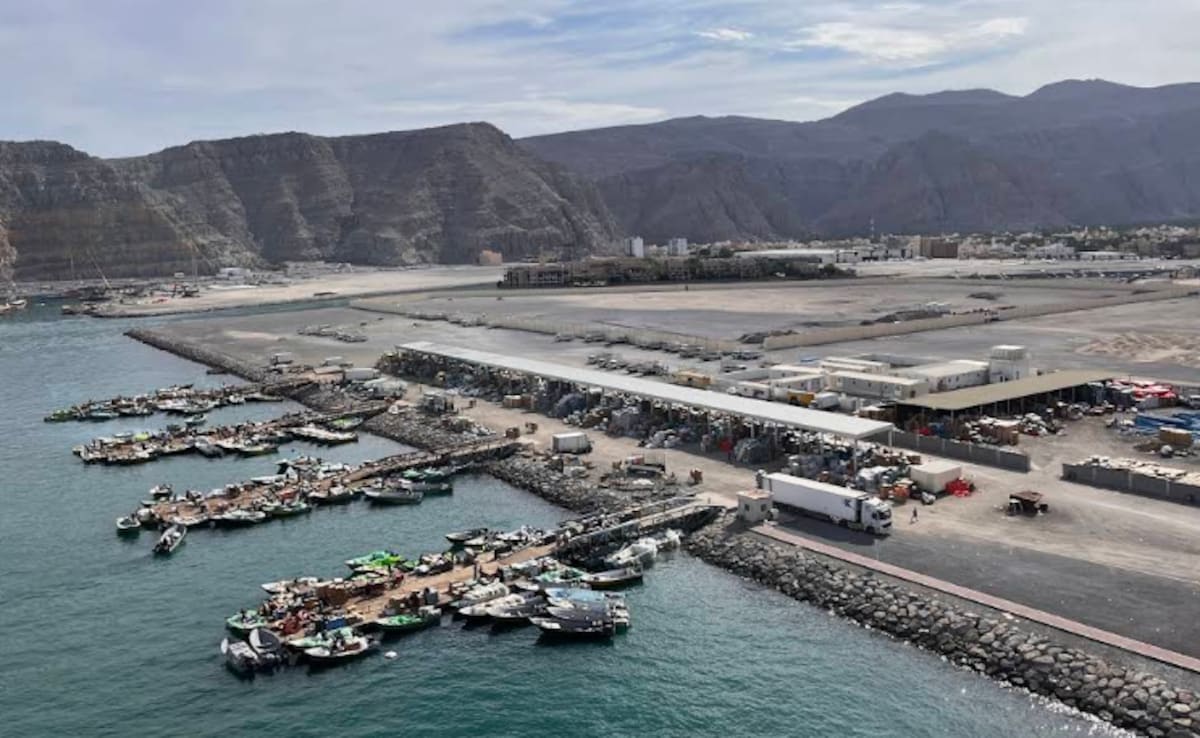
Unlike traditional bombs that explode on contact, these munitions use a delayed-fuze mechanism synchronized with a high-velocity, heavy-metal casing. The kinetic energy generated by a release from high altitude allows the weapon to "drill" into the earth. For the Iranian crews stationed in the "missile cities" carved into the jagged cliffs of the Musandam Peninsula’s northern approach, the arrival of a GBU-72 is a death sentence delivered through the ceiling.
However, destroying a launcher is different from securing a waterway. Iran's coastal defense doctrine relies on redundancy and mobility. For every hardened silo the U.S. collapses, a dozen truck-mounted launchers remain hidden in civilian warehouses or limestone caves, ready to roll out, fire, and vanish within minutes.
The Myth of the Open Strait
Despite Defense Secretary Pete Hegseth’s assertions that the Iranian military is "combat ineffective," the commercial shipping industry isn't buying it. Insurance premiums for tankers attempting to transit the Persian Gulf have reached "war risk" levels that make the journey economically suicidal.
- Traffic Reduction: Satellite data shows a 70% drop in AIS-active vessels compared to February.
- Alternative Routes: Ships are now diverting around the Cape of Good Hope, adding 10 to 14 days to global supply chains.
- The Shadow Fleet: Only vessels identifying as Chinese or carrying specific guarantees from Tehran are currently navigating the narrows with any regularity.
The U.S. Navy is currently grappling with a "saturation" problem. Even if 90% of Iran’s missile batteries are neutralized, the remaining 10%—combined with swarms of low-cost sea drones—creates a risk profile that most Western shipping conglomerates refuse to accept.
A Coalition of One
The most striking aspect of the Hormuz crisis is the silence from America’s traditional allies. President Trump’s recent public frustrations with NATO partners highlight a deep strategic rift. Germany and France have explicitly declined to contribute warships to a "Hormuz Escort" mission, fearing that direct involvement would turn a regional conflict into a global conflagration.
This leaves the U.S. in a precarious position. It possesses the world's most advanced air force, capable of dropping 2,200 kg bombs with five-meter accuracy, but it lacks the diplomatic "buy-in" to stabilize the market. The bunker busters may be hitting their targets, but they are not hitting the root cause of the economic paralysis: the loss of trust in maritime security.
The Tactical Dead End
The use of "deep penetrator" munitions is often the final stage of an air campaign before a ground intervention—or a long, grinding stalemate. If these strikes do not force a reopening of the strait by the end of the week, the administration faces a choice between further escalation or watching the global economy buckle under $150-per-barrel oil.
Military power is being tested against a decentralized, asymmetric opponent that views the destruction of its own infrastructure as an acceptable price for global leverage. The concrete is breaking, but the blockade is holding.
Precision-guided gravity bombs are marvels of modern physics. They can find a vent shaft from 30,000 feet and vaporize a command center. They cannot, however, convince a merchant captain that the horizon is safe when the sea is still burning.