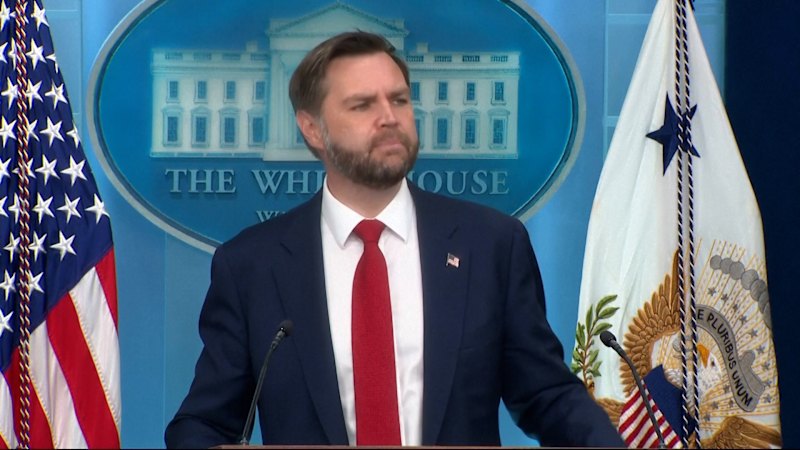
The illusion of a seamless geopolitical marriage between the United States and Israel has officially dissolved. When Vice President JD Vance stood before the White House press corps to defend the administration’s newly signed memorandum of understanding with Iran, his words were not those of a traditional diplomat trying to smooth over a rough patch. They were an blunt declaration of leverage from a superpower that believes its client state has forgotten who pays the bills. Vance explicitly stated that Donald Trump is the only world leader still sympathetic to Israel, warning Jerusalem that it is rapidly running out of friends.
This is no longer a quiet disagreement behind closed doors. It is a public fracture. The immediate catalyst is the 14-point agreement signed by Trump and Iranian President Masoud Pezeshkian at Versailles, an interim deal designed to halt the regional war that erupted on February 28. While Washington views the deal as a necessary check on an exhausting conflict, prominent factions within Israel's governing coalition view it as total capitulation to Tehran. By publicizing this rift, the White House has exposed a fundamental divergence in how both nations define their long-term survival.
The Math of Dependence
At the core of Vance’s public dressing-down was a stark reminder of material reality. For decades, American politicians have spoken of the bond with Israel in romanticized, ideological terms. Vance discarded that script entirely. He pointed out that over the past three months of intense regional combat, two-thirds of the defensive weapons protecting the Israeli homeland were built by American hands and financed by American taxpayers.
This is the cold geometry of the relationship. Israel boasts a highly sophisticated domestic defense sector, yet its operational longevity remains inextricably tied to American supply chains. When interceptors for the Iron Dome and David’s Sling are expended at a rapid rate, the replenishment comes from American factories.
Vance’s message was unambiguous. If you are entirely dependent on a single benefactor for the ammunition that keeps your cities safe, you do not get to dictate the terms of global diplomacy to that benefactor. The vice president’s frustration was aimed directly at far-right cabinet members like National Security Minister Itamar Ben-Gvir and Finance Minister Bezalel Smotrich, who have publicly trashed the Trump administration's diplomacy. Vance effectively told them to look at their inventory logs before they open their mouths.
Divergent War Aims
The friction is not just about rhetoric. It is about a fundamental disagreement over how the war should end. When the conflict began earlier this year, Washington and Jerusalem appeared aligned. That alignment was superficial. The Trump administration sought a swift, decisive show of force to reset deterrence and force Tehran to the negotiating table. Israel's leadership, particularly its right-wing fringe, viewed the conflict as an existential opportunity to permanently dismantle the entire Iranian proxy network and neutralize Tehran's nuclear ambitions once and for all.
The Versailles memorandum exposes this gap. The agreement institutes an immediate, permanent termination of military operations across all fronts, including Lebanon. It establishes a 60-day clock to negotiate a permanent settlement, offering Iran immediate economic relief through lifted oil waivers and sanctions rollbacks in exchange for future compliance metrics.
To the White House, this is a pragmatic diplomatic victory that avoids an endless, multi-front quagmire. To critics in Jerusalem, it is a disaster. It stops the clock while Hezbollah is still functioning in southern Lebanon and leaves Iran's ballistic missile infrastructure intact. Ben-Gvir responded to Vance on social media by comparing the current Iranian government to 20th-century totalitarians, arguing that you cannot negotiate with an existential threat. The problem for Israel is that its primary backer is no longer interested in fighting an absolute war of annihilation.
The Limits of Kinetic Force
The administration’s shift reflects a deeper skepticism about Israel’s current strategic trajectory. In an interview, Vance posed a direct question to the Israeli cabinet. What is the exact proposal? He noted that a nation of nine million people cannot simply kill its way out of every national security crisis.
This cuts to the heart of the analytical divide. For decades, Washington has humored the doctrine of "mowing the lawn"—the strategy of periodic military operations to keep hostile actors off balance. But the scale of the current conflict has made that approach unsustainable for American global strategy. The Trump administration is looking at a broader global board, where a protracted Middle Eastern war drains resources, spikes oil prices, and complicates competition with other global powers.
Trump’s own patience has clearly worn thin. At the G7 summit in France, he openly chided Prime Minister Benjamin Netanyahu, suggesting a "softer touch" was needed in Lebanon and grumbling that Israel did not need to knock down a building every time a single hostile actor entered it. When Israel launched a massive airstrike in a civilian center in Beirut right as diplomats were closing in on the text of the agreement, the White House viewed it as a deliberate attempt to sabotage the peace process. The administration is no longer willing to write a blank check for military actions that disrupt its own global agenda.
A Republic of One
By declaring Trump the only world leader still sympathetic to Israel, Vance was not just praising his boss. He was issuing a warning about total international isolation. The global political climate has shifted dramatically. European allies have largely broken with Jerusalem over the conduct of the war, and regional normalization efforts with Arab states are on ice.
If the American presidency is indeed the only shield left preventing total diplomatic and economic isolation, then alienating that president is an act of strategic recklessness. Netanyahu himself understands this, which is why he has remained publicly quiet about the deal while asserting that Israeli forces will stay in southern Lebanon as long as security requires. He is attempting to walk a tightrope, placating his domestic coalition without triggering a catastrophic break with Washington.
But the tightrope is fraying. The administration has signaled that its patience with this double game has expired. By telling Israeli critics to wake up and smell reality, Vance has laid bare the transactional nature of modern American foreign policy under Trump. Sympathy exists, but it is bounded by American interests, American dollars, and American patience. Jerusalem now faces a brutal calculation: accept an imperfect peace engineered by its only superpower ally, or risk going it alone in a region that remains entirely unforgiving.


