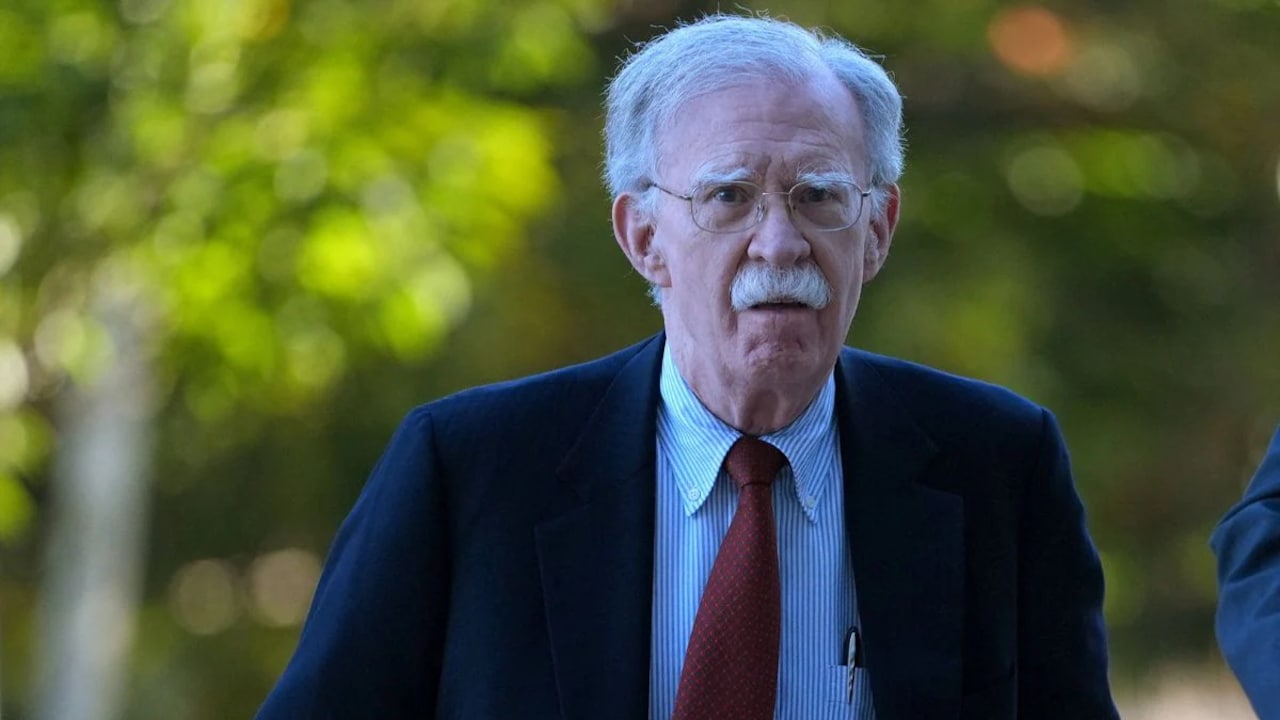
Former National Security Advisor John Bolton pleaded guilty in a Maryland federal courtroom on Friday to mishandling classified information, closing a dark chapter on a sprawling multi-year investigation into his personal record-keeping habits. The hawk who spent decades advocating for the absolute authority of the American state fell victim to its most unyielding machinery. He admitted to a single felony count of unlawfully retaining national defense information. He will pay a staggering $2.25 million fine. His government pension is gone. This plea marks the definitive fall of an establishment figure who believed his personal journals were exempt from the laws governing the rest of the nation.
The case exposes a systemic vulnerability in how Washington elite handle secrets. It was not a whistleblowing operation or a ideological leak. It was a matter of extreme vanity and routine digital negligence.
The Digital Trail of an Unsecured Diary
For years, Bolton maintained a detailed, diary-style log of his daily activities at the highest levels of American government. He recorded the minutiae of meetings with foreign leaders, specific intelligence assessments, and internal West Wing deliberations. The problem lay not in the act of writing, but in how those records were moved, preserved, and stored.
Prosecutors established that Bolton systematically transmitted more than 1,000 pages of these sensitive notes using a personal AOL email account and commercial messaging applications. The recipients were not foreign handlers, but his own wife and daughter. He sought their assistance in organizing material for what would eventually become his lucrative 2020 memoir. This process bypassed every established secure channel required for handling national defense data. The consequences of this choice were immediate and severe.
Foreign intelligence agencies do not ignore unsecured personal email accounts belonging to top Western officials. Sometime after Bolton left his official post, cyber operatives linked to the Iranian government successfully breached his personal email infrastructure. The hackers gained access to the precise journal entries containing sensitive defense data. Bolton discovered the intrusion and reported it to authorities, unintentionally triggering the exact federal investigation that culminated in his courtroom capitulation.
The irony is thick. A man who built a career on identifying and counteracting foreign cyber threats left his back door wide open to one of his primary geopolitical adversaries.
The Architecture of the Legal Deal
Federal prosecutors originally hit Bolton with an 18-count indictment in October 2025, accusing him of eight counts of unlawful transmission and ten counts of unlawful retention under the Espionage Act of 1917. Had he proceeded to trial on the full slate of charges, he faced the very real prospect of spending the rest of his life in a federal penitentiary. The financial toll alone would have decimated his estate.
The deal struck with the U.S. Attorney’s Office for the District of Maryland represents a calculated retreat by both sides.
By pleading guilty to just one count of unlawful retention, Bolton capped his maximum potential prison exposure at five years. U.S. District Judge Theodore Chuang scheduled sentencing for October 28, leaving the former ambassador in a state of legal limbo through the autumn. Defense attorney Abbe Lowell spun the plea as an act of leadership, claiming his client took responsibility to prevent the public disclosure of further classified material during a prolonged trial.
The financial penalties serve as a direct clawback of Bolton's commercial success. The $2.25 million fine matches the approximate earnings generated by his book sales. The government effectively stripped the financial incentive from his rule-breaking. Combined with the total forfeiture of his lifetime federal retirement benefits, the fiscal judgment functions as an economic eviction from the permanent political class.
Selective Prosecution and the Double Standard
The resolution of this case brings uncomfortable political questions to the surface. Critics point out that while Bolton faces financial ruin and potential incarceration, other high-profile figures accused of similar or more severe infractions have walked away entirely unscathed.
The shadow of the executive branch hangs over the entire proceeding. Bolton’s legal team repeatedly hinted that the investigation was fueled by a desire for political retribution, pointing to his vocal criticisms of the administration after his dismissal. The Justice Department under the current administration has pursued multiple adversaries of the executive branch with varying degrees of success, fueling public cynicism about the independence of federal law enforcement.
The contrast with the dismissed classified documents case of the executive himself is impossible to ignore. That case was summarily thrown out by a sympathetic federal judge, creating a stark dichotomy in how corporate political power is treated compared to displaced bureaucratic officials.
Yet career prosecutors maintain that the merits of the Bolton case stand independently of political theater. The physical reality of an Iranian hack on an AOL account containing top-secret weapons of mass destruction data removed any room for prosecutorial discretion. The department had to act, if only to preserve the illusion that rules still apply to those who once held the keys to the kingdom.
The Illusion of Ownership Over State Secrets
The core of Bolton's defense always rested on an unwritten rule of Washington life. High-ranking officials frequently treat their personal reflections and diaries as private property. They view these materials as raw material for future historical accounts, memoirs, or media appearances.
This assumption is legally flawed. The Supreme Court has repeatedly affirmed that information generated during the execution of official national security duties belongs exclusively to the public trust. It cannot be converted into a personal asset. Bolton believed his status as an elder statesman shielded him from the strict enforcement applied to low-level whistleblowers and intelligence contractors.
He was wrong. The system eventually protects its secrets, even if it takes years to catch up with the perpetrator.
The administrative state handles classified material through rigid, unyielding protocols for a reason. When an individual, regardless of their past title or ideological alignment, decides that those protocols are an unnecessary hindrance to their personal convenience, the entire security apparatus degrades. Bolton's true offense was not malice. It was a profound, unchecked arrogance that convinced him he could manage national security data on a consumer email platform.
Sentencing will occur in late October. Whether Judge Chuang imposes active prison time or opts for a combination of probation and home confinement, the structural damage to Bolton’s legacy is complete. The veteran bureaucratic infighter who survived decades of shifting political winds will be remembered primarily for the vulnerability he created in an AOL inbox.


