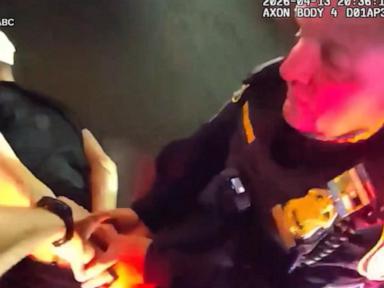
The footage is grainy, shaky, and punctuated by the sharp, rhythmic clicking of police boots on a suburban driveway. Within the first thirty seconds of the recently released bodycam video, the illusion of a "technical support" emergency vanishes. We see a New York woman, visibly shaken, clutching a manila envelope containing $25,000 in cash. Standing across from her are two men who, moments earlier, had claimed to be federal agents sent to "secure" her assets. Instead, they find themselves face-down on the pavement as undercover officers swarm the scene.
This isn’t an isolated incident of local crime. It is a window into a sophisticated, multi-layered extraction industry that has turned the New York metropolitan area into a high-yield harvest zone. While the viral video focuses on the "take-down," the real story lies in the mechanics of how these crews identify, groom, and eventually bleed their targets dry before the first siren is ever heard.
The Anatomy of the Courier Play
For years, the standard operating procedure for digital scams involved wire transfers or gift cards. Those methods left digital breadcrumbs that specialized task forces began to track with increasing accuracy. In response, the industry has pivoted back to the physical world. The "Courier Model" seen in the N.Y. case relies on a terrifying psychological cocktail of urgency and isolation.
The scam typically begins with a pop-up alert or a "spoofed" phone call claiming a compromise of the victim's social security number or bank account. The attackers don't just ask for money; they provide a solution. They convince the victim that their local bank branch is "under investigation" and that the only way to protect their life savings is to withdraw the cash and hand it over to a "bonded courier" for safekeeping in a government locker.
It sounds absurd in the cold light of day. However, when a victim is kept on a continuous phone call for six hours—denied the ability to consult family or even hang up—the brain enters a state of high-cortisol survival mode. The couriers caught on the N.Y. bodycam were the final link in a chain that likely stretched across three continents.
Why New York is the Epicenter
The density of wealth in the New York tri-state area, combined with a high population of retirees living alone, makes it a primary target for these operations. Data from the FBI’s Internet Crime Complaint Center (IC3) suggests that New York consistently ranks among the top states for total losses in elder fraud, with figures climbing into the hundreds of millions annually.
The sophistication of the "foot soldiers" is also evolving. The individuals arrested in the footage weren't traditional street criminals. They were often "money mules" recruited through encrypted messaging apps, promised a small percentage of the haul for simply picking up a package. This compartmentalization protects the "ringleaders" who remain safely behind keyboards in jurisdictions beyond the reach of the NYPD or the FBI.
The Breakdown of Trust
- Spoofing Technology: Attackers use software to make the victim's caller ID display "New York Police Dept" or "Department of Justice."
- The "Script": Scammers use psychological scripts developed by behavioral specialists to bypass the victim's natural skepticism.
- Physical Presence: Sending a person to the door adds a layer of perceived legitimacy that a simple email cannot match.
The Invisible Failures of the Banking System
The woman in the video had to walk into a physical bank branch and withdraw $25,000 in cash. A question that often goes unasked in the wake of these arrests is why the red flags weren't raised at the teller window.
While the New York State Department of Financial Services has issued guidance on elder financial exploitation, the implementation is inconsistent. Tellers are often caught between their duty to protect the customer and the customer's right to access their own money. In this specific case, the victim had been coached by the scammers to tell the bank the money was for a "home renovation project."
This coaching is a standard part of the heist. If the bank doesn't have a protocol to dig deeper—to look for signs of distress, trembling hands, or a customer who won't hang up their cell phone—the scammer wins long before the courier arrives at the doorstep.
The Bodycam as a Double Edged Sword
The release of this footage serves a dual purpose. For law enforcement, it is a deterrent and a public service announcement. It shows that these "ghost" couriers can be caught. However, there is a grimmer reality to the "bodycam hustle" currently trending on social media.
A growing cottage industry of YouTube channels now uses FOIA (Freedom of Information Act) requests to obtain arrest footage of citizens in their most vulnerable moments. While the "take-down" of a scammer is cathartic, the permanent digital record of the victim's trauma is a heavy price to pay for public awareness. The woman in the New York video is seen in a state of near-collapse, a moment now archived forever on the internet for the sake of "engagement."
Tactical Reality of the Arrests
The tactical unit involved in the N.Y. take-down utilized a "controlled delivery" technique. Once the victim realized she was being scammed—often through the intervention of a family member or an observant neighbor—the police didn't just stop the transaction. They allowed the courier to arrive, ensuring they could charge the suspects with more than just attempted fraud.
The struggle seen in the footage highlights the desperation of the low-level mules. These are people often operating under the threat of the same cartels that organize the scams. When the handcuffs click shut, the flow of money for that specific cell stops, but the infrastructure remains intact.
The Only Real Defense
The arrest in New York is a victory, but it is a small one. For every courier tackled on a driveway, ten more are being recruited on Telegram. The "Brutal Truth" is that law enforcement cannot police their way out of this crisis. The sheer volume of attempts makes 100% interdiction impossible.
The solution requires a fundamental shift in how we handle digital and physical security for the vulnerable. It means banks must be willing to "be the bad guy" and hold large cash withdrawals for 24 hours. It means telecommunications companies must be held liable for allowing spoofed government numbers to traverse their networks.
Until the cost of doing business for the scammers exceeds the massive payouts they receive from a single successful New York "hit," the shaky bodycam footage we see today will just be a trailer for the next thousand crimes. The men in the video will be replaced. The script will be updated. The manila envelopes will keep moving.
Protection starts with the realization that no government agency will ever send a stranger to your door to collect cash for "safekeeping." If someone shows up, the only person you should be calling is the one wearing the bodycam.