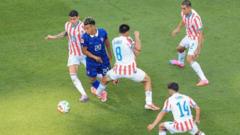
When the final whistle blew, the French players did not celebrate so much as exhale in collective relief. They had survived. Superficially, the narrative surrounding France’s chaotic clash with Paraguay frames the South American side’s tactics as an embarrassing aberration, a toxic exhibition of gamesmanship that nearly ruined a football match. But dismissing Paraguay’s approach as mere "dark arts" misses the entire tactical mechanism at play. What looks like a disgrace from the VIP boxes of Western Europe is actually a highly sophisticated, deeply integrated defensive system designed to neutralize systemic talent deficits. Elite European teams keep struggling against these tactics because they treat them as a moral failing rather than a structural problem that requires a footballing solution.
To understand why France sputtered and lost its composure, you have to look past the theatrical diving and the tactical fouls. You have to look at the clock management.
The Mechanics of Frustration
Football at the highest level relies heavily on rhythm. Teams like France are engineered to operate in high-gear transitions, where ball circulation speeds dictate the movement of the opposition defensive block. Paraguay’s primary objective was not necessarily to win the ball, but to destroy the concept of time itself.
Every throw-in became a three-minute negotiation. Every minor collision in the midfield triggered a medical intervention. By fracturing the 90-minute match into dozens of isolated, three-second micro-events, Paraguay successfully prevented France from building any structural momentum.
This is where the European tactical bias reveals itself. European academies produce players who thrive in highly structured, predictable environments where space is hunted and found through positional play. When a match loses its structure entirely, elite players begin to improvise poorly. They force passes that do not exist. They over-dribble into blind alleys. Most importantly, they lose their emotional discipline.
The Hidden Numbers Behind the Chaos
Statisticians tracking modern football metrics frequently point to effective playing time—the actual duration the ball is in active play. In an average elite European match, this number hovers around 60 to 65 minutes. Against a masterclass in disruption, that number plummeted significantly.
When the ball is active for less than half the match, every single possession carries an inflated premium.
- Elevated Stress Levels: Players realize they have fewer opportunities to score, leading to rushed decision-making.
- Physical De-conditioning: The constant stop-start nature of the game prevents players from reaching their physical cruising altitude, causing premature muscle fatigue.
- Referee Exploitation: Officials are forced to police behavioral infractions rather than technical ones, shifting the criteria of what constitutes a foul.
Paraguay did not stumble into this strategy; they engineered it. It is a mathematical equalizer. If Team A possesses a squad value fifty times greater than Team B, Team B cannot compete in an open, fluid athletic contest. They must reduce the amount of actual football played to the absolute minimum, relying on set pieces, physical intimidation, and psychological warfare to steal a result.
The Myth of the Passive Referee
A common complaint from the French camp centered on the officiating. The prevailing view was that the referee allowed Paraguay to dictate the physical boundaries of the match. This argument ignores the reality of international officiating.
An international referee is tasked with managing a match, not sanitizing it. When a team executes tactical fouling with precision—distributing the infractions across six different players to avoid accumulation yellow cards—they are exploiting the rulebook, not breaking it. It is the football equivalent of a regulatory loophole.
France expected the referee to protect their creative assets. Instead, Paraguay forced the official to become a bureaucrat, bogged down in endless minor disputes.
Breaking the Disruption Cycle
The solution for elite sides confronting these tactics is not public lamentation or calls for greater protection from officials. The solution is tactical adaptation.
First, teams must refuse to engage with the provocation. When a Paraguayan defender confronts a French winger after a challenge, any response other than walking away is a tactical victory for the defender. It burns twenty seconds off the clock, raises the winger’s cortisol levels, and edges him closer to a booking.
Second, the structural response to a low block that utilizes dark arts is a ruthless insistence on widening the pitch. France consistently tried to pierce Paraguay through the central corridors, playing directly into the densest thicket of the opposition’s defensive structure. By stretching the play to the touchlines and utilizing rapid, one-touch cross-field diagonals, a attacking team forces the defensive unit to sprint laterally.
It is physically impossible to maintain an aggressive, disruptive press while constantly chasing 50-yard diagonal switches. The defensive lines inevitably fray. Gaps open. The dark arts lose their efficacy when the practitioner is too exhausted to get close enough to foul.
The irritation felt by France is understandable, but the righteous indignation is counterproductive. Football has never been an aesthetic beauty pageant; it is a contest of resource optimization. Paraguay used the resources available to them—grit, cynicism, and an intimate understanding of human psychology. France survived because their raw talent rescued them in a handful of isolated moments, but until European giants treat disruption as a legitimate tactical puzzle to be solved rather than a dirty trick to be scorned, they will continue to find themselves dragged into the mud.