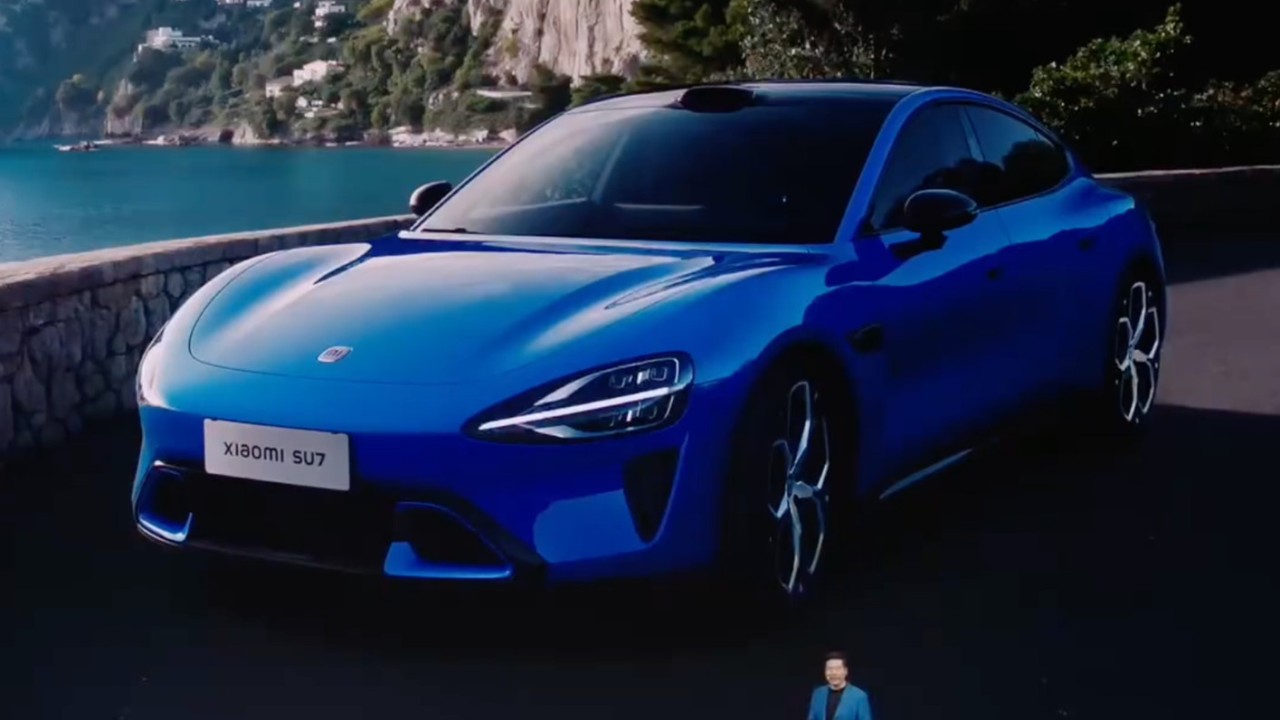
Xiaomi CEO Lei Jun recently stood before a live-streamed audience to perform a "teardown" of his company’s newest vehicle, the YU7. This wasn't just a marketing stunt; it was a forensic demonstration of intent. While the world watched the first-generation Xiaomi SU7 become the first electric vehicle to systematically outsell the Tesla Model 3 in China, the tech giant was already gutting its own production lines to make room for a second act. By March 2026, Xiaomi had discontinued the original SU7 after a mere 381,000 units—a blink of an eye in automotive cycles—to launch a successor that is more expensive, more powerful, and arguably more dangerous to the established order.
The primary query for anyone watching the Chinese EV sector is no longer "Can a phone company build a car?" but rather "Can Tesla survive the hardware-software convergence that Xiaomi has perfected?" The answer lies in the sheer velocity of the Xiaomi SU7 Ultra and its refreshed siblings. Xiaomi has transitioned from a smartphone maker into a high-scale automotive manufacturer in under 20 months, setting a global record by rolling its 500,000th car off the Beijing assembly line in late 2025.
The Power Gap Is Real
If you want to understand the psychological blow dealt to Tesla, look at the SU7 Ultra. This is not a subtle competitor. It is a tri-motor beast delivering 1,548 horsepower and 1,305 lb-ft of torque. In recent head-to-head drag races against the Tesla Model S Plaid, the Ultra demonstrated a relentless top-end pull that left the American benchmark behind once speeds crossed the 124 mph threshold.
While the Model S Plaid remains a master of initial traction and off-the-line responsiveness, the SU7 Ultra’s 9.3-second quarter-mile time is a testament to brute force and superior aerodynamics. Xiaomi isn't just chasing 0-60 times; it is chasing the Nürburgring. The production-spec Ultra clocked a lap time of 7:04.957, positioning it in a rarefied air that Tesla’s aging flagship platform struggles to reach without significant aftermarket modification.
Software is the New Suspension
The "why" behind Xiaomi's success isn't just found in motor windings or carbon fiber. It is found in the ecosystem. Tesla’s software, once the gold standard, now feels like a walled garden in a world of open architecture. Xiaomi’s "Human x Car x Home" strategy allows a driver to adjust their home thermostat or check a security camera from the dashboard with the same fluid responsiveness as a flagship smartphone.
The refreshed 2026 SU7 line takes this a step further by making LiDAR standard across all trims. This is a direct philosophical counter-argument to Tesla’s "Vision Only" approach. While Elon Musk has famously derided LiDAR as a "crutch," Xiaomi is leveraging it to provide a 700 TOPS computing platform that handles complex urban navigation with a level of hardware redundancy that Chinese consumers increasingly demand.
The 800-Volt Architecture Pivot
Efficiency is the hidden battlefield. The 2026 SU7 has moved to an 800-volt architecture across its entire lineup, featuring silicon carbide (SiC) high-voltage platforms with 752V and 897V values. This allows the Pro version to claim a CLTC-rated range of 902 kilometers (roughly 560 miles).
Tesla’s Model 3, by comparison, has seen its market share in China erode from 16% in 2020 to a precarious single-digit position by early 2026. The Model 3 delivered roughly 200,000 units in 2025, while the SU7 surged past 258,000. Consumers are choosing the newer, faster-charging architecture over the familiar but aging American platform.
Market Realities and the 550,000 Unit Goal
Xiaomi isn't profitable on every car yet, but it is getting close. In the third quarter of 2025, the automotive unit reported its first operating profit of approximately 700 million yuan ($98 million). This is a terrifying milestone for competitors. Most EV startups bleed cash for a decade before seeing black ink. Xiaomi did it in less than two years.
For 2026, the company has set a delivery target of 550,000 vehicles. This is a 34% increase over 2025, supported by a supply chain that now benefits over 300 auto parts enterprises. The strategy is clear: use the massive cash flow from the smartphone and IoT business to subsidize the aggressive scaling of the EV wing until the "Model Y killer," the YU7 SUV, reaches full volume.
Why Tesla's Rebound Might Not Be Enough
Data from early 2026 shows a slight rebound in Tesla's China sales, largely driven by aggressive financing and the enduring popularity of the Model Y. However, the narrative has shifted. Tesla is no longer the "aspirational" brand for China’s tech-savvy youth. Xiaomi has captured that cultural zeitgeist. When Xiaomi opened pre-orders for the refreshed SU7 in January 2026, it secured 100,000 orders in just 15 days, despite a price increase of about 14,000 yuan ($2,000) over the previous generation.
This willingness of consumers to pay more for a Xiaomi vehicle suggests that the "cheap smartphone" brand image has been successfully shed. The company is now viewed as a premium technology integrator.
The Expansion Threat
The final piece of the puzzle is international. While Xiaomi is currently focused on the domestic Chinese market to refine its manufacturing, 2027 is earmarked as the year of global expansion. A new R&D center in Munich, staffed by former BMW executives, signals that Europe is the next target.
Tesla’s advantage has always been its global Supercharger network and brand recognition. But as Xiaomi scales its 800V tech and integrates its vast IoT ecosystem into the driving experience, the "Plaid" performance and "Autopilot" features that once seemed futuristic are beginning to look like the baseline.
The industry is no longer waiting for a "Tesla killer" to emerge from the traditional German or American automakers. It is already here, and it was built by a company that used to just make your phone.
Would you like me to analyze the specific supply chain advantages Xiaomi holds over Tesla in the mainland China market?