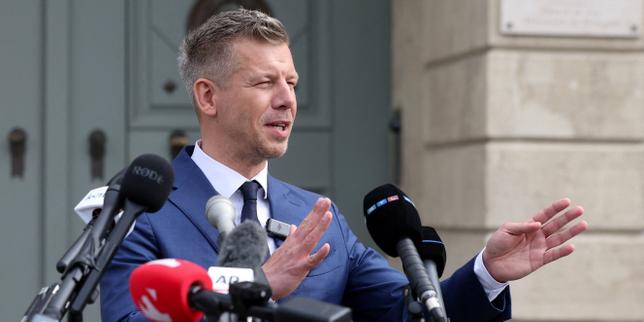
The political earthquake currently rattling Budapest has finally forced a crack in Hungary’s long-standing blockade of Ukrainian aid. Under the rising pressure of Péter Magyar and his TISZA party, Viktor Orbán’s administration has signaled a tactical retreat regarding the European Union’s proposed €35 billion loan package for Kyiv. While the Hungarian government maintains its refusal to directly contribute a single forint to the effort, it has quietly signaled it will no longer burn the bridge for the rest of the continent. This is not a sudden change of heart. It is a calculated survival move in a shifting domestic climate where being "pro-peace" no longer means being "pro-obstruction."
The TISZA Factor and the End of Monolithic Power
For a decade, the narrative inside Hungary was controlled by a singular voice. That voice argued that any assistance to Ukraine was an invitation to global conflict. But the emergence of Péter Magyar has shattered that monopoly. Magyar, a former insider who knows exactly where the bodies are buried in the Fidesz party apparatus, has forced the government to recalculate its math.
Magyar’s stance is a nuanced, albeit frustrating, middle ground. He supports the loan because he understands that Hungary cannot afford to be the permanent pariah of the European Council, especially while billions in recovery funds remain frozen by Brussels. However, he is also playing to a domestic audience that remains skeptical of deep military involvement. By saying "yes to the loan, no to the participation," he has created a template that the Orbán government is now forced to mimic to avoid looking like the less reasonable option.
This shift reveals a deeper truth about Hungarian foreign policy. It was never about ideology. It was about leverage. Now that Magyar is siphoning off voters from the right and the center, the leverage Orbán once enjoyed by being the "lone holdout" has become a liability. If the opposition is seen as more pragmatic on the international stage while remaining "Hungary-first," Fidesz loses its primary weapon.
The Mechanics of the Loan and the G7 Connection
To understand why this specific loan matters, one has to look at the plumbing of international finance. This isn't just a simple handout. The €35 billion is part of a larger $50 billion package agreed upon by G7 leaders, backed by the future interest earned on frozen Russian central bank assets.
The complexity of this arrangement is what allowed Hungary to find an exit ramp. Because the loan is serviced by "windfall profits" from seized Russian assets rather than direct taxpayer contributions from member states, Budapest can claim to its voters that it isn't spending Hungarian money on a foreign war. It is a linguistic loophole large enough to drive a tank through.
The financial reality for Hungary is grim. The country has faced some of the highest inflation rates in the EU over the last two years. The manufacturing sector, heavily reliant on German automotive demand, is sputtering. In this environment, continuing to block aid that doesn't technically cost Hungary anything was becoming a political suicide mission. The "neutrality" they now claim is essentially a dignified surrender to the economic reality that Hungary needs the EU more than the EU needs Hungary's permission.
The Strategy of Passive Resistance
We are seeing the birth of a new Hungarian doctrine: passive resistance. By stepping aside but refusing to participate, Hungary attempts to retain its "peace" credentials while stopping the bleeding in its relationship with the European Commission.
The Cost of Isolation
The isolation of the past two years has been expensive. Hungary has been frozen out of key security briefings and has seen its influence within the Visegrád Four—once a formidable power block including Poland, Czechia, and Slovakia—evaporate. Poland’s shift under Donald Tusk left Orbán without his most powerful shield in Brussels.
Magyar’s rise is simply the final nail in the coffin of the "Great Obstruction" strategy. He has shown that a politician can be critical of the war's management without being a roadblock to the entire continent's security architecture.
Risk Management in Brussels
The European Commission is not celebrating yet. They know that a "not-no" from Budapest is not a "yes" to future integration. There are still dozens of hurdles regarding Ukraine's potential EU accession and future budget cycles. However, the precedent is now set. The Hungarian veto is no longer an absolute; it is a negotiable commodity.
The Internal Power Struggle
Inside the halls of the Hungarian Parliament, the mood is frantic. Fidesz strategists are trying to figure out how to reclaim the "peace" narrative from Magyar. If Magyar can convince the public that he is the one who unlocked the European funds by being "reasonable," the foundation of Fidesz’s 2026 election campaign could crumble.
This is why the government's rhetoric has become so convoluted. They must explain to a base they have spent two years radicalizing against Ukraine why they are suddenly letting a massive loan package pass. The answer they’ve settled on is a classic bit of political theater: "We didn't change; the world did." They claim that because the loan is now tied to Russian assets, it fits within their "no Hungarian money" red line. It’s a thin argument, but in a controlled media environment, it might just hold.
Beyond the Loan
The loan is a symptom, not the disease. The real issue is the long-term stability of the Eastern Flank. If Hungary remains a "reluctant partner," it creates a soft spot in NATO and EU cohesion that Moscow is more than happy to exploit.
Magyar’s TISZA party represents a new breed of Eastern European populism—one that is pro-EU but anti-Brussels-bureaucracy. It’s a distinction that often confuses Western observers but is vital for understanding the region. He isn't looking to make Hungary a foot soldier for Western interests; he’s looking to make Hungary a functional player that can actually collect its paycheck from the EU.
The business community in Budapest is breathing a sigh of relief. For the CEOs of Hungary’s largest banks and energy companies, the constant friction with the EU was an invisible tax on their operations. Uncertainty kills investment. A Hungary that steps aside and lets the grown-ups talk is a Hungary that is a safer bet for foreign capital.
The Russian Reaction
One cannot ignore how this plays in Moscow. For years, the Kremlin has viewed Budapest as its Trojan horse within the EU. A Hungary that stops vetoing aid packages is a Hungary that is losing its utility to Vladimir Putin.
If Orbán can no longer deliver a stalled Europe, his value as a "bridge" between East and West collapses. This puts him in a dangerous position. He needs the EU money to keep his economy afloat, but he has spent years building an energy dependency on Russia that cannot be undone overnight. He is walking a tightrope that is being greased by his own domestic opposition.
What This Means for Kyiv
For Ukraine, the Hungarian shift is a tactical victory, but a bitter one. They will get the money, which is essential for keeping the lights on and the government running through another winter of high-intensity conflict. But they also know that this support is transactional. It isn't born of a deep commitment to Ukrainian sovereignty or democratic values; it is the result of a domestic power struggle in a neighboring country.
Kyiv has learned to take what it can get. The €35 billion will provide a much-needed buffer against the volatility of American politics, especially as the upcoming US elections cast a long shadow over future military aid. Having a secured European funding stream that isn't subject to the whims of a single Hungarian veto is a massive win for Ukrainian financial planning.
The New Normal of European Diplomacy
The era of the "unanimous" EU that actually agrees on everything is dead. What we are seeing is the rise of the "Constructive Abstention" and the "Strategic Absence." Hungary is pioneering a way to be part of a club while refusing to follow its rules, and as long as they don't block the door for everyone else, the rest of Europe seems willing to tolerate it.
This is a messy, imperfect solution. It creates a multi-speed Europe where some countries lead, some follow, and some simply sit in the corner and watch. But in a time of war, a messy solution that works is infinitely better than a perfect one that is vetoed.
The focus now shifts to the 2026 Hungarian elections. If Péter Magyar continues his ascent, the "Budapest Paradox" will only deepen. We may see a Hungary that is even more vocal about its "neutrality" while being even more compliant with EU financial demands. It is a cynical, pragmatic, and entirely necessary evolution for a country that has run out of friends and is starting to run out of cash.
The loan will pass. The money will flow. Hungary will remain "neutral." And the geopolitical theater will continue, with the actors merely swapping scripts to fit the latest polling data. This is the reality of modern European power politics: it’s not about who is right, but who can stay in the room the longest without being thrown out.
The real test will be whether this "passive" stance holds when the EU eventually asks for more than just a signature on a loan document. When it comes time to talk about security guarantees or long-term reconstruction, the "not-no" strategy will reach its breaking point. For now, the European Union has bought itself a reprieve, and Viktor Orbán has bought himself another day of domestic relevance by simply getting out of the way.