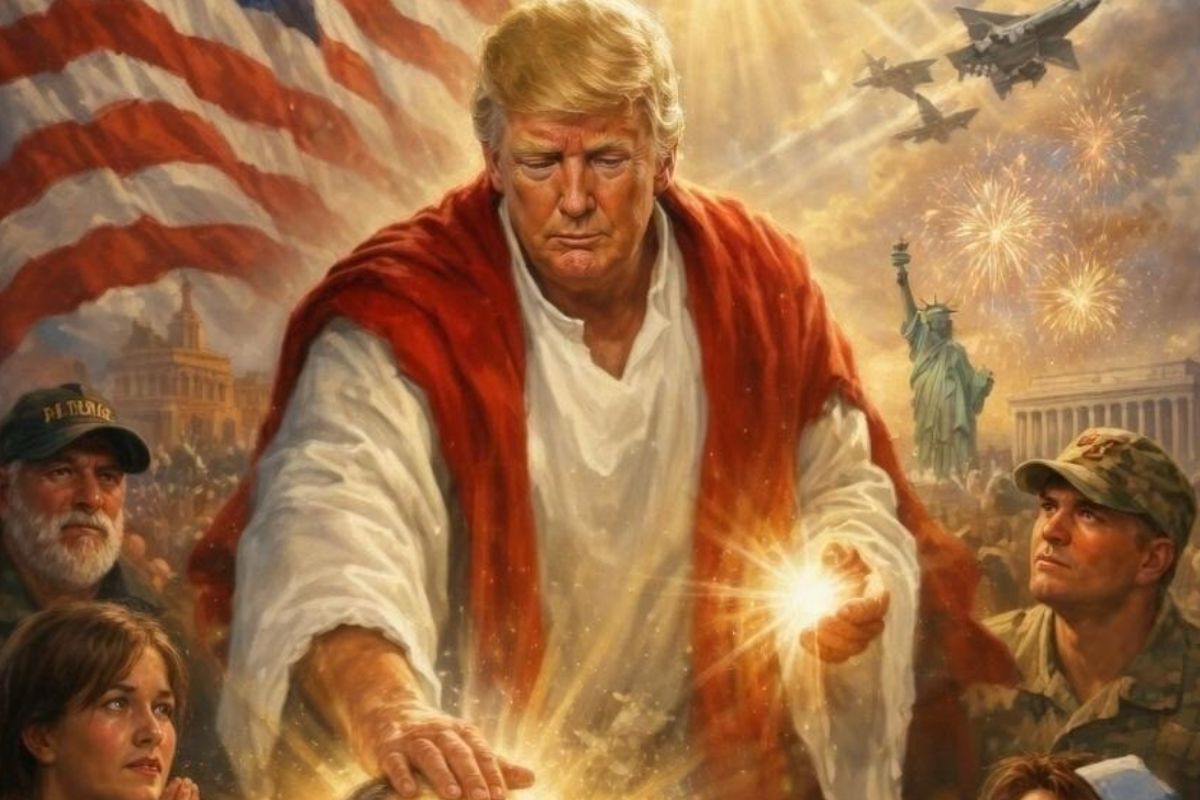
The screen glows in the dark of a suburban living room. An old man, fingers calloused from forty years of trade work, stares at a digital image that shouldn't make sense, yet feels like the most natural thing in the world. On his feed, Donald Trump sits at a table, bathed in a soft, ethereal light. Behind him stands a figure with long hair and a white robe, hands resting firmly on the former president’s shoulders.
It is a composite. A fabrication of pixels and faith. But for the man watching, it is a mirror.
We are witnessing a collision between the oldest stories we tell and the newest tools we have built. When a religion expert looks at the flood of AI-generated "Jesus and Trump" imagery, they don't just see a political meme. They see the desperate, human need for an imprimatur—the divine seal of approval on an earthly struggle. These images aren't just art; they are emotional infrastructure.
The Weight of the Halo
Think about the sheer audacity of the visual. For centuries, the iconography of Christ was managed by the Church with the strictness of a brand identity. There were rules about the tilt of the head, the color of the robes, and the specific geometry of the halo. These were meant to keep the sacred separate from the profane.
Now, that gate is gone. A teenager in a basement or a political operative in a high-rise can prompt a generator to "make Trump look like a martyr being comforted by Christ."
This isn't just about politics. It’s about the collapse of the distance between the holy and the human. When we see these images, we aren't seeing a theological argument. We are seeing a visual hug. For a segment of the population that feels the world is moving too fast—that their values are being erased and their culture is under siege—that image of Jesus placing a hand on a political leader’s shoulder acts as a psychic anchor.
It says: You are not alone. Your side is the right side.
The danger isn't in the art itself, but in what the art replaces. When a political figure is draped in the visual language of the divine, they cease to be a person who can be critiqued or a policy-maker who can be debated. They become a vessel.
The Psychology of the Shared Pixel
Consider a hypothetical woman named Martha. Martha grew up in a church where the only images of Jesus were stained glass windows, high up and untouchable. Today, she opens her phone and sees Jesus walking through a crowd of protestors alongside a man she voted for.
The image bypasses her logic. It goes straight to the amygdala.
Neuroscience tells us that our brains process images 60,000 times faster than text. By the time Martha has read a single headline about a court case or a policy shift, her heart has already registered the "truth" of the image. The image says that the struggle is cosmic. It suggests that the stakes aren't just taxes or borders, but the soul of the nation itself.
This is the power of the visual shorthand. It turns a complex, messy democratic process into a biblical epic.
The competitor’s view on this often stays on the surface, debating whether it’s "blasphemous" or "effective." But the real story is the hunger. People are hungry for a version of reality where the chaos of the news cycle is governed by a higher power. If the real world feels like a storm, these AI images are the lighthouse.
When the Metaphor Becomes the Map
We have entered an era where the metaphor has begun to dictate the reality. Historically, political leaders used religious language to garnish their speeches. A mention of "God bless America" was a polite nod to the rafters.
Today, the visual language is much more aggressive. The imagery suggests a partnership. In many of these AI-generated scenes, Jesus isn't just a distant figure; he is a co-pilot. He’s in the courtroom. He’s in the Oval Office. He’s at the rally.
This creates a peculiar kind of armor. If you believe, even subconsciously, that a leader is literally backed by the Creator of the universe, how do you process their flaws? You don't. You see those flaws as trials. You see their enemies not as political opponents, but as spiritual adversaries.
The invisible stakes here are the death of compromise. You cannot compromise with the "enemy" if you believe you are fighting alongside the Messiah. The art reinforces the wall.
The Ghost in the Machine
What is most haunting is that these images are birthed by machines that have no concept of faith. An AI doesn't know who Jesus is. It only knows that in millions of paintings across human history, a man with these features, wearing these colors, represents "Holiness" or "Authority." It synthesizes centuries of human devotion and spits it back at us to trigger a specific reaction.
It is a feedback loop of our own making. We fed the machine our sacred art, and now the machine is using that art to sell us a version of our current reality.
We are essentially talking to ourselves through a digital mask.
The experts can point to the specific theological inconsistencies—the way these images often ignore the actual teachings of the historical Jesus in favor of a "Warrior Christ" aesthetic—but that misses the point of the person scrolling on their phone at 11:00 PM. They aren't looking for a Bible study. They are looking for a reason to believe that their world still makes sense.
The Final Frame
Imagine the digital landscape as a vast, dark gallery. Every time one of these images is shared, a new light flickers on. The gallery is filling up with scenes of a divine-political hybrid that looks more like a comic book than a scripture.
We are participating in a mass-scale re-imagining of what power looks like.
The true cost isn't the "fake" nature of the photos. We all know, on some level, they aren't real photographs. The cost is the erosion of our ability to see the human in our leaders because we are too busy looking for the god.
When we stop demanding that our leaders be better men and start insisting that they be icons, we lose the very thing that makes democracy work: the understanding that we are all, every one of us, fallible.
The screen flickers. The old man in the living room hits "Share." He feels a surge of peace. Outside, the world remains as complicated and broken as it was five minutes ago, but in the palm of his hand, the savior is still standing there, his hand on the shoulder of the man on the screen, promising that none of it matters as long as you’re on the right side of the frame.
The light of the phone fades, leaving the room darker than before.