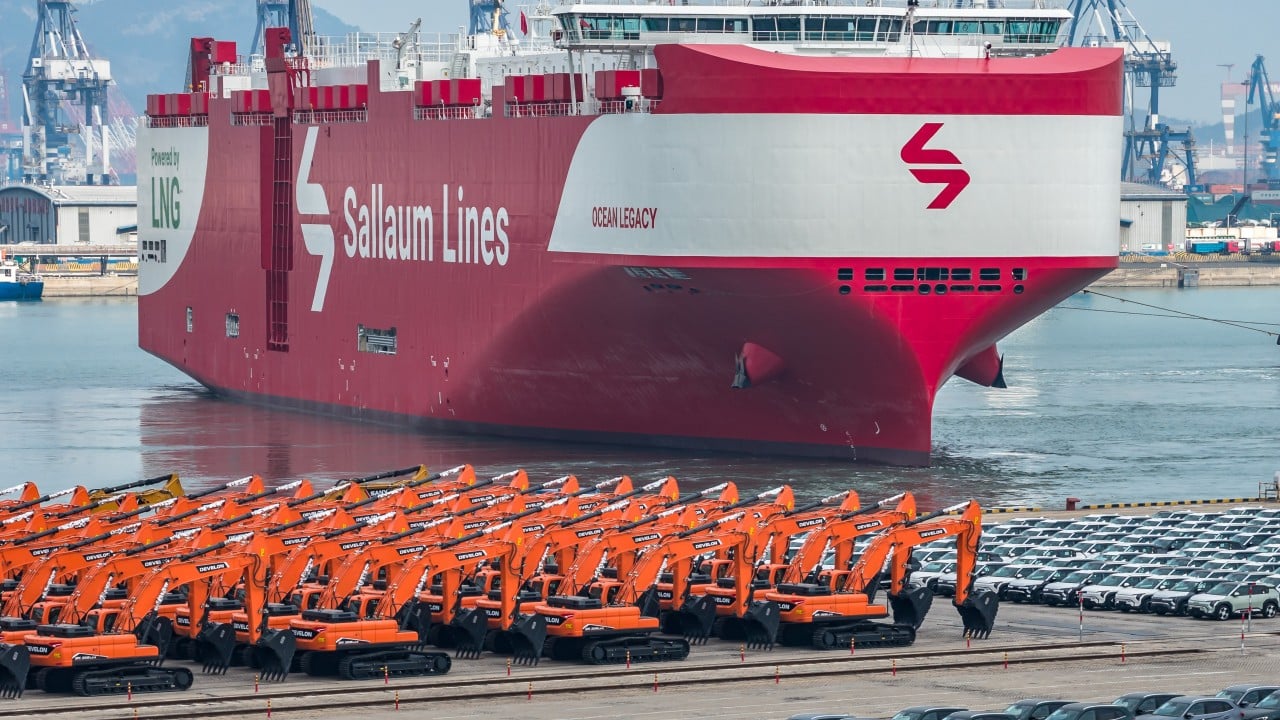
The shipping lanes through the Red Sea aren't just lines on a map anymore. They’re a choke point that’s currently strangling the idea of a frictionless global economy. If you’ve looked at a freight invoice lately, you already know the story. Regional instability involving Iran hasn’t just bumped up insurance premiums; it’s forced a fundamental rethink of how China gets its goods to the world. For decades, the "Made in China" machine relied on cheap, predictable ocean transit. That predictability is dead.
We’re seeing a massive stress test of China's export power in real-time. It’s not just about drones or missiles. It’s about the fact that the world’s manufacturing hub is geographically tethered to some of the most volatile transit corridors on earth. When the Suez Canal becomes a gamble, the entire Chinese economic model feels the heat. You can't just "pivot" millions of tons of steel, electronics, and textiles to a different continent overnight.
The Myth of the Unstoppable Export Machine
People often talk about China like it’s an invulnerable titan. It isn't. The country's economy is desperately dependent on external demand to keep its factories humming and its population employed. When conflict in the Middle East flares up, the cost of moving a container from Shanghai to Rotterdam doesn't just go up by a few hundred bucks. It triples. Or quadruples.
This isn't a theoretical problem for 2027. It's happening now. Shipping giants like Maersk and Hapag-Lloyd have spent months rerouting around the Cape of Good Hope. That adds ten days to a journey. It burns more fuel. It ties up ships that should be elsewhere. For a Chinese exporter working on razor-thin margins, those extra ten days are a death sentence for profitability. If you’re a buyer in Berlin or Paris, you start wondering if sourcing from a factory in Vietnam, Mexico, or Poland makes more sense.
China's "Belt and Road" was supposed to fix this. The idea was to build land-based alternatives—trains through Central Asia and pipelines through Pakistan. But rail can only carry a tiny fraction of what a Megamax container ship holds. You’d need thousands of trains to replace one fleet of ships. The land routes are also politically messy. Every border is a potential delay or a bribe or a localized conflict.
Why the Iran Variable Changes Everything
Iran is a "frenemy" that China can't quite control. On paper, they’re partners. China buys massive amounts of Iranian oil, often through backchannels to avoid Western sanctions. In return, Iran gets a financial lifeline. But Iran’s regional strategy often involves backing groups that disrupt the very shipping lanes China needs to stay open.
It’s a bizarre contradiction. China needs stability to sell its cars and smartphones. Iran uses instability as a geopolitical tool. Beijing has tried to play the mediator—remember the Saudi-Iran deal they brokered in 2023?—but diplomatic handshakes don't stop Houthi rebels from firing at tankers. This disconnect exposes a limit to Chinese influence. They can buy the oil, but they can't necessarily buy the peace.
If the conflict escalates further, we might see the Strait of Hormuz come into play. That’s the nightmare scenario. Roughly a fifth of the world's oil passes through there. If that closes, the energy costs for Chinese factories would skyrocket. You’d have a double whammy: it becomes more expensive to make the goods and nearly impossible to ship them.
Supply Chains are Fracturing for Good
We’ve moved past the "just-in-time" era. We’re now in the "just-in-case" era. Multinational companies are terrified of being caught with empty shelves because of a regional war they can’t control. This is fueling a trend called "China Plus One." Companies don't necessarily leave China entirely, but they stop putting all their eggs in that one basket.
Mexico is a big winner here. So is India. These countries offer something China currently can’t guarantee: a route to market that doesn't involve sailing through a combat zone. When you look at the surge in foreign direct investment in Southeast Asia, you’re seeing the physical manifestation of fear.
- Logistics costs are no longer a footnote in quarterly reports. They’re the main event.
- Transit time is becoming a competitive advantage.
- Geopolitical alignment is starting to dictate who buys from whom.
Think about the automotive industry. China is desperate to dominate the Electric Vehicle market. They’ve got the batteries and the tech. But if it costs $5,000 more to ship a car to Europe because of Red Sea diversions, that price advantage vanishes. Local European manufacturers or those shipping from North Africa suddenly look a lot more attractive.
The Rail Route Reality Check
There’s a lot of hype about the China-Europe Railway Express. It sounds great. You bypass the sea, you avoid the pirates, and you stay on land. But let’s be real. The capacity is a joke compared to ocean freight. Plus, a huge chunk of that rail line goes through Russia.
Since the invasion of Ukraine, many Western companies won't touch the Russian rail routes. They don't want the legal headache or the PR nightmare. That leaves the "Middle Corridor" through Kazakhstan, the Caspian Sea, and Turkey. It’s an infrastructure mess. You have to move goods from trains to boats and back to trains again. It’s slow. It’s expensive. It’s not a solution for mass exports.
China is stuck. They built a giant factory for the world, but they forgot that the roads leading out of that factory are owned by people who don't always get along.
What This Means for Your Bottom Line
If you’re running a business that relies on Chinese imports, you’ve got to stop assuming the prices you see today will be the prices you pay tomorrow. The era of "cheap China" was built on the back of $1,500 container rates. Those days are gone.
You need to audit your tier-two and tier-three suppliers. Where do they get their raw materials? If your "local" supplier is just assembling parts that come through the Suez Canal, you’re still at risk.
Start looking at "nearshoring" options now. It's not just a buzzword. It's a survival strategy. Whether it’s Turkey for European markets or Mexico for the US, the shorter the distance, the lower the risk.
The Iran conflict isn't just a news cycle event. It’s a signal that the old map of global trade is being torn up. China is trying to tape it back together, but the glue isn't holding. Expect more delays, higher prices, and a lot more "Made in Vietnam" labels on your doorstep.
Immediate Actions for Risk Management
Stop waiting for "things to get back to normal." Normal is gone. The first thing you should do is diversify your shipping ports. If you always ship into Long Beach or Rotterdam, look at secondary hubs that might have more flexible feeder routes.
Next, renegotiate your contracts to include "force majeure" clauses that specifically address regional blockades. You don't want to be on the hook for payments when your goods are sitting on a ship anchored off the coast of Africa for three weeks.
Finally, build up a buffer. The cost of holding extra inventory is high, but the cost of having zero inventory is much higher. Most businesses that failed during the last big supply chain crunch did so because they didn't have a thirty-day safety stock. Don't be that person. Assume the Red Sea will be a mess for the foreseeable future and plan your 2026 budget accordingly. If you aren't looking at alternative sourcing regions like Brazil or the ASEAN bloc today, you're already behind the curve.