Forty years after the reactor four core at the Chornobyl Nuclear Power Plant tore itself open, the 30-kilometer Exclusion Zone has morphed from a site of industrial catastrophe into a bizarre laboratory of human absence and geopolitical tension. While casual observers often view the area through the lens of a "nature reclaiming the ruins" narrative, the reality is far more clinical and dangerous. The soil remains a patchwork of isotopic hotspots, and the recent military occupation has proved that even a nuclear graveyard can be weaponized.
The story of Chornobyl is no longer just about 1986. It is about how we manage the eternal remains of a failed empire and the terrifying realization that "safe" is a relative term when dealing with a half-life of 24,000 years. For an alternative perspective, check out: this related article.
The Myth of the Reclaimed Wilderness
Travel agencies and photographers love to promote the image of the Exclusion Zone as a lush, green Eden where wolves and Przewalski's horses roam free of human interference. This is a half-truth that masks a grimmer biological reality. While the absence of people has allowed wildlife populations to expand, these animals are living in a chronic experiment of low-dose radiation exposure.
Biologists have documented higher rates of albinism, smaller brain sizes in birds, and a significant decrease in the abundance of insects and spiders in the most contaminated sectors like the Red Forest. The trees themselves refuse to rot at a normal rate because the fungi and microbes responsible for decomposition are also suffering from radiation damage. This creates a massive fire hazard. A single forest fire in the Zone doesn't just burn wood; it aerosolizes the Cesium-137 and Strontium-90 trapped in the leaf litter, sending radioactive smoke drifting toward Kyiv and beyond. Related reporting on the subject has been shared by NBC News.
The "return to nature" is a superficial mask over a stagnant ecosystem. We aren't looking at a thriving forest. We are looking at a landscape that has been chemically paused.
The Sarcophagus and the Billion Dollar Band-Aid
In 2016, the New Safe Confinement (NSC) was slid into place over the crumbling 1986 concrete sarcophagus. It is a marvel of engineering, a massive arch designed to last 100 years. However, the NSC is not a solution. It is a containment vessel. Inside, the original structure is still decaying, and the corium—the lava-like mixture of melted fuel, sand, and concrete—remains largely unreachable and volatile.
The international community spent over $1.6 billion on this arch, but the funding for the next phase is precarious. To truly "solve" Chornobyl, the melted fuel must be removed, stabilized, and moved to a permanent geological repository. Currently, no such repository exists in Ukraine that can handle that level of high-level waste. We have essentially built a very expensive garage for a car that is still on fire.
The Geopolitics of a Hot Zone
The 2022 invasion of Ukraine by Russian forces fundamentally changed the security calculus of the Exclusion Zone. For weeks, the world watched in horror as tanks rolled through the Red Forest, kicking up radioactive dust that had been settled for decades. Trenches were dug in some of the most contaminated soil on the planet.
This wasn't just a military blunder. It was a demonstration of how the Exclusion Zone serves as a strategic corridor. The shortest route from the Belarusian border to Kyiv runs directly through the heart of the Zone. The reactors, once symbols of Soviet progress, are now hostages of war. The occupation led to the loss of monitoring data and disrupted the essential maintenance of the cooling systems for spent fuel.
Even now, after the liberation of the site, the threat remains. The Zone is heavily mined. The infrastructure used by scientists to monitor radiation levels was looted or destroyed. We are now more blind to the movements of the radiation than we were five years ago.
The Human Cost of Staying Behind
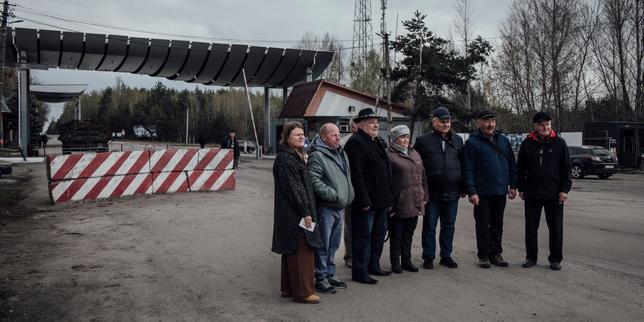
Beyond the scientists and the soldiers, there are the Samosely—the self-settlers. These are mostly elderly residents who refused to leave their ancestral homes or returned shortly after the evacuation. For decades, they lived on a diet of garden vegetables and well water, both of which contain measurable levels of radionuclides.
Their survival has often been used by pro-nuclear advocates to suggest that the dangers of radiation are overblown. This is a dangerous simplification. The Samosely are a self-selecting group of survivors with specific genetic resilience or simply a high tolerance for chronic illness that goes unreported in rural settings. Their existence does not negate the fact that the Zone remains legally uninhabitable for a reason.
The Ethics of Disaster Tourism
Before the full-scale war, the Exclusion Zone had become a bucket-list destination for "dark tourists." People paid hundreds of dollars to take selfies in the abandoned classrooms of Pripyat or to stand in front of the iconic Ferris wheel.
This commercialization of tragedy raises a difficult question: Does tourism help preserve the memory of the disaster, or does it turn a graveyard into a theme park? The "Chornobyl Brand" has often prioritized aesthetics over education. Tours focus on the haunting decay of gas masks and doll heads—often staged by previous visitors—rather than the complex environmental and health data that scientists are still struggling to interpret.
Engineering the Eternal
The technical challenge of Chornobyl is moving from containment to remediation. This requires more than just steel arches. It requires a long-term commitment to robotics and remote handling. The radiation levels inside the reactor hall are still high enough to fry the electronics of standard robots.
Ukraine is currently testing specialized drones and crawlers designed to map the "fuel-containing materials" (FCMs) inside the reactor. This data is vital. If the FCMs turn to dust, they could be released into the atmosphere if the inner sarcophagus collapses. The clock is ticking on the internal structures, which are held up by little more than gravity and hope.
The Nuclear Renaissance and the Chornobyl Shadow
As the world looks toward small modular reactors and new nuclear technology to combat climate change, Chornobyl remains the ultimate counter-argument used by skeptics. However, the industry argues that the RBMK reactor design was fundamentally flawed and that modern Western reactors have passive safety systems that make a Chornobyl-style event physically impossible.
This misses the point of the Chornobyl lesson. The disaster wasn't just a failure of physics; it was a failure of governance, transparency, and safety culture. A perfectly designed reactor can still be compromised by human error, political pressure, or military conflict. The Exclusion Zone is a monument to the fact that when nuclear technology fails, the consequences outlast the civilizations that built them.
The Waste Problem That Won't Die
Ukraine is now home to the Centralized Spent Fuel Storage Facility (CSFSF) within the Zone. This facility is intended to store spent fuel from Ukraine's other operating nuclear plants, ending their dependence on Russia for fuel processing.
While this is a win for energy independence, it further concentrates the nation's nuclear risk into a single, vulnerable geographic area. We are essentially doubling down on the Exclusion Zone as the permanent waste bin of the country. This creates a "sacrifice zone" that will likely never be returned to normal use.
The Invisible Legacy
When you walk through the streets of Pripyat, the silence is heavy. It isn't just the absence of noise; it's the weight of a missing future. 50,000 people were cleared out of this city in a single afternoon. They left behind a life that was supposed to be the pinnacle of Soviet achievement.
The true legacy of Chornobyl is the erosion of trust. It taught the world that a government would prioritize its image over the lives of its citizens. The four-day delay in admitting the scale of the disaster led to thousands of unnecessary cases of thyroid cancer in children who were allowed to drink contaminated milk while the Kremlin stayed silent.
The Reality of the 40 Year Mark
As we approach the four-decade milestone, we must stop treating Chornobyl as a historical event. It is a live, unfolding process. The Exclusion Zone is a laboratory for the Anthropocene, showing us exactly what remains when we are gone: plastic, concrete, and isotopes.
The focus must shift from gawking at the ruins to the grueling, unglamorous work of waste management and environmental monitoring. The international community cannot afford to look away just because a new arch is in place. Chornobyl is not "fixed." It is merely muffled.
The radioactive elements buried in the soil of the Exclusion Zone don't care about borders, wars, or the lifespan of a democratic state. They only care about the relentless, ticking clock of physics. If we fail to maintain the site, the forest fires of the future or the next military incursion will remind us that the dragon is still very much alive under its steel cage.
The most urgent task is the dismantling of the unstable structures within the New Safe Confinement. This work is dangerous, expensive, and technically daunting. It requires a level of international cooperation that is currently strained by global conflicts. Yet, the cost of inaction is a second disaster that would make the first one look like a rehearsal.
We have spent forty years mourning the past in Pripyat. It is time we start worrying about the next ten thousand years. Physical containment is a temporary mask for a permanent problem. The only way forward is a cold-eyed, well-funded, and permanent commitment to the science of the aftermath. Stop looking at the ferris wheel and start looking at the sensors.