The wind off the water in Nampo does not care about geopolitics. It is a biting, salt-crusted chill that cuts through heavy wool coats and chaps the skin of dockworkers who have spent decades riveting steel in the shadow of the West Sea Barrage. On a morning dictated entirely by the meticulous scheduling of state advance teams, this biting wind carried the scent of fresh, synthetic gray paint.
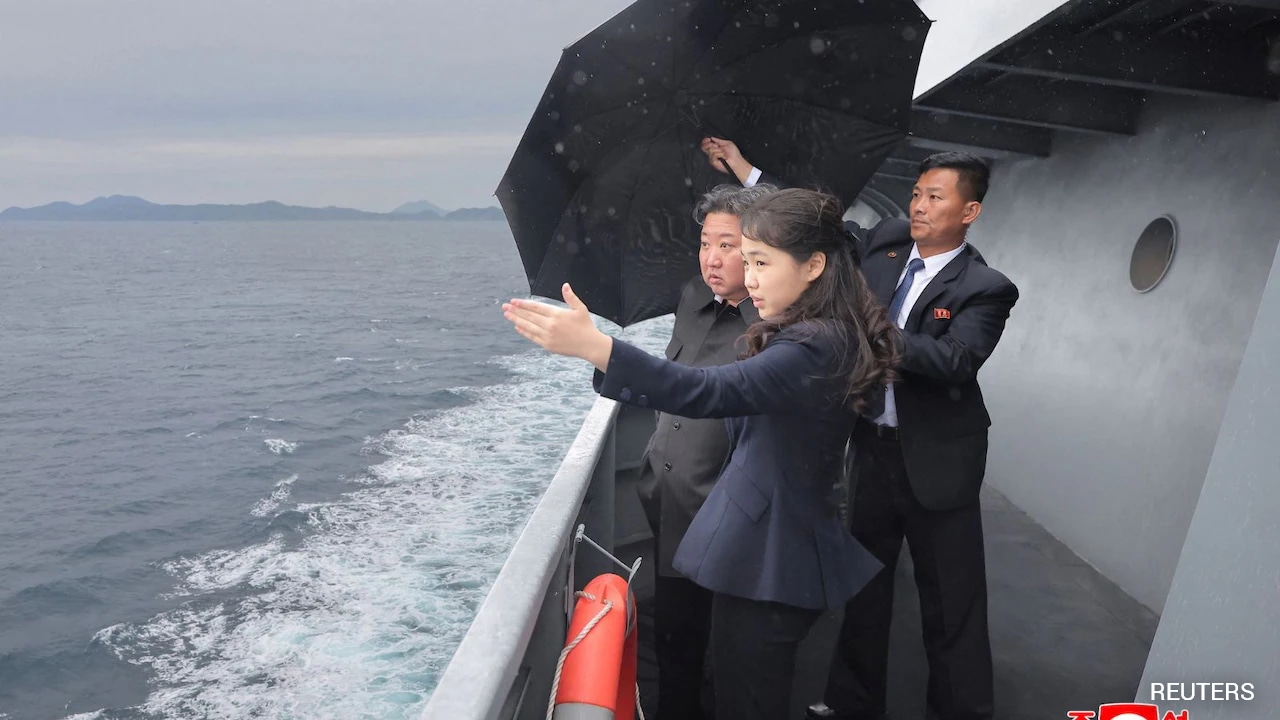
A new warship sat tied to the concrete pier. Its lines were sharp, angular, and aggressively modern, designed to deflect radar waves and project an image of absolute self-reliance. Standing on the deck, dwarfed by the superstructure, was Kim Jong Un. For another perspective, consider: this related article.
To the casual observer scanning global headlines, this was just another Tuesday in East Asia. Another photo op. Another piece of military hardware rolled out to rattle the cages of Washington, Seoul, and Tokyo. But military analysts who spend their lives staring at grainy satellite imagery did not look at the guns. They looked at the timing. They looked at the empty seat across the ocean in Beijing.
This vessel was not built to win a war against the United States Navy. It was built to buy respect from the one man whose nod dictates the economic survival of the entire hermit kingdom: Xi Jinping. Further reporting on the subject has been published by TIME.
The Theater of Sovereignty
Consider the quiet panic of a junior intelligence analyst staring at a monitor in Seoul. For months, commercial satellites had tracked a strange shape under construction at the Nampo shipyard. In the insular world of naval architecture, a country’s economic health is laid bare by its keel lines. If a nation is struggling for fuel, its ships sit rusting. If its steel foundries are failing, the hulls warp under the strain of substandard alloys.
Yet, there it was.
The state media broadcasted images of the supreme leader walking the pristine teak decks, gesturing toward the horizon with a cigarette burning down between his fingers. The narrative delivered to the citizens of Pyongyang was one of triumphs born from hardship. But the real problem lies elsewhere, far beneath the propaganda machine's glossy veneer.
North Korea operates on a ledger of extreme precarity. Every calorie consumed, every liter of heavy oil burned in a generator, and every sheet of specialized steel used to forge a missile tube requires a nod of acquiescence from China. Beijing is the lungs through which Pyongyang breathes. This dependency creates an agonizing friction for a regime whose entire foundational mythos is built on Juche—absolute, unyielding self-reliance.
Imagine the psychological tightrope. You must beg your neighbor for grain to keep your capital city from starving, but you must also convince that same neighbor that you are a fierce, independent nuclear power worthy of an alliance, not a client state to be managed.
The new warship is a physical manifestation of that tightrope. It is a message wrapped in steel, launched precisely as diplomatic advance teams finalized the itinerary for a high-level Chinese delegation to Pyongyang.
The Invisible Stakes on the Water
Western commentators often make the mistake of viewing North Korean military advancements through a purely destructive lens. They count the anti-ship cruise missiles. They measure the displacement of the hull. They argue about whether the automated fire-control systems actually work or if the radar domes are merely fiberglass shells hiding outdated Soviet tech.
But focusing on the hardware misses the human drama playing out in the diplomatic backrooms.
When a superpower looks at a troubled neighbor, it looks for liability. For years, Beijing’s greatest fear has not been a democratic Korean peninsula, but a chaotic collapse on its northeastern border—a scenario that would send millions of refugees streaming across the Yalu River and place American troops directly on China's frontier. To prevent this, China feeds the regime. It keeps the lights on, barely.
But that charity comes with profound condescension. Chinese diplomats have long viewed their North Korean counterparts as erratic, expensive dependents who break the rules and bring international scrutiny down on the region.
Now, look at the deck of that warship through Xi Jinping’s eyes.
The message Kim Jong Un is sending is subtle, dangerous, and remarkably clever. He is showing that despite years of maximum pressure campaigns, despite crushing international sanctions that should have paralyzed his heavy industry, his shipyards can still turn out a modern surface combatant. It is an assertion of agency. It says: We are not your buffer state. We are a power in our own right, and you must treat us as equals.
Copper Pipes and Empty Stomachs
The technical reality of building a ship like this is dizzying. Modern naval vessels are not just floating pieces of metal; they are dense, incredibly complex networks of fiber-optic cables, sonar arrays, engine cooling systems, and electronic warfare suites.
To understand how difficult this is, consider the international embargo. Under United Nations sanctions, North Korea is prohibited from importing nearly everything required to build a modern machine. Precision CNC milling tools from Germany? Banned. Advanced marine radar components from Japan? Banned. High-grade marine lubricants? Banned.
To build a warship under these conditions requires an underground economy of terrifying efficiency. It means smuggling components across the East China Sea via ship-to-ship transfers in the dead of night, turning off transponders, and falsifying manifests. It means taking consumer-grade electronics bought through shell companies in Shenzhen and ruggedizing them in hidden workshops in Pyongyang to survive the corrosive salt air of the ocean.
Every copper pipe running through the belly of that hull represents a choice. It represents capital that could have bought fertilizer for failing farms in the southern provinces. It represents resources diverted from repairing a decrepit civilian electrical grid that plunges entire cities into darkness the moment the sun drops below the mountains.
The cost is human, paid in the quiet endurance of a population that has learned to survive on promises of national glory while watching the smoke rise from defense plants.
The Calculus of the Guest
When the Chinese delegation arrives in Pyongyang, there will be grand banquets. There will be synchronous card-turning displays in the stadium, and there will be toasts to the "immortal, blood-forged friendship" between the two nations.
But behind the smiles, the atmosphere will be cold.
China is currently navigating its own delicate economic transition, balancing fractured relations with Europe and a tense, low-boil trade war with the West. The last thing Beijing wants is an unpredictable ally dragging it into a maritime crisis in the Yellow Sea. Xi Jinping desires stability above all else. He wants North Korea to be quiet, obedient, and out of the headlines.
Kim Jong Un knows this. He also knows that quiet dependency is a slow death sentence for his regime.
By showcasing this warship, he forces China’s hand. He demonstrates that North Korea has the domestic capability to escalate, to build, and to project power independently. He tells his patron that if they want a stable border, they cannot treat Pyongyang like an afterthought. They must pay for that stability with better trade deals, more oil, and diplomatic cover at the United Nations security council.
It is a masterclass in weak-state diplomacy: using your very volatility as leverage against a much larger neighbor who has too much to lose.
The Wake Behind the Hull
Late in the afternoon, the official photography wrapped up. The state media crews packed away their lenses, and the heavy black sedans idled on the pier, waiting to carry the leadership back to the secure compounds of the capital.
The ship remained tied to the dock, its gray silhouette sharp against the darkening sky.
In a few days, the Chinese diplomats will look out over the water, perhaps during a curated tour designed to show off the regime’s modernization efforts. They will see the new hull. They will understand the engineering miracles required to build it under the nose of global intelligence agencies, and they will recognize the defiance woven into its very welds.
The ship may never fire a shot in anger. It may spend most of its operational life tied to a pier to conserve precious diesel fuel, acting more as a floating battery than a true blue-water combatant. But its first mission—its true mission—is already complete.
The iron has been cast, the paint has dried, and the message has been delivered across the water to Beijing. In the high-stakes theater of East Asian survival, the currency isn't gold or goodwill. It is the cold, unmistakable weight of defiance floating in the harbor.