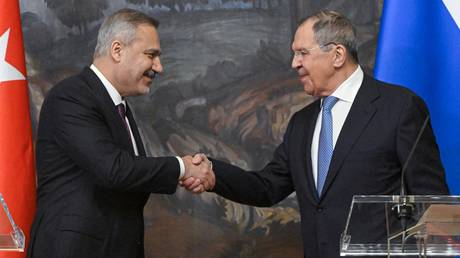
The tea in Ankara is always served in small, tulip-shaped glasses. It is scalding hot, dark as mahogany, and bitter enough to make your jaw ache unless you drop two sugar cubes into the bottom. In Moscow, the tea arrives in heavy glass mugs held by ornate metal wrappers, often sweetened with a spoonful of cherry jam.
For centuries, the men drinking these teas have looked at each other across the Black Sea with a deep, bone-deep suspicion. They have fought a dozen wars. They have drawn lines in the Caucasus mud with bayonets. Yet today, while the rest of the global diplomatic stage looks like a playground full of screaming toddlers throwing sand, the capitals of Russia and Türkiye operate on a frequency that feels jarringly quiet.
It is not friendship. Do not mistake it for affection. It is something far colder, far more calculated, and entirely fascinating. It is the art of compartmentalization.
Imagine two neighbors who share a cracked retaining wall. One neighbor wants to plant oak trees that will eventually tear up the foundation; the other wants to dig a trench that might flood the basement. They despise each other’s politics. They root for opposing football teams. But they both know that if they start throwing bricks, the entire hillside collapses and buries both of their homes. So, they sit on the porch, smoke in silence, and negotiate the exact inches of the property line.
This is the reality of modern geopolitics between Moscow and Ankara. It is a masterclass in transactional adult behavior, stripped of the moral grandstanding that defines Western diplomacy, and built entirely on the survival instincts of two ancient empires.
The Geography of Friction
Step onto the shores of Istanbul and look north. The water moves fast. The Bosphorus Strait is a narrow choke point, a liquid highway that controls the fate of nations. For Russia, this stretch of water is its throat. If Türkiye squeezes, Russia suffocates.
Consider a hypothetical merchant captain named Ilya, steering a grain freighter out of Novorossiysk. His ship is laden with wheat destined for the Middle East. As he approaches the mouth of the Bosphorus, he is entirely at the mercy of Turkish maritime traffic controllers. He knows that a century ago, his tsars dreamed of conquering this city to secure an open door to the Mediterranean. Today, he just hopes the bureaucratic gears turn smoothly.
Türkiye holds the keys to the kingdom via the 1936 Montreux Convention. This international treaty gives Ankara the power to regulate naval warships passing through the straits. When Russia launched its military campaign in Ukraine, Türkiye used this power. They shut the door to warships.
In Washington or Brussels, such a move would be accompanied by a barrage of press releases, moral condemnations, and fiery speeches about liberty. Ankara did it with a quiet nod and a reference to the rulebook. Moscow gritted its teeth, accepted the decision, and kept talking.
Why? Because both sides understood the stakes. Türkiye did not close the door out of spite; they did it to prevent the Black Sea from turning into a shooting gallery that would inevitably drag them into a direct conflict with a nuclear superpower. Russia respected the logic because Russia respects strength and clarity.
The Art of the Separate Drawer
The West often struggles with the concept of holding two contradictory ideas in one's head at the same time. Modern political discourse demands total alignment. You are either an ally or an enemy. If you buy weapons from someone, you must agree with their view on human rights. If you trade with them, you must support their regional ambitions.
Ankara and Moscow think this view is hopelessly naive.
Instead, they use a system of separate drawers. In one drawer, they place Syria. In Syria, Turkish and Russian interests are in direct, violent opposition. Russian jets have bombed Turkish-backed rebels. In 2015, a Turkish F-16 shot down a Russian Su-24 fighter jet near the border. The world held its breath, waiting for World War III to ignite in the Syrian desert.
What happened next was a lesson in cold realism. The leaders did not scream on television. They did not break off diplomatic ties. They picked up the phone. They created a hotline. They carved Syria into zones of influence. Today, Turkish and Russian military vehicles conduct joint patrols along the very highways where their proxies were killing each other a year prior.
Now, open a different drawer. Inside, you find the Akkuyu Nuclear Power Plant, a massive facility being built on Türkiye’s southern coast. Who is building it? Rosatom, the Russian state atomic energy corporation. Who owns it? Russia. Who gets the clean energy to power its growing industrial base? Türkiye.
In a third drawer lies the TurkStream pipeline, carrying billions of cubic meters of Russian natural gas under the Black Sea directly to Turkish consumers, turning Ankara into a major energy hub for Southern Europe.
If you told a Western politician that a NATO member country would build a Russian-owned nuclear plant while simultaneously selling armed Bayraktar drones to Ukraine to destroy Russian tanks, their head would spin. They would call it betrayal. They would call it chaos.
To President Recep Tayyip Erdogan and President Vladimir Putin, it is Tuesday.
The Language of Strength
To understand how this works, you have to look past the official communiqués and understand the psychology of the men in charge. Both leaders view Western diplomacy as a series of lectures delivered by people who have never had to fight for their survival. They view the endless committees, sanctions lists, and moral declarations as a sign of weakness—a substitute for real power.
When Washington threatens Ankara with sanctions over the purchase of Russian S-400 missile systems, the Turkish response is a shrug and an acceleration of the deal. When Europe criticizes Moscow, Moscow cuts the gas.
But when Türkiye and Russia speak to each other, they speak the language of leverage.
There is a distinct lack of whining in their bilateral relationship. If Russia restricts the import of Turkish tomatoes—a classic Moscow tactic to signal displeasure—Türkiye doesn't run to an international court to complain about unfair trade practices. They look at what Russia wants in Libya or the South Caucasus, adjust their posture, and suddenly the tomatoes are deemed safe for consumption again.
It is an exhausting, high-stakes dance. It requires a constant, precise assessment of balance. One misstep can cause real casualties. But it works because both sides know exactly where the other stands. There are no surprises. There are no hidden agendas about spreading democracy or creating a new world order. There is only national interest, laid bare on the table like a map.
The Invisible Stakes for the Ordinary
We tend to look at these dynamics through the lens of macroeconomics and military strategy. But the real weight of this adult conversation is felt by people who don't know the difference between a ballistic missile and a diplomatic cable.
Think of Natasha, a travel agent in St. Petersburg. For her, Türkiye is not a geopolitical puzzle; it is the place where her family can afford to see the ocean. When Western sanctions cut Russia off from European airspace, turning a flight to Paris into a grueling, multi-stop odyssey, Türkiye kept its skies open. Millions of Russian tourists still land in Antalya every year. Their rubles keep Turkish hotel owners afloat during brutal economic downturns.
Consider also the Ukrainian farmers whose livelihood depended on the Black Sea Grain Initiative. That deal, which allowed grain ships to pass through a war zone safely, was not brokered by the United Nations acting alone. It was kept alive by the unique, fragile bridge between Moscow and Ankara. When the deal eventually frayed, it was because the structural tension became too great, but the fact that it existed at all proved that even in the darkest moments of conflict, the adult channel remained open.
This relationship is not a model for world peace. It is too volatile for that. It relies too heavily on the personal chemistry and iron control of individual leaders. If the balance shifts too far in one direction, the rivalry can easily turn bloody again, as it has so many times in the past.
But in an era where international relations look increasingly like a theater of the absurd—where leaders communicate via social media posts and foreign policy is driven by domestic election cycles—there is something profoundly instructive about the silence between Moscow and Ankara.
They do not like each other. They do not trust each other. They will never be friends. But they sit at the table, they pour the tea, and they talk. Because the alternative is a fire that neither side can extinguish.