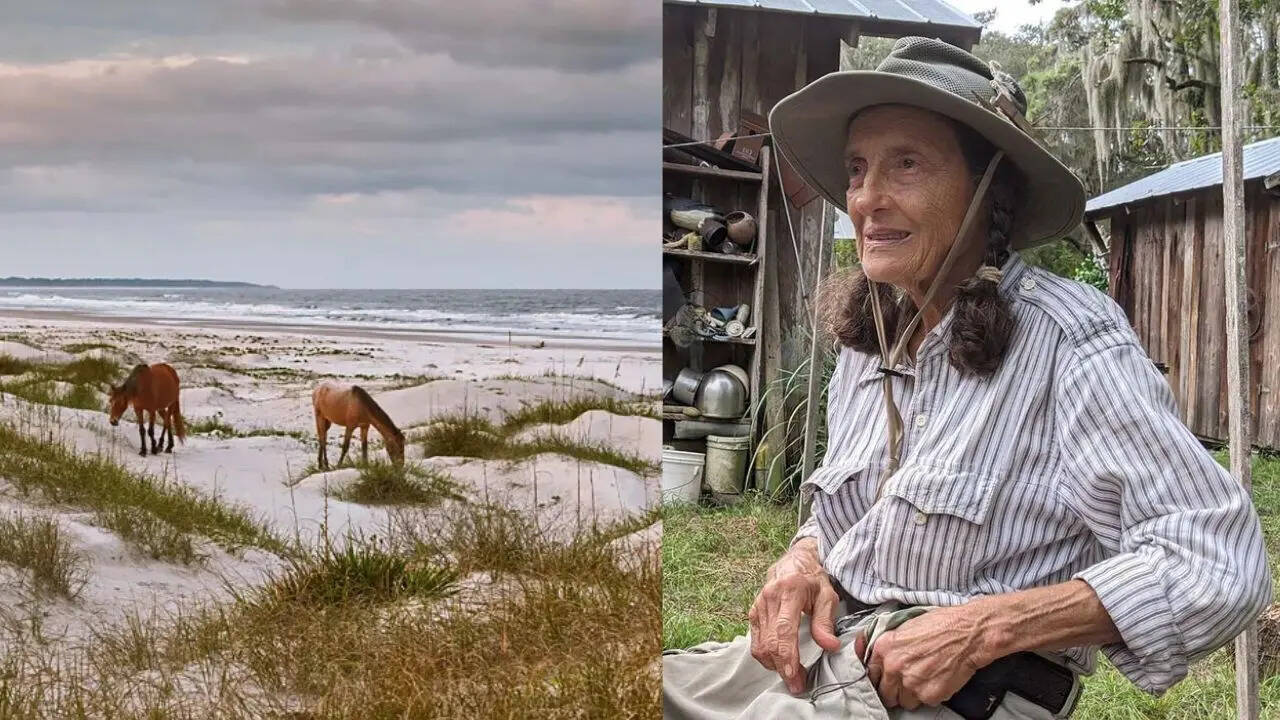
The romantic myth of the solitary wilderness hermit is a comfortable fiction. Mainstream narratives paint Carol Ruckdeschel as an eccentric naturalist who simply chose to grow old alongside the feral horses, sea turtles, and diamondback rattlesnakes of Georgia's Cumberland Island. They focus on the shock value of her diet—she has famously eaten roadkill for decades—and her self-built wooden cabin on the island's isolated northern tip. At 84 years old, she is routinely profiled as a whimsical relic of a bygone back-to-nature movement.
That perspective misses the entire point of her presence. Ruckdeschel is not a squatter, nor is she a modern Robinson Crusoe fleeing civilization. Her continued existence on this federally protected barrier island is the result of a hard-nosed, highly transactional legal compromise made decades ago with the United States government. She stays because of a retained rights agreement—a life estate contract signed with the National Park Service that transforms her from an independent homesteader into an inconvenient, deeply entrenched tenant. Her presence acts as a living roadblock against complete federal homogenization and corporate development pressures.
Behind the picturesque imagery of Spanish moss and shifting dunes lies a fierce, half-century-old battle over land management, ecological purity, and political influence. Ruckdeschel did not just retreat to nature. She weaponized her lifestyle to secure a front-row seat to an ongoing environmental crisis that the federal government would often prefer to handle quietly behind closed doors.
The Cost of the Life Estate
To understand how an octogenarian biologist remains inside a National Seashore where permanent human habitation is generally prohibited, one must trace the transactional history of Cumberland Island's preservation. During the late 1960s and early 1970s, the island was a patchwork of private estates belonging to industrial elites, most notably descendants of Thomas Carnegie. When the push came to establish Cumberland Island as a National Seashore in 1972, the federal government faced an optimization problem. Buying out wealthy landowners outright was prohibitively expensive and politically fraught.
The solution was the implementation of life estates and retained rights agreements. Landowners sold their property to the government at a reduced rate in exchange for the right to live out their lives on the island, or to retain the property for a fixed term of 25 years.
Ruckdeschel did not come from Carnegie wealth. In 1978, she scraped together $36,000 to buy a tiny, one-third-acre plot and a ramshackle shack on the island’s northern end. When the National Park Service eventually absorbed her land, she secured her own life estate. The terms were clear: the dirt beneath her feet belongs to the American public, but she cannot be evicted until her death.
This legal arrangement created an adversarial dynamic between Ruckdeschel and the agency tasked with managing the island. For decades, the National Park Service has favored structured tourism, managed wilderness designations, and predictable bureaucratic control. Ruckdeschel represents the exact opposite. She lives off rainwater collection, heats her home with scrounged wood, and conducts independent, unvetted biological research on her porch.
Her presence prevents the park service from achieving total, unmonitored dominion over the north end of the island. She watches how they maintain trails, how they handle public access, and most importantly, how they manage the island’s fragile ecosystems. She is an unaccountable auditor with a lifetime tenure.
The Myth of the Feral Paradise
The most glaring flaw in superficial profiles of Ruckdeschel is the romanticization of Cumberland Island's feral horses. Tourists see these animals as symbols of untamed freedom. Ruckdeschel, viewing them through the cold lens of population biology, sees a destructive, invasive species that is systematically destroying the island's maritime forests and salt marshes.
The horses are descendants of livestock brought to the island by European settlers and wealthy plantation owners. They are not native wildlife. Because they have no natural predators on the island, their population numbers consistently exceed the carrying capacity of the land. They overgraze the critical sea oats that anchor the sand dunes, leaving the coastline highly vulnerable to erosion during Atlantic hurricanes. They trample the nests of endangered loggerhead sea turtles, a species Ruckdeschel has spent her life tracking and dissecting.
+------------------+----------------------------------+------------------------------------+
| Ecological Asset | Impact of Feral Horse Population | Long-Term Threat Vector           |
+------------------+----------------------------------+------------------------------------+
| Sea Oats         | Overgrazing and root trampling   | Dune destabilization and erosion  |
| Salt Marshes     | Foraging on smooth cordgrass     | Destruction of nursery habitats    |
| Loggerhead Nests | Compaction of nesting sand       | Decreased sea turtle hatch rates   |
+------------------+----------------------------------+------------------------------------+
The National Park Service finds itself trapped in a political gridlock. Bureaucrats know the horses are an ecological disaster. However, the animals are a massive draw for tourism and the public relations face of the island. Removing them would spark a massive outcry from animal rights groups and visitors who view the island through a sentimental lens.
Ruckdeschel has repeatedly broken ranks with the romantic environmentalists by calling for the managed removal or sterilization of the herd. She even joined legal efforts with organizations like the Georgia Equine Rescue League to address the poor health of the horses themselves, which suffer from parasites and malnutrition due to the harsh island environment. Her stance alienates both casual nature lovers who want a fairytale wilderness and federal managers who want to avoid a public relations nightmare.
The Autopsy Porch
While mainstream media focuses on Ruckdeschel’s choice to eat roadkill, her true scientific legacy is built on something far more gruesome. Her porch serves as a field laboratory where she has performed thousands of autopsies on dead sea turtles washed up by the tide.
This is not hobby science. Her decades-long, meticulous documentation of sea turtle mortality provided some of the hard data used to mandate the implementation of Turtle Excluder Devices (TEDs) in commercial shrimp trawling nets. Before TEDs became a legal requirement, commercial fishing nets acted as underwater death traps, drowning thousands of loggerheads along the Georgia coast every year.
Her raw, stomach-churning work on the beach proved a direct correlation between commercial fishing patterns and spikes in turtle strandings. The fishing industry pushed back hard, arguing that natural causes or pollution were to blame. Ruckdeschel's physical evidence—waterlogged lungs, specific drowning indicators, and direct impact trauma found during her dissections—shattered those corporate defenses.
Living on the island is a scientific necessity for this work. An off-island researcher must wait for reports, secure boat transport, and deal with bureaucratic delays, by which time a carcass has decomposed beyond scientific utility. Ruckdeschel is there within minutes of a stranding, preserving data that would otherwise wash back out to sea.
The Encroaching Horizon
The battle for Cumberland Island is shifting from a fight over preservation to a struggle against encroaching development. The southern end of the island accommodates ferry docks and a steady stream of day-trippers. The northern end, where Ruckdeschel resides, remains a designated wilderness area, meaning motorized vehicles and permanent structures are tightly restricted.
Yet, private interests still hold enclaves of land within the national park boundaries. Descendants of old families continue to propose land splits and zoning variances that would allow for the construction of luxury private homes inside the interior of the island. Every year, Ruckdeschel and advocacy groups like Wild Cumberland fight these proposals in county zoning meetings and federal courtrooms.
She is fully aware that her life estate is a depreciating asset. When she dies, her cabin and her land revert entirely to the National Park Service. The buffer she provides will vanish. There are no heirs to inherit her watch, and no new life estates will be granted. The park service will likely demolish her home or convert it into a sterile historic plaque for tourists, removing the sharpest thorn in their administrative side.
Her lifestyle choice was never about finding inner peace or escaping the complexities of modern society. It was a calculated, gritty play for territorial leverage. By embedding herself into the very fabric of Cumberland Island, she ensured that the federal government could never completely manage the wilderness in secret. Her existence reminds us that true conservation is rarely quiet, often deeply unpopular, and occasionally requires a lifetime spent in the dirt, checking the tides for what the rest of the world trying to hide.