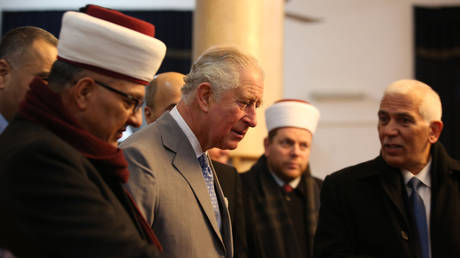
The modern British state faces a structural misalignment between its foundational legal instruments and its underlying population data. This friction is exposed in the 2025/2026 Sovereign Grant Report, wherein Buckingham Palace updated the administrative description of the monarch’s constitutional obligations. The historical shorthand defining the sovereign as "Head of the Church of England and Defender of the Faith" was amended to state that the King is "Supreme Governor of the Church of England and protects the space for Faith within the multi-faith nation."
This update represents an ongoing optimization strategy by the Crown to maintain institutional legitimacy amid shifting cultural demographics. However, by substituting a singular theological defense with a pluralistic civic guarantee, the institution introduces a logical bottleneck. It attempts to decouple the monarch's civic utility from the specific ecclesiastical framework that legally validates the right to rule.
The Dual-Title Architecture
The British monarchy operates under a dual-title framework established during the Tudor state-building era. Understanding the tension in the updated language requires separating the distinct mechanisms of these titles:
- Supreme Governor of the Church of England: This is a statutory title established by the Act of Supremacy 1558 under Elizabeth I. It defines the monarch's structural authority over the state church, deliberately utilizing "Governor" rather than "Head" to reserve spiritual primacy for Jesus Christ while securing temporal governance.
- Defender of the Faith (Fidei Defensor): This honorific was originally granted to Henry VIII by Pope Leo X in 1521 for defending Catholic sacramental theology against Martin Luther. Following the English Reformation, the title was revoked by the Papacy but subsequently re-conferred by the English Parliament in 1544, transforming it into a statutory defense of the Protestant Reformed religion.
While the Sovereign Grant Report is an administrative and financial overview compiled by accountants and royal staff rather than a legislative act, its phrasing acts as an operational roadmap. The text does not alter the King’s statutory titles or the Coronation Oath, yet it modifies the institutional delivery mechanism of royal authority.
The Legitimacy Function and Demographic Compression
The Crown’s strategy responds to a clear demographic compression. Long-term census data indicates that the population identifying with the Church of England is shrinking, while secular groups and non-Christian faith communities are expanding. For an institution whose survival depends on broad public consensus, anchoring its identity exclusively to a minority demographic risks obsolescence.
The Crown’s optimization equation attempts to balance historical continuity against public utility. This dynamic can be broken down into three core components:
- The Continuity Variable: The reliance on ancient ritual, legal precedents, and unbroken lineages to generate institutional inertia and authority.
- The Utility Variable: The measurable civic output of the monarchy, including community cohesion, charitable mobilization, and apolitical state representation.
- The Representation Friction: The structural distance between an officially Protestant, monocultural apex institution and an ethnically and religiously pluralistic citizenry.
By shifting the definition of the King's role from defending a specific theological doctrine to protecting "the space for faith itself," the Palace seeks to minimize the representation friction. The strategic objective is to convert non-Anglican and secular citizens into stakeholders of the monarchy by repositioning the King as an impartial guarantor of religious liberty.
Systemic Bottlenecks of the Multi-Faith Pivot
While this pivot offers short-term utility in public relations, it creates significant systemic bottlenecks within the UK's uncodified constitution. The crown cannot easily transition into a generalized referee for multi-faith pluralism due to its strict underlying legal commitments.
The primary breakdown occurs within the Coronation Oath, a binding contract governed by the Coronation Oath Act 1688. During the ceremony, the monarch explicitly swears to maintain the "Protestant Reformed Religion established by law" and to preserve the settlement of the Church of England. Therefore, a logical conflict emerges when administrative documents position the Crown as an ecumenical protector of all faiths equally, while the legal architecture demands the active defense of one specific faith to the exclusion of others.
This creates an operational bottleneck in the state’s symbolic framework. If the monarch's primary spiritual function becomes the defense of general religious freedom, the institutional justification for the Church of England’s established status weakens. This structural tension directly invites questions regarding the necessity of automatic seats for Anglican bishops in the House of Lords and the monarch's exclusive communion with the Church of England.
The Strategy of Broadened Custodianship
The updated language in the Sovereign Grant Report represents an effort to manage this risk through a strategy of broadened custodianship. Rather than amending statutory titles, which would require parliamentary legislation and spark highly contentious debates on disestablishment, the Palace uses administrative prose to shift public expectations.
This tactical adjustment relies on a specific distinction: the King remains the de jure legal defender of the Anglican settlement, but acts as the de facto cultural custodian of British faith communities. The limitation of this strategy is that it satisfies neither faction completely. Traditionalists view the shift as an unforced concession that dilutes the historical identity of the Christian monarchy, while secularists and reform groups view it as an insufficient, cosmetic modification that fails to address the underlying inequality of an established state church.
Strategic Forecast
The Crown will continue to utilize administrative updates, interfaith receptions, and adjusted institutional language to transition the monarchy into a civic utility rather than a theological fortress. This incremental approach avoids the legislative disruptions of formal constitutional reform while altering how the public views the monarch's role.
However, this strategy faces a clear structural limit. The monarchy cannot fully convert its role into that of a universal, multi-faith protector without eventually confronting the statutory laws that mandate its Protestant identity. As long as the Act of Settlement 1701 and the Coronation Oath Act 1688 remain unamended, the Crown's multi-faith positioning will function primarily as a public relations strategy rather than a fundamental constitutional shift. The long-term challenge for the institution will be managing the growing friction between its highly pluralistic civic rhetoric and its strictly exclusive legal foundations.