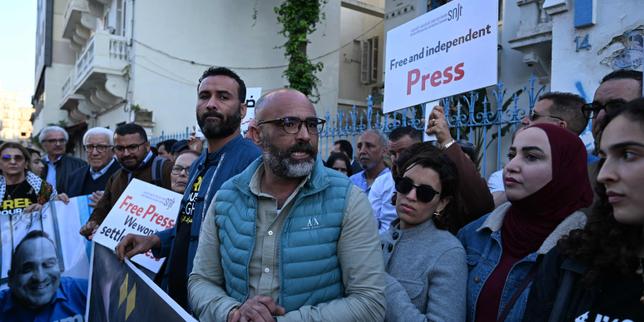
The arrest and continued detention of Mourad Zeghidi in Tunis marks a definitive shift in the North African nation’s relationship with the free press. Zeghidi, a veteran journalist with a high profile in both Tunisia and France, was swept up by authorities not for a grand conspiracy or violent incitement, but for the modern sin of critical commentary. This is no longer a matter of temporary judicial oversight. It is a structural demonstration of power.
Zeghidi stands accused under the infamous Decree 54, a piece of legislation ostensibly designed to combat cybercrime and "fake news," but which has morphed into a versatile tool for state-sponsored censorship. Specifically, his detention stems from media statements and social media posts where he analyzed the political and socio-economic direction of the country. By holding a prominent figure like Zeghidi—who has worked for major outlets such as Canal+ and various Tunisian radio stations—the state sends a shockwave through the entire media ecosystem.
The Mechanics of a Media Crackdown
To understand why Zeghidi is behind bars, one must look at the legal machinery being used against him. Decree 54, enacted in September 2022, carries heavy prison sentences for anyone found guilty of spreading what the government deems "false information." The problem lies in the definition. The law does not distinguish between a factual error and a dissenting opinion.
The judicial process in these cases follows a predictable, grim pattern. First comes the summons, often based on a complaint filed by a public official or a government body. This is followed by a period of "preventive detention," a tactic used to remove a voice from the airwaves immediately without needing a formal conviction. For Zeghidi, this means his seat on the popular "Noujoum" program remains empty, serving as a daily visual reminder to his colleagues of the risks associated with open debate.
The chilling effect is the intended product. When a journalist of Zeghidi’s stature is detained for mere analysis, the average reporter thinks twice before questioning inflation figures or criticizing executive decisions. This is "soft" censorship through hard legal consequences.
The Death of the Post-Revolutionary Dream
For a decade, Tunisia was the sole success story of the Arab Spring, at least regarding civil liberties. The media blossomed. New stations appeared, and the "red lines" of the Ben Ali era seemed to have vanished forever. We are now seeing the systematic dismantling of that legacy.
The current administration argues that these measures are necessary to maintain "national sovereignty" and protect the public from "chaos." However, the reality on the ground suggests that sovereignty is being conflated with total immunity from criticism. Zeghidi’s detention is not an isolated incident; it coincides with the arrest of other high-profile figures like Borhen Bssais, suggesting a coordinated effort to clear the board of influential commentators before major political milestones.
This isn't about one man. It is about the definition of truth in a state that is increasingly sensitive to its own failures. Tunisia’s economy is struggling, with high unemployment and a debt crisis that threatens basic services. In such a climate, a journalist who connects the dots between policy and poverty becomes a threat.
The International Dimension and the French Connection
Zeghidi’s dual nationality adds a layer of diplomatic complexity that the Tunisian government seems willing to ignore. Typically, having French citizenship provides a degree of "visibility protection." The Quai d’Orsay is forced to pay attention. Yet, the Tunisian judiciary has proceeded with a bluntness that suggests they are no longer concerned with Western optics.
This defiance is a calculated move. By ignoring the traditional diplomatic pressure that usually accompanies the arrest of a dual national, the Tunisian state is signaling its pivot away from European norms of governance. They are betting that the world’s attention is too fragmented—distracted by conflicts in Gaza and Ukraine—to mount a significant defense of a single journalist in Tunis.
The Vanishing Middle Ground
The tragedy of the Zeghidi case is that he was never a radical. He was a professional. He represented the "center"—the intellectual space where policy is debated with facts and historical context. By criminalizing this middle ground, the state forces the population into a binary choice: total silence or underground resistance.
The courts have repeatedly rejected requests for Zeghidi’s release. Each denial reinforces the narrative that the judiciary is no longer an independent arbiter but an extension of executive will. When the law becomes a weapon rather than a shield, the very concept of a "republic" begins to dissolve.
Journalists in Tunis now operate in a climate of pervasive paranoia. They check their phones for tracking, they use encrypted apps for basic coordination, and they weigh every adjective in their scripts against the potential years of prison time it might carry under Decree 54. This is the exhaustion of a profession.
The international community often talks about "democratic backsliding," but that term is too clinical for what is happening here. This is a targeted, manual override of a country’s vocal cords. Mourad Zeghidi’s cell is a message written in the ink of state power, intended for anyone who still believes that a microphone is a tool for accountability.
The trial of Zeghidi is not just a legal proceeding; it is a stress test for the remaining fragments of Tunisian civil society. If a man with his resources, his international profile, and his decades of experience can be silenced for a few sentences uttered on a radio show, then no one is safe. The message from the Ministry of Justice is clear: the era of the analyst is over. The era of the echo chamber has begun.
Expect the pressure to increase as election cycles approach. The state has found its rhythm with Decree 54, and it is unlikely to stop until the airwaves are scrubbed clean of anything resembling a hard question.