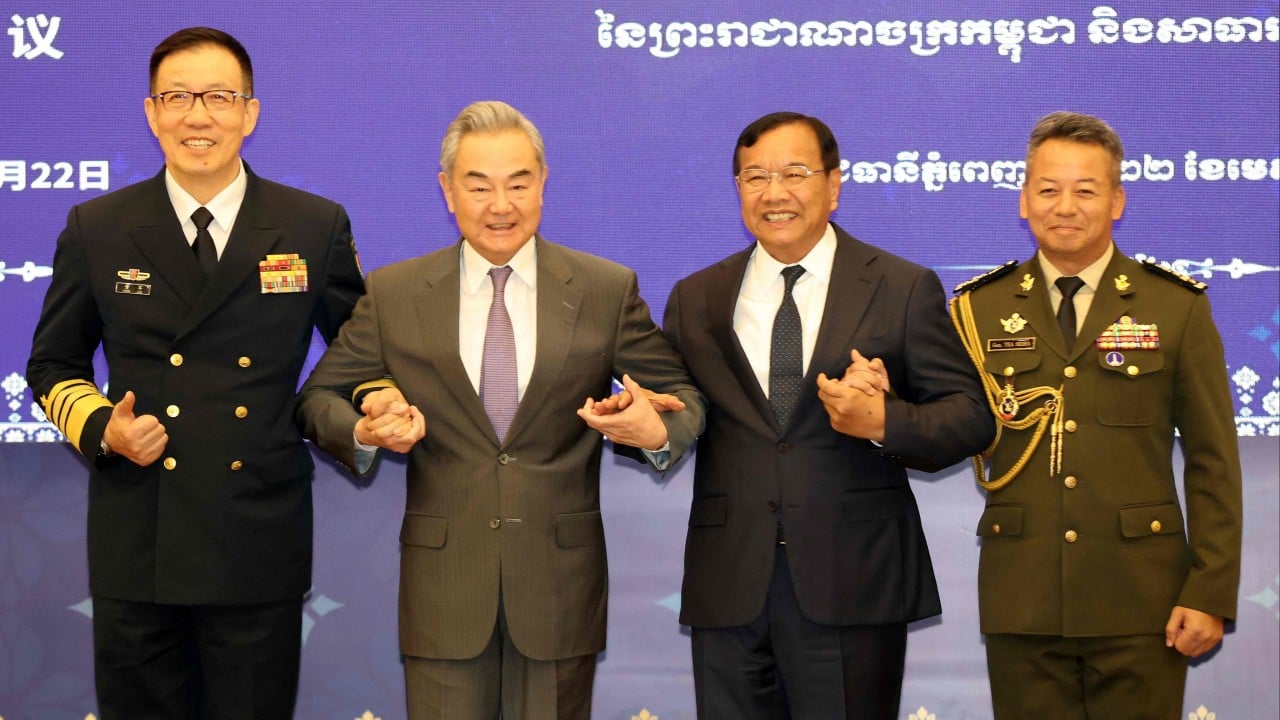
China is pressuring Cambodia to enter a "shared security" pact that effectively integrates the Southeast Asian nation into Beijing’s defensive perimeter. This isn’t just a diplomatic request; it’s an ultimatum born of shifting global tensions and the hardening of regional blocs. Beijing wants to ensure that as Western pressure mounts, Cambodia remains a reliable, fortified outpost. To understand why this is happening now, one must look past the official handshakes and focus on the infrastructure of dependence that has been decades in the making.
Phnom Penh has long been Beijing’s most reliable proxy within ASEAN. But the nature of that relationship is changing from one of financial patronage to one of direct military and internal security integration. When Chinese officials speak of "shared risks," they are signaling that Cambodia’s sovereignty is now tied to the survival and success of the Chinese Communist Party’s regional strategy. Expanding on this topic, you can find more in: The Brutal Math of the Shahed Attrition War.
The Ream Naval Base and the Shadow of Permanent Presence
The most visible sign of this security merger is the Ream Naval Base. For years, officials in Phnom Penh denied that the base would host Chinese military assets, citing the Cambodian constitution’s ban on foreign military bases. Those denials have evaporated as Chinese warships have become a semi-permanent fixture at the newly expanded pier.
The pier is long enough to accommodate aircraft carriers. That isn't a coincidence. By securing a footprint at Ream, Beijing gains a strategic vantage point near the Malacca Strait and the South China Sea. This isn't just about ships; it is about the "Five-Year Plan for Military Cooperation" which seeks to standardize training, equipment, and command structures between the People’s Liberation Army (PLA) and the Royal Cambodian Armed Forces (RCAF). Analysts at USA Today have also weighed in on this trend.
When the RCAF adopts Chinese communication hardware and tactical software, they are not just buying gear. They are locking themselves into an ecosystem. Once a military is integrated into a specific technological stack, switching costs become prohibitive. Cambodia is currently being wired into a system where its eyes and ears are manufactured in Shenzhen.
Economic Coercion Masked as Development
The "shared security" narrative is the defensive shell for a massive economic engine. Cambodia’s debt to China is estimated to be roughly 40% of its total foreign debt. This creates a feedback loop where Phnom Penh must comply with security demands to ensure the continued flow of credit and the deferment of existing obligations.
The Belt and Road Initiative (BRI) has paved the country with highways and powered it with dams, but these projects often come with "security attachments." Chinese-funded special economic zones (SEZs) function almost as extraterritorial enclaves. In these zones, Chinese security firms—many staffed by former PLA officers—operate with significant autonomy. This creates a fragmented sovereignty where the Cambodian state governs the people, but Beijing governs the infrastructure.
The Digital Iron Curtain
Security in 2026 is as much about data as it is about boots on the ground. China is helping Cambodia build its National Internet Gateway. This isn't merely a technical upgrade; it’s a blueprint for social control. By centralizing all international web traffic through a single point, the Cambodian government gains the ability to monitor and throttle dissent in real-time.
Beijing views this as a security measure. In their eyes, a stable Cambodia is a Cambodia where the ruling elite cannot be challenged by Western-backed color revolutions. By exporting their surveillance tech, China ensures that the leadership in Phnom Penh remains indebted and ideologically aligned. This is the "shared risk" in practice—if the Cambodian government falls, a vital piece of China’s regional security architecture collapses with it.
The RCAF Transition to Chinese Standards
The transformation of the Cambodian military is nearly complete. We are seeing a total replacement of aging Soviet and limited Western equipment with modern Chinese platforms.
- Main Battle Tanks: The RCAF has integrated Type 92 and Type 90 AFVs.
- Air Defense: Transitioning to KS-1A and FM-90 surface-to-air missile systems.
- Small Arms: Standardizing on the QBZ-series rifles.
This hardware transition dictates the doctrine. When Cambodian officers go to Beijing for training, they learn to fight the way the PLA fights. They use the same maps, the same satellite navigation (Beidou), and the same encryption protocols.
Western Miscalculations and the Empty Seat at the Table
Washington and Brussels have spent the last decade trying to use human rights as a lever to pull Cambodia back into the democratic fold. It failed. Every time the West pulled back or imposed sanctions, Beijing moved in with an open checkbook and no questions asked.
The suspension of Cambodia’s "Everything But Arms" (EBA) trade status by the EU was intended to punish the government for democratic backsliding. Instead, it accelerated the pivot to China. The Cambodian leadership realized that their economic survival depended on the China-Cambodia Free Trade Agreement rather than Western benevolence.
The ASEAN Fracture
Cambodia’s alignment with China has effectively neutralized ASEAN’s ability to form a united front on the South China Sea. As a consensus-based organization, ASEAN cannot act if one member dissents. Cambodia has repeatedly played the role of the spoiler, ensuring that any joint statements regarding Chinese maritime aggression are watered down or blocked entirely.
This isn't just about being "pro-China." It’s about a calculated realization by the Hun Manet administration that the US security umbrella is inconsistent, whereas China’s proximity and presence are permanent.
Internal Risks of the Shared Security Model
There is a danger in this level of intimacy. The "shared security" model assumes that the interests of the Cambodian elite will always align with Beijing’s global ambitions. However, the heavy presence of Chinese organized crime, unregulated gambling hubs in Sihanoukville, and the resulting local resentment create a volatile internal environment.
If a local backlash against Chinese influence turns violent, Beijing faces a dilemma. Does it intervene to protect its citizens and assets, thereby proving it views Cambodia as a vassal state? Or does it let the Cambodian government struggle, risking the "shared security" they have worked so hard to build?
The "Golden Dragon" military exercises are no longer just drills; they are rehearsals for domestic stabilization. The PLA is training the RCAF not for a war against a foreign invader, but for the protection of Chinese-funded assets within Cambodian borders.
The Architecture of Total Alignment
The shift we are witnessing is the end of Cambodian neutrality. The rhetoric of "shared security" is a polite way of describing a client-state relationship where the junior partner provides the geography and the senior partner provides the muscle and the money.
Phnom Penh has bet everything on the idea that the 21st century belongs to Beijing. They have integrated their communications, their currency, their military hardware, and their internal surveillance systems with the Chinese model. There is no easy way to undo this. Every new pier at Ream, every new server in the National Internet Gateway, and every new loan agreement further cements this reality.
Cambodia is no longer just a neighbor to the superpower; it is becoming a functional extension of its defensive and economic apparatus. This is the price of "shared security"—a loss of independent movement in exchange for a guaranteed place in the new regional order.