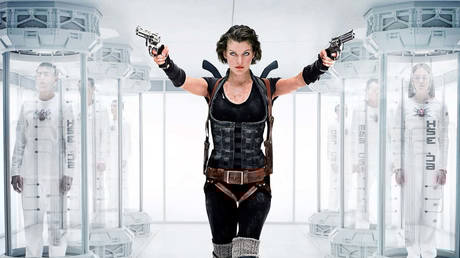
The announcement of a generative AI project by a high-profile actor—specifically Milla Jovovich—marks a transition from experimental deepfakes to the institutionalization of the "Synthetic Persona." This is not an aesthetic shift; it is a fundamental reconfiguration of the labor economics within the entertainment industry. When a performer licenses their likeness to an AI model, they are decoupling their earning potential from their physical presence. This creates a tripartite value structure consisting of the biological original, the mathematical model, and the resulting digital output.
Understanding this shift requires a breakdown of the three pillars of synthetic asset management: Meanwhile, you can read similar stories here: The Night the Vault Doors Stayed Open.
- The Sovereignty of Data: The transition of a human face and voice into a proprietary dataset.
- Computational Scalability: The ability to deploy a likeness across infinite media streams simultaneously without additional physical exertion.
- Legal Encumbrance: The contractual framework that determines who owns the "weights and biases" of an actor's digital representation.
The Unit Economics of the Synthetic Actor
Traditional film production relies on a linear cost function. For every hour an actor works, the production incurs costs related to salary, insurance, logistical support, and physical space. The actor’s output is capped by biological limits—fatigue, aging, and the inability to be in two locations at once.
The introduction of a verified AI project, such as the Jovovich initiative, shifts this to a non-linear model. The primary cost is front-loaded into the "Training Phase." Once a high-fidelity digital twin is established, the marginal cost of producing additional content drops toward zero. This creates a massive incentive for talent agencies to pivot from "booking agents" to "asset managers." To see the full picture, check out the detailed article by ZDNet.
The Scalability Matrix
The utility of a digital twin is measured by its performance across three specific vectors:
- Linguistic Versatility: The capacity to output high-fidelity voice performances in hundreds of languages while maintaining the unique tonal inflections of the original actor.
- Temporal Agelessness: The removal of biological time as a constraint, allowing a 48-year-old actor to perform in roles requiring a 25-year-old version of themselves without the uncanny valley associated with traditional CGI.
- Interactivity: The ability to deploy the likeness in real-time environments, such as gaming or personalized marketing, where a static video file would be insufficient.
Defining the Synthetic Labor Bottleneck
The primary friction point in this technological adoption is not the software capability, but the "Fidelity-Control Tradeoff." High-end generative models often struggle with consistency. If an actor’s digital twin produces a frame that looks "off," the brand equity of that actor is diluted.
The Three Layers of Control
- The Geometry Layer: This involves the 3D mesh of the actor’s skull and musculature. It ensures that any digital performance adheres to the physical realities of the person’s face.
- The Texture Layer: This handles skin micro-expressions, light scattering (subsurface scattering), and the imperfections that signal "humanity" to the viewer’s brain.
- The Behavioral Layer: This is the most complex. It involves training an AI on the specific "acting choices" of a performer—their unique pauses, eye movements, and emotional triggers.
Without these three layers working in sync, the AI project remains a novelty rather than a professional-grade asset. The Jovovich project suggests an attempt to bridge the gap between these layers by utilizing high-quality reference data from her extensive filmography.
The Intellectual Property Crisis of the Weight-Space
The most significant risk in the "Resident Evil" star's foray into AI is the definition of ownership over the trained model. Historically, an actor owns their image. However, a generative AI model is a collection of weights—numerical values within a neural network.
If a studio helps fund the creation of an actor's digital twin, a conflict of interest arises. Does the studio own the model? Does the actor? This creates a "Data Lock-in" effect. If the model is proprietary to a specific tech firm or studio, the actor becomes an employee of their own digital ghost, unable to move that asset to another platform or production house.
Tactical Risk Variables for Talent
- Derivative Rights: The right to create "new" performances that the actor never actually filmed.
- Ethical Guardrails: Strict limitations on the type of content the AI can generate, preventing the likeness from being used in politically sensitive or adult-oriented material without explicit per-instance consent.
- Revenue Distribution: A shift from "day rates" to "API call royalties," where the actor is paid every time their digital twin is accessed or rendered.
The Bifurcation of the Entertainment Market
The deployment of these AI projects will likely lead to a split in the labor market. We are seeing the emergence of "Tier 1: Biological Premiums" and "Tier 2: Synthetic Volume."
Tier 1 will consist of high-prestige, "all-human" productions where the physical presence of the actor is a marketing point. Tier 2 will encompass high-volume content: mobile gaming, localized advertising, and iterative franchise films. The Jovovich project is a strategic hedge against the devaluation of Tier 2 labor. By owning the digital twin, the performer can capture the value of the "Volume" market without sacrificing the time required for "Prestige" projects.
Causality: Why Actors are Moving Now
The timing of these AI initiatives is a direct reaction to the stabilization of Latent Diffusion Models and Neural Radiance Fields (NeRFs). Previously, creating a digital human required a multi-million dollar VFX budget and a "mo-cap" suit. Now, consumer-grade hardware can run models that achieve 80% of the same fidelity.
The move by stars to debut their own "official" AI projects is an offensive maneuver to set a market standard before the "unofficial" (pirated) AI models become indistinguishable from the real thing. It is an attempt to exert "First-Mover Authority" in a space that is currently a legal vacuum.
The Feedback Loop of Synthetic Content
- Data Ingestion: Decades of film footage are fed into a specialized model.
- Refinement: Humans (often the actors themselves) "rate" the outputs to align the AI with their personal brand.
- Deployment: The model is integrated into a production pipeline.
- Data Recycling: New synthetic footage is used to further refine the model, creating a self-improving loop of digital mimicry.
Strategic Recommendation: The Asset-First Approach
For performers and production entities, the path forward is not to resist the technology but to treat the digital likeness as a separate corporate entity.
- Infrastructure Autonomy: Performers must own the "Base Model" of their likeness. This model should be stored in a hardware-secure environment, not on a studio's server.
- Granular Licensing: Contracts must move away from "all media now known or hereafter devised" and toward "specific-use tokens." A license to use an AI face for a 30-second localized ad in Tokyo should be distinct from a license to use it in a feature film.
- Hybrid Performance Protocols: The most successful implementations will likely be "Puppetry Models," where a lower-cost human actor provides the movement and emotional base, and the celebrity's digital twin is "mapped" over them. This maintains the physical nuance of a human performance while providing the brand power of a star.
The "Resident Evil" star's AI project is the first visible crack in the traditional talent-contracting dam. The bottleneck is no longer the technology—it is the speed at which the legal system can define the "soul" of a mathematical model. The winners in this new economy will be those who treat their digital twin not as a tool, but as an appreciating capital asset that requires its own management, security, and independent legal standing.