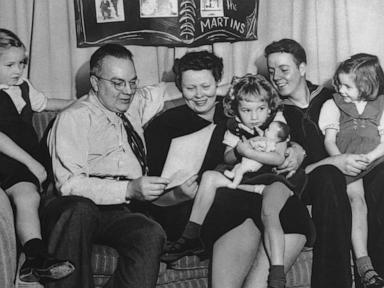
The Columbia River kept a secret for over six decades, but it couldn't hide from modern forensic science. For sixty-six years, the disappearance of the Martin family remained Oregon's most haunting mystery. On December 7, 1958, Kenneth and Barbara Martin and their three daughters vanished while searching for Christmas greenery. They left behind a half-decorated house and a world of questions. Now, we finally have the truth about the remains found in the water.
This isn't just a cold case update. It's a testament to the fact that time doesn't erase evidence; it just waits for technology to catch up. DNA testing recently confirmed that skeletal remains discovered in the Columbia River belong to the missing family. Skeptics long wondered if they were murdered or if they fled. The reality is both simpler and more tragic.
Why the Martin Family Mystery Haunted Oregon for Decades
Imagine a typical 1950s Sunday. The Martin family—Kenneth, Barbara, and their daughters Barbie, Susan, and Virginia—piled into their 1954 Ford station wagon. They headed toward the Columbia River Gorge to gather greens for holiday decorations. They didn't come home.
The initial search was massive. Police found tire tracks near a cliff edge leading into the river. They even found a blood-stained handgun nearby, which sent the investigation down a rabbit hole of foul play theories. But the river was deep, the current was fast, and the technology of 1958 was primitive. Divers searched, but they found nothing. A few months later, the bodies of Susan and Virginia washed up miles apart. The rest of the family stayed lost.
The case went cold. It stayed cold for a lifetime. People speculated about local outlaws or family secrets. But those theories ignored the most likely culprit: a tragic accident on a slick road.
The Science That Brought the Martin Family Home
Solving a case this old doesn't happen with a magnifying glass. It happens in a lab. DNA forensics has undergone a massive shift in the last five years. We've moved past simple matching to advanced genetic genealogy.
The remains in question were actually found years ago, but they were unidentifiable at the time. They sat in storage, labeled as "John Doe" or "Jane Doe." Forensic anthropologists eventually revisited these cases. They extracted DNA from degraded bone fragments, which is no easy feat.
Think about the environment. Bone in water for decades breaks down. The DNA becomes fragmented. Labs now use "Massively Parallel Sequencing" to piece together these tiny, damaged strands of genetic code. They compared the results to modern DNA databases and living relatives. The match was definitive. It wasn't a guess. It was a biological certainty.
The Problem With Cold Case Investigations Today
You might think every old case should be solved by now. It doesn't work that way. The biggest hurdle isn't always the science; it's the bureaucracy and the lack of funding. Many police departments have thousands of unidentified remains sitting in lockers. They don't have the budget to run a $5,000 DNA test on every single one.
Another issue is the chain of custody. If evidence was handled poorly in 1960, it might be contaminated today. We're lucky the Martin family evidence was preserved well enough to yield results. Most families of the "long-term missing" never get this kind of closure. They're stuck in a limbo where they know their loved ones are likely dead but can't prove it.
Why Genomic Sequencing is the Real Game Changer
Standard CODIS testing—the kind police used in the 90s—is limited. It looks for specific markers. If you don't have a direct sample from the victim to compare it to, you're stuck. Modern forensic genealogy looks at the whole picture. It finds cousins, second cousins, and distant relatives. It builds a family tree backward until it finds a hole where a missing person should be.
This technology is what caught the Golden State Killer, and it's what finally gave Kenneth and Barbara Martin their names back. Honestly, if we doesn't invest more in these labs, thousands of other families will die without knowing what happened to their parents or siblings.
Lessons Learned From the Columbia River Tragedy
We can't change what happened in 1958, but we can change how we handle mysteries today. The Martin case proves that "unsolvable" is a temporary state. If you have a missing person in your family history, don't assume the trail is dead.
- Upload your DNA to public databases. Services like GEDmatch or FamilyTreeDNA allow law enforcement to search for missing persons. You could be the link that identifies a distant relative found decades ago.
- Preserve physical evidence. If you have items belonging to a missing person, keep them in a cool, dry place. Hairbrushes or old envelopes can sometimes provide the reference DNA needed to close a case.
- Push for cold case reviews. Local sheriffs respond to public interest. If a community keeps asking about an old case, it's more likely to get the funding for modern testing.
The Martin family's story ended at the bottom of a river, but their legacy is now a part of forensic history. It's a reminder that every "John Doe" has a name and a family waiting for them. The next time you hear about a discovery like this, remember it took 66 years of patience and a massive leap in human ingenuity to make it happen. Stop waiting for the news to find you. If you have an unsolved story in your family tree, look into forensic genealogy now.