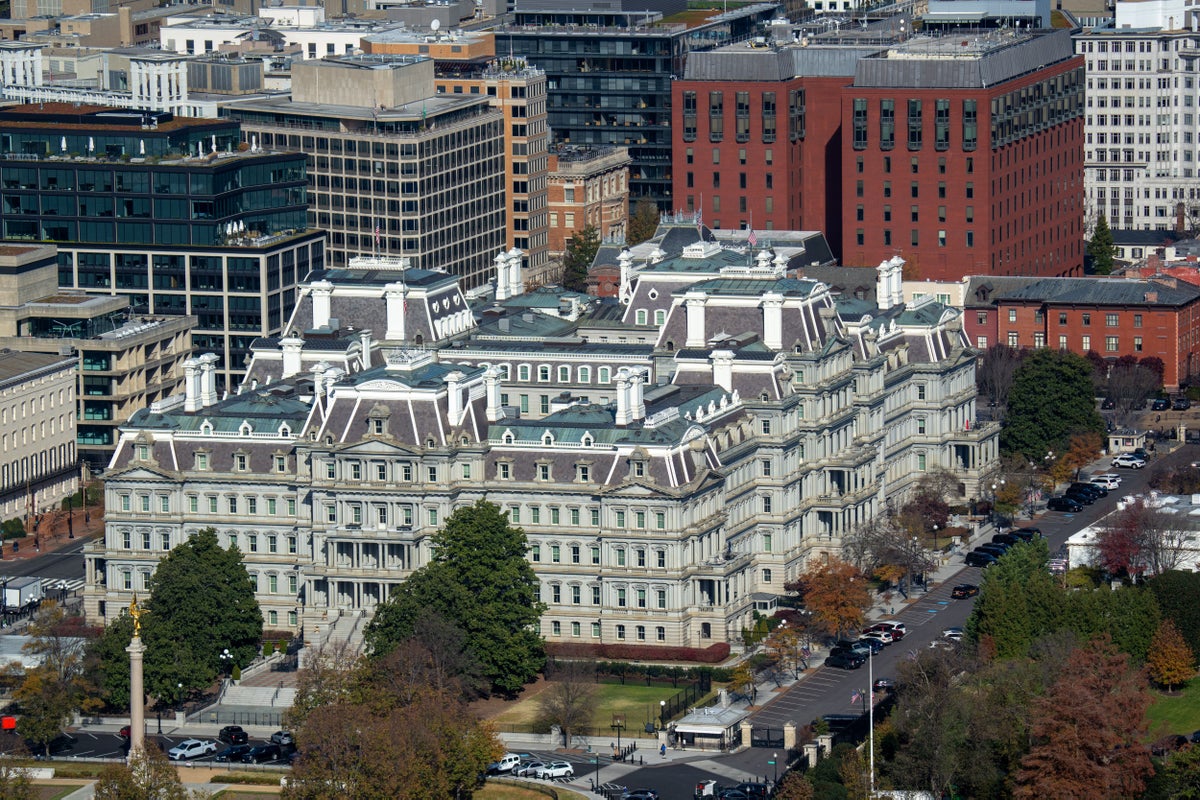
Donald Trump wants to paint the Eisenhower Executive Office Building (EEOB). To the casual observer, this sounds like a minor real estate whim, the kind of aesthetic gripe a billionaire developer might have about a neighbor’s fence. But in the high-stakes world of Washington power dynamics and federal preservation, it is a declaration of war against the architectural identity of the executive branch. Trump has characterized the massive, granite Second Empire-style structure as an "eyesore" that clashes with the pristine white facade of the White House. He has already gone as far as submitting preliminary plans to give the building a massive facelift, one that would likely involve a light-colored wash or paint to "unify" the 17th Street corridor.
The EEOB is not just another office block. It is a French Renaissance-inspired fortress that houses the heartbeat of the Vice President’s office, the National Security Council, and the Office of Management and Budget. Since its completion in 1888, it has stood as a defiant, ornate contrast to the neoclassical simplicity of the White House. While Trump views this contrast as a visual failure, historians and architects view it as a masterpiece of granite craftsmanship. Changing its exterior isn't just about color; it’s about erasing 150 years of federal history to satisfy a specific, modern-day branding exercise.
The Architectural Friction of 17th Street
To understand why this is happening, you have to look at the building through the eyes of a developer who built his career on gold leaf and glass. The EEOB is dark. It is heavy. Originally built as the State, War, and Navy Building, it was designed by Alfred B. Mullett to be a fireproof, granite statement of American permanence. It features nearly two miles of corridors and over 500 exterior windows, all framed by intricate dormers and columns.
Trump’s critique is rooted in a desire for visual cohesion. He views the White House complex as a single "campus" that should adhere to a uniform aesthetic. In his view, the dark, multi-textured granite of the EEOB distracts from the iconic image of the North and South Porticos. He isn't the first person to hate the building; Mark Twain famously called it the "ugliest building in America," and Harry Truman once referred to it as an "architectural monstrosity." However, those men lived in an era before the building was protected by the National Historic Preservation Act. Today, the EEOB is a National Historic Landmark, meaning you can't just slap a coat of Sherwin-Williams on it because you don't like the shade of grey.
The Cost of a Presidential Paint Job
The logistical reality of painting a granite structure of this scale is a nightmare that would make any civil engineer break out in a cold sweat. Granite is a porous stone. Once you paint it, you trap moisture inside. This leads to a cycle of peeling, cracking, and eventual structural degradation known as spalling. To maintain a painted EEOB, the federal government would have to commit to a multi-million dollar repainting cycle every few years, funded entirely by taxpayers.
The Maintenance Trap
When you paint historic masonry, you aren't just changing the look; you are changing the "breathability" of the building. The EEOB was designed to weather the humid, swampy climate of D.C. naturally.
- Thermal Expansion: Granite expands and contracts with the seasons. Paint is less flexible, leading to immediate chipping.
- Moisture Seepage: Rain finds its way behind paint through microscopic cracks. If that water can't evaporate, it rots the stone from the inside out.
- The Strip-Down Risk: If a future administration decided to return the building to its original state, the chemical stripping required would likely damage the intricate carvings that make the building famous.
Beyond the technical hurdles, there is the matter of the Commission of Fine Arts (CFA). This body oversees the aesthetic integrity of the capital. During his first term, Trump attempted to reshape the CFA by appointing members who favored classical architecture. This "paint job" proposal is a continuation of that philosophy—a push toward a Romanesque, white-washed version of Washington that ignores the Victorian and Second Empire layers of the city's history.
A Branding Strategy Disguised as Preservation
This isn't about maintenance. It is about a specific vision of American power. Trump’s preference for the neoclassical—typified by the "Making Federal Buildings Beautiful Again" executive order—suggests that he views architecture as a tool for national branding. By painting the EEOB white, he effectively expands the visual footprint of the White House. It turns the EEOB from a separate, storied institution into an annex of the President’s personal residence.
Critics argue this is an attempt to "McMansion-ize" the federal government. There is a certain irony in calling a building made of solid Maine and Virginia granite an eyesore while promoting a finish that is essentially a facade. Real estate analysts point out that in the private sector, painting over high-quality natural stone is often seen as a "cheap fix" that lowers the long-term value of a property. In the public sector, it is seen as a desecration of the public trust.
The Bureaucratic Blockade
Even if the President issues a direct order, the path to changing the EEOB is blocked by a thicket of regulations. The General Services Administration (GSA) manages the property and is bound by strict guidelines regarding historic structures. They cannot simply follow a mood board. They have to conduct environmental impact studies and consult with the State Historic Preservation Officer.
The "why" behind the push is clear: Trump wants a legacy that is visible from 30,000 feet. He wants the executive complex to look like a singular, gleaming fortress of marble and white paint. But the "how" remains the sticking point. The EEOB has survived fires, demolition threats in the 1960s, and the general wear and tear of being the busiest office building in the world. It was built to outlast the whims of its occupants.
If the plans move forward, the cost will be measured in more than just dollars. It will be measured in the loss of texture and the flattening of history. The EEOB stands as a reminder of a specific time in American history when we weren't afraid of complexity or "heavy" aesthetics. Smoothing that out with a coat of paint doesn't make the building more beautiful; it just makes it less real.
The fight over the EEOB’s facade is a proxy for the larger fight over what the American government should look like: a collection of diverse, historical layers, or a streamlined, uniform brand. For now, the granite remains. It is cold, it is grey, and it is incredibly difficult to cover up.
The weight of the stone is the only thing standing in the way of a bucket of white paint.