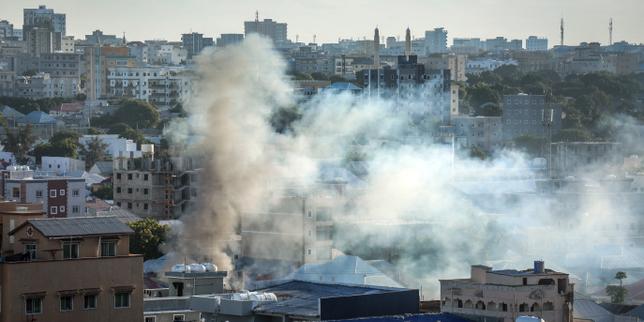
The sound of a heavy machine gun does not travel through the air so much as it vibrates through the soles of your feet. In the concrete labyrinth of Mogadishu, that vibration is a familiar, terrifying clock. It tells the people living there exactly how much time they have to drop to the floor, to pull their children beneath mattresses, to pray that the walls of their compound are thick enough to stop a stray 50-caliber round.
When video footage emerged showing fierce combat between Somali government forces and opposition fighters in the heart of the capital, the international media treated it as another bleak entry in a decades-long ledger of chaos. To the outside world, it was just standard breaking news. A brief flash of gunfire on a screen. A muted report on shifting political alliances.
But geopolitical shifts do not happen in a vacuum. They happen in neighborhoods. They happen on the very streets where vendors sell camel milk and children kick deflated soccer balls through the dust. To understand why those guns are firing again, we have to look past the political rhetoric and look at the fragile, human architecture of a city constantly forced to rebuild itself from its own rubble.
The Friction of Two Guiding Suns
Imagine a ship with two captains, each holding a different map, each spinning the wheel in a different direction. That is the fundamental crisis of the Somali state. On one side stands the federal government, backed by international recognition and foreign military aid, attempting to solidify a centralized authority. On the other side sits a loose, shifting coalition of opposition forces, clan leaders, and regional powerbrokers who view that centralized authority not as a stabilizing force, but as an existential threat.
This is not a simple story of good guys and bad guys. It is a story of deep-seated, systemic mistrust.
The federal government argues that a strong, central state is the only mechanism capable of defeating Al-Shabaab, the insurgent group that has plagued the nation for years. They see centralization as survival. The opposition, however, remembers the brutal dictatorship of the late twentieth century. They look at a powerful center and see the seeds of renewed tyranny. They believe true security can only be built from the ground up, rooted in traditional clan structures and regional autonomy.
When these two philosophies collide, the compromise rarely happens in a parliament building. It happens in the streets.
Consider a hypothetical shopkeeper named Abdi. He does not care about constitutional amendments or the specific wording of electoral laws. His reality is defined by the checkpoints. When the government controls the intersection at the end of his block, he pays a tax to a man in a government uniform. When the opposition advances and takes that same intersection overnight, he pays a tax to a man in a mismatched camo jacket. If he refuses either, his shop burns. For millions of Somalis, politics is not an abstract debate; it is a direct tax on the right to exist.
The Anatomy of an Urban Skirmish
The video clips that flickered across global news feeds showed a specific kind of warfare. This is not a war of trenches and vast front lines. It is an intimate, claustrophobic conflict fought around corners, from the beds of modified pickup trucks known as technicals, and through the blown-out windows of residential villas.
During these flare-ups, the transformation of Mogadishu is instantaneous. A street that was bustling with traffic at noon becomes completely desolate by 12:05. The only movement is the swirling dust kicked up by spinning tires and the hurried scramble of fighters seeking cover behind concrete blast walls.
The terror of urban combat is its unpredictability. A stray bullet doesn't care about political alignment. It penetrates the corrugated tin roof of a family home just as easily as it shatters the window of an armored SUV.
During one of the recent standoffs, the fighting concentrated around key neighborhoods where prominent opposition leaders lived. The government forces attempted to blockade these areas, viewing them as pockets of rebellion. The opposition responded by mobilizing their own heavily armed militias, many of whom are tied to the same clans that make up the government's own army. This is the tragic paradox of the Somali security sector: the men shooting at each other across the barricades are often cousins, uncles, and former comrades. They share the same language, the same faith, and the same history. Yet, they are divided by the loyalties demanded of them by political elites who rarely stand on the front lines themselves.
The Invisible Stakes
When we look at the breakdown of security in Somalia, the immediate focus is always on the body count and the territorial control. But the deepest wounds are the ones that don't bleed right away.
Every time a mortar shell lands in a civilian district, years of painstaking economic progress vanish in a flash of cordite. Mogadishu had been experiencing a quiet, defiant renaissance. Diaspora Somalis were returning from London, Minneapolis, and Nairobi, bringing capital and hope. They were building hotels, opening tech startups, and investing in solar energy. They were trying to rewrite the narrative of their homeland.
But capital is a coward. It flees at the first sound of gunfire.
When the political elites choose violence over negotiation, they aren't just risking the lives of the fighters on the street. They are strangling the economic future of the country. A restaurant owner who spent his life savings to open a business on Lido Beach suddenly finds himself wondering if he should pack his bags and leave the country once again. The young university graduate who was about to start an internship sees the office closed indefinitely due to security concerns.
This psychological toll is immense. Living in a state of perpetual uncertainty creates a collective trauma that shapes every decision. You don't buy a house; you rent. You don't invest in long-term infrastructure; you keep your assets liquid, ready to be carried away in a single suitcase. It is impossible to build a stable nation when the population is forced to live with one foot always out the door.
The Shadow in the Hinterlands
There is an even darker element to this political infighting, one that the video footage of urban combat fails to capture. Every bullet fired between the government and the opposition is a gift to Al-Shabaab.
The Islamist insurgency thrives on the fractures of the state. When the federal army and the opposition militias are busy pointing their weapons at each other in Mogadishu, they are pulling troops away from the front lines in the rural provinces. They are leaving villages undefended. They are creating security vacuums that the militants are only too happy to fill.
The ultimate tragedy of the political gridlock in the capital is that it distracts from the country's most existential threat. While politicians argue over term extensions and electoral models, Al-Shabaab continues to enforce its own brutal brand of order in the countryside, waiting for the fragile coalition in Mogadishu to tear itself apart from within.
The international community watches this cycle with a mixture of fatigue and frustration. Billions of dollars in aid and security assistance have been poured into Somalia over the decades. Yet, the foundations remains shaky because the core issue is not a lack of resources or training. It is a lack of political will to prioritize the collective survival of the nation over the short-term gains of individual factions.
The Long Road to Midnight
Fixing a broken state requires more than just holding an election or signing a peace treaty brokered in a foreign hotel room. It requires a fundamental recalculation of how power is shared and how justice is delivered.
The people of Mogadishu have shown an incredible, almost incomprehensible capacity for resilience. They have survived famine, foreign interventions, civil war, and terrorism. They are experts at clearing away the glass, washing the blood from the pavement, and opening their shops the morning after a bombing.
But resilience should not be a permanent requirement for citizenship.
As the sun sets over the Indian Ocean, casting long shadows across the scarred architecture of the capital, the city holds its breath. The gunfire has paused, for now. The technicals have retreated to their bases, and the political leaders are back behind closed doors, negotiating the next temporary truce.
A mother sits in a darkened room, listening to the quiet breathing of her sleeping children, wondering if the morning will bring the market vendors or the mortars. She knows better than anyone that the true cost of this war is not measured in the territory gained or lost by powerful men, but in the stolen peace of the children who have to grow up listening to the rhythm of the guns.


