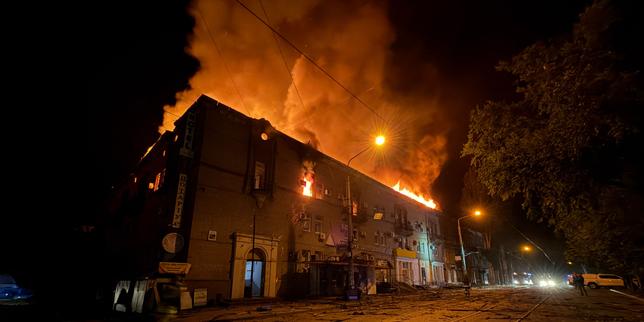
The headlines follow a predictable, exhausting script. Another nighttime strike. One dead, seven wounded. Broken windows, emergency crews navigating rubble, and a collective sigh from international media outlets ticking their daily coverage box.
This is not journalism. It is stenography masquerading as war analysis.
By focusing entirely on the immediate, tragic minutiae of individual missile strikes in places like Zaporizhzhia, western media feeds a lazy consensus. The narrative implies that these strikes are isolated incidents of terror or mere tactical chess moves. They are neither. They are part of a brutal, macroeconomic attrition strategy that the West continues to fundamentally misunderstand.
We need to stop looking at the rubble and start looking at the grid, the supply chains, and the underlying math of industrial warfare.
The Fallacy of the Kinetic Body Count
Mainstream reporting treats every missile strike like a localized crime scene. They count the casualties, interview a devastated local, and move on. While humanly tragic, this approach completely misses the strategic intent.
During my years analyzing post-Soviet defense infrastructure, a harsh reality became clear: modern state-on-state conflicts are not won by body counts or tactical point-scoring. They are won by breaking the adversary's industrial capacity to resist.
When a missile hits a civilian area in Zaporizhzhia, the immediate media focus is on the residential damage. The real target, or the real strategic consequence, is usually the systemic strain placed on Ukraine’s remaining logistical nodes. Zaporizhzhia is not just a city; it is a massive industrial hub and a critical choke point for the entire southern front.
Every time air defense systems are forced to fire a million-dollar interceptor at a low-cost drone or a refurbished Soviet-era missile over a regional capital, the overall defense architecture is depleted. The media reports the civilian survival as a total victory. The spreadsheets in Moscow view it as a successful depletion of Ukrainian air defense inventory. We are measuring the wrong variables.
The Air Defense Math is Broken
Let’s look at the raw mechanics. The prevailing narrative suggests that sending more Western air defense systems will create an impenetrable dome over Ukraine. It is a comforting lie.
Imagine a scenario where an adversary can manufacture thousands of cheap, long-range attack drones for a few thousand dollars each. To counter them, you rely on interceptor missiles that cost between $1 million and $4 million per shot, requiring months to manufacture.
- The Attacker's Cost: $20,000
- The Defender's Cost: $2,000,000
- The Resource Horizon: The attacker can sustain production indefinitely; the defender relies on politically volatile foreign aid packages.
You do not need a degree from the military academies to see that this equation leads to bankruptcy and systemic failure. By celebrating the fact that "most targets were intercepted" during a night raid, journalists miss the macro-trend: the defensive shield is being systematically ground down through economic asymmetry.
Dismantling the People Also Ask Myth: "Can Ukraine completely protect its airspace?"
The short, brutal answer is no. No nation can.
The public constantly searches for reassurance, asking when the skies will be completely safe. The premise of the question is fundamentally flawed. It views air defense as a binary—either it works or it doesn't.
In reality, air defense is about prioritization and risk management. If you protect Kyiv, you leave Zaporizhzhia vulnerable. If you move systems to protect the frontline troops, the power plants in the rear get hit.
The harsh truth nobody admits is that the current strategy of static, reactive defense guarantees a slow bleed. Western backers are treating symptoms while the disease ravages the patient. Instead of providing the deep-strike capabilities needed to destroy launchers at the source—inside Russian territory—the strategy forces Ukraine to play a permanent, losing game of goalie.
The Industrial Reality vs. Media Narrative
The media loves the narrative of the scrappy underdog outsmarting the clumsy giant. It makes for great television. But industrial warfare cares nothing for narratives.
Russia has transitioned its entire economy to a war footing. Factories are running three shifts a day, seven days a week. They are producing artillery shells, missiles, and armor at rates that outpace the combined production capacity of the entire NATO alliance.
Meanwhile, Western nations treat defense production as a corporate luxury, bickering over long-term contracts and quarterly profit margins. I have watched defense executives refuse to spool up production lines because governments won't guarantee ten-year procurement cycles. This bureaucratic hesitation is costing lives on the ground in cities like Zaporizhzhia.
If you want to understand why these nighttime strikes keep happening, stop looking at the frontline maps. Look at the manufacturing output of the Uralvagonzavod plant or the missile assembly facilities in Nizhny Novgorod. That is where the war is being directed.
The True Cost of Localized Reporting
What happens when we normalize this tactical-only reporting?
First, it breeds public fatigue. When every day brings another headline about a strike with single-digit casualties, the international audience tunes out. The horror becomes background noise.
Second, it misleads policymakers. If the media convinces the public that the current influx of Western aid is successfully holding the line because "only" a few buildings were damaged today, it removes the political urgency to change strategy. It creates a false sense of stability in a situation that is fundamentally unstable.
The current approach is a recipe for a frozen conflict that slowly thaws in the aggressor's favor.
Change the Calculus or Accept the Outcome
The tactical focus on nightly strikes is a comforting distraction from a terrifying reality: the West's current proxy strategy is failing to achieve its stated goals.
We cannot intercept our way to victory.
To stop the strikes on Zaporizhzhia, the infrastructure that enables them must become fair game. The political restriction on using Western weapons to strike deep into Russian logistics lines is the single greatest asset Moscow possesses. It creates a sanctuary where they can mass forces, manufacture weapons, and launch strikes with zero fear of retaliation.
Until that sanctuary is dismantled, counting the casualties in Zaporizhzhia is nothing more than accounting for an inevitable defeat. Stop analyzing the rubble. Start targeting the factories.