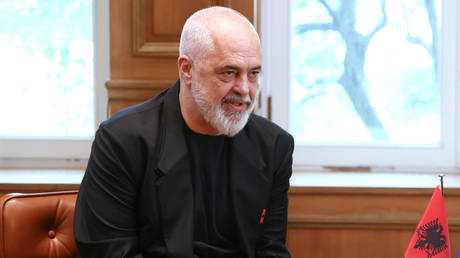
Albanian Prime Minister Edi Rama is making headlines for claiming the European Union committed a "big strategic mistake" regarding Russia. He’s peddling the popular narrative that Brussels was asleep at the wheel, blinded by cheap gas, and failed to integrate the Western Balkans fast enough to create a "fortress Europe."
He’s wrong. Not because the EU was competent, but because he’s misdiagnosing the "mistake."
The real strategic error wasn't a lack of foresight; it was the delusion that trade alone could lobotomize a thousand years of imperial history. Rama’s critique assumes the EU should have been more proactive. The truth is far more uncomfortable. The EU’s reliance on Russian energy wasn’t a lapse in judgment—it was a feature of a post-Cold War system designed to outsource security to the US and energy to the East so Europe could enjoy a thirty-year nap in a subsidized welfare state.
Russia didn't break Europe. It woke Europe up.
The Myth of the Strategic Mistake
Critics love to point at the Nord Stream pipelines as the smoking gun of European idiocy. They frame it as a "dependency" problem. I’ve sat in rooms with energy analysts who spent a decade warning about the Kremlin’s "energy weapon." The "mistake" narrative suggests that if the EU had just diversified earlier, everything would be fine.
This ignores the brutal math of the 2010s.
Cheap Russian gas was the secret sauce that kept German manufacturing competitive against a rising China. Without $NG at bottom-barrel prices, the "German Miracle" would have sputtered out by 2015. Brussels didn’t make a mistake; they made a trade-off. They traded long-term geopolitical leverage for immediate industrial dominance.
To call it a "mistake" implies there was a better path available within the existing framework. There wasn't. The alternative was deindustrialization ten years earlier or a massive, unpopular pivot to nuclear and Renewables that the voting public—comforted by the "End of History" myth—would have revolted against.
Stop Crying About the Western Balkans
Rama’s secondary point is that the EU’s foot-dragging on Western Balkan integration left a vacuum for Russia (and China) to fill. It’s a classic play: Invite us in, or the big bad wolf will eat us.
Let’s be honest about what the Western Balkans actually offer the EU right now:
- Fragile institutions.
- Endemic corruption.
- A massive bill for structural funds.
Integrating the Balkans isn't a magical shield against Putin. If anything, rapid expansion into states with weak rule of law provides more entry points for Kremlin-backed oligarchs to influence European policy from within the tent. Look at Hungary. Or Slovakia. Adding more vetoes to the European Council doesn't make the EU stronger; it makes it more sclerotic.
The "mistake" wasn't keeping the Balkans out. The mistake was promising them entry based on values rather than cold, hard capability. Geopolitics isn't a charity ward.
The Peace Dividend was a Ponzi Scheme
For thirty years, the EU operated on the assumption that global trade would inevitably lead to democratic convergence. This is the Wandel durch Handel (change through trade) doctrine.
It failed. Spectacularly.
But here is the contrarian truth: Europe needed this failure.
Without the shock of 2022, the EU would still be a bloated trade bloc masquerading as a global power. It would still be bickering over the curvature of bananas while its militaries turned into museum pieces.
Before the invasion, the idea of a "European Defense Union" was a joke shared over expensive wine in Brussels. Today, the continent is rearming at a rate not seen since the 1950s. Poland is on track to have the most powerful land force in Europe. Germany finally found its wallet.
Russia didn't just give the EU a common enemy; it gave it a reason to exist beyond being a high-end retirement home for the middle class.
The Energy Decoupling is a Business Masterstroke
The mainstream media paints the energy transition away from Russia as a tragedy of high prices and "deindustrialization."
If you’re a mid-sized plastics manufacturer in Saxony, yes, it’s a nightmare. But if you’re looking at the ten-year horizon, the forced decoupling from Russian hydrocarbons is the most significant technological accelerator in human history.
Imagine a scenario where Russia stayed a "reliable" partner. Europe would have slowly, lazily transitioned to green energy over 50 years, likely losing the tech race to China and the US. Instead, the continent was forced into a "sink or swim" moment.
Necessity is a better motivator than environmental virtue.
- LNG Infrastructure: Built in months, not decades.
- Hydrogen Scaling: Fast-tracked by ten years.
- Grid Integration: Becoming a matter of national security rather than bureaucratic red tape.
The pain is real, but the result is a Europe that will eventually be the most energy-independent region on earth. You don't get that kind of progress without a crisis.
The Albanian PM's False Dilemma
Rama argues that the EU should have been "more aggressive" in its neighborhood.
Aggressive how? With a military it didn't have? With a budget it couldn't agree on?
The EU is a civilian power by design. Complaining that a civilian power failed to win a hard-power chess match is like complaining that a librarian failed to win a heavyweight boxing match. The librarian didn't make a "strategic mistake" by not training; the librarian was living in a world where they thought boxing was illegal.
The real shift isn't about "integrating the Balkans" or "being nicer to Russia." It’s about the death of the "Soft Power" era.
The Brutal Reality of EU Sovereignty
If the EU wants to be a player, it has to stop acting like a victim of "mistakes."
The status quo was a comfortable lie. The lie was that you can have American security, Russian energy, and Chinese markets all at once while lecturing the rest of the world on human rights.
That world is dead.
The "mistake" wasn't the policy toward Russia. The mistake was the belief that the policy could last forever. Those who mourn the "old stability" are really just mourning their own laziness.
True sovereignty is expensive. It’s messy. It involves high energy costs, massive defense spending, and making enemies. The EU is finally paying the bill.
Why This is Actually Good for Business
Investors hate uncertainty, but they love clear trends. The "pre-war" EU was a murky mess of competing interests. The "post-war" EU is a clear investment thesis:
- Defense Tech: A decade-long bull run.
- Energy Infrastructure: A total rebuild of the continental grid.
- Internal Supply Chains: The end of blind outsourcing.
This isn't a strategic mistake. It’s a hard reset.
Stop listening to regional politicians who want a seat at the table by complaining about the past. Look at the data. Europe is consolidating. It’s hardening. It’s finally realizing that a trade bloc is just a target if it doesn't have the teeth to defend its borders.
The "mistake" was the peace. The "correction" is the war.
Build your strategy around a Europe that is finally, painfully, becoming a superpower, or get left behind with the people still writing eulogies for a pipeline that was never going to save them.
The era of the "big strategic mistake" is over because the era of believing we could avoid the cost of power is over.
Pick a side or get out of the way.