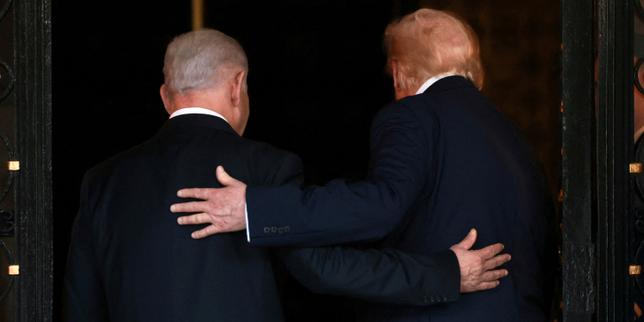
The oval room smelled of heavy drapes, old wood, and the faint, distinct electricity of a crisis in progress. It was late, the kind of hour where lines on maps stop looking like lines and start looking like graves. For years, the two men had operated on a shared frequency of performative strength. They were political twins separated by an ocean, each using the other’s shadow to look taller to their voters back home. Donald Trump called him "Bibi." Benyamin Netanyahu called him "Donald." They traded favors like baseball cards, moving embassies, tearing up treaties, and rewriting the psychology of the Middle East over casual phone calls.
Then the missiles launched.
When the long-brewing shadow war with Iran finally exploded into open, chaotic combat, the calculus changed overnight. War has a brutal way of stripping away marketing. Suddenly, the performative intimacy of two of the world's most aggressive nationalists faced the one thing it wasn't built to survive: a divergence of self-interest.
The Mirage of the Blank Check
To understand how we arrived at this crack in the bedrock, you have to look at the illusion that built it. For four years during his first term, Trump handed Netanyahu a series of historical trophies. He tore up the Iran nuclear deal, a move Netanyahu had spent years lobbying for with the desperation of a man watching a countdown clock. He recognized Jerusalem as Israel’s capital. He watched, smiling, as the Abraham Accords were signed on the White House lawn.
It looked like an unbreakable alliance. It wasn't. It was a transaction.
"I helped him," Trump would later mutter to reporters, grumbling about Netanyahu's quick congratulation of Joe Biden after the 2020 election. "He was falling apart. I saved him."
The flaw in their proximity was always rooted in a fundamental misunderstanding of what motivated each man. Netanyahu views the confrontation with Iran through an existential, almost biblical lens. To him, Tehran’s nuclear ambitions are not a geopolitical puzzle to be managed; they are a direct threat to the survival of his country and his own legacy as the ultimate protector of the Jewish state.
Trump views the world through a ledger.
For the American president, foreign policy is an extension of real estate negotiation. Everything is an asset to be leveraged, a debt to be collected, or a liability to be shed. He didn't break the Iran deal because he shared Netanyahu’s historical anxiety. He broke it because it was Barack Obama’s deal, and because he believed a strategy of "maximum pressure" would force Tehran to crawl back to the table for a better, more Trump-centric agreement. He wanted a victory lap, not a trench war.
When "America First" Meets "Israel Forever"
Consider what happens when a country goes to war. The economy shifts. Oil markets, those sensitive, jittery barometers of global anxiety, begin to spike.
This is where the friction turns into heat. A full-scale war with Iran is not a localized affair. It chokes the Strait of Hormuz, a narrow bottleneck through which a fifth of the world’s petroleum passes. As the conflict escalated, the price of crude oil ticked upward, threatening to ignite inflation back in the United States.
For Netanyahu, the cost of the war is measured in the survival of his state. For Trump, the cost of a war is measured in the domestic economy and the approval ratings of the American voter who doesn't want to pay six dollars a gallon at the pump for a conflict thousands of miles away.
The "America First" doctrine was never an invitation to endless foreign intervention. It was a promise to pull back. Netanyahu’s strategy, by contrast, relies entirely on the absolute certainty of American military and financial backing. When the rockets began falling on Tel Aviv and the American response was measured in cautionary press releases rather than immediate, devastating air strikes, the silence from Washington was deafening.
It wasn't a betrayal. It was simply the math of survival overriding the poetry of friendship.
The Hidden Cost of the Spotlight
In the corridors of power in Jerusalem, the mood shifted from confidence to a cold, calculating realism. Staffers who once bragged about having a direct line to Mar-a-Lago began speaking in hushed tones about the volatility of their primary benefactor.
The problem with relying on a leader who prizes personal loyalty above systemic alliances is that personal loyalty is a fluid commodity. Netanyahu had spent decades cultivating the American institutional right, building deep relationships with Congress, evangelical groups, and defense contractors. But Trump had effectively decentralized that power. The alliance was no longer between the United States and Israel; it had been reduced to a personal pact between two men.
When that pact faced the strain of real blood and real economic consequence, the institutional safety nets were gone.
The defense establishment in both countries knew the risks. American generals had spent years warning that a direct conflict with Iran would drag the U.S. into another multi-trillion-dollar quagmire in the Middle East—the exact scenario Trump had built his political brand on avoiding. Netanyahu, pushed by an ultra-nationalist coalition at home, could not afford to look weak. He needed to strike hard, deep, and decisively into Iranian territory.
But every time Israel prepared to swing, Washington pulled at the leash.
The Ghost in the Machine
There is a third player in this room, invisible but felt in every tremor of the stock market and every radar blip in the Pentagon. Iran is not a static target. It is a sophisticated regional power that has spent forty years preparing for this exact confrontation.
Tehran understood the psychology of the Trump-Netanyahu relationship better than perhaps anyone else. They knew that Trump’s primary vulnerability was his aversion to body bags and economic instability before a major domestic cycle. By carefully calibrating their retaliation—striking commercial shipping, activating proxy networks across Lebanon and Yemen, and threatening regional oil infrastructure—they forced a wedge into the crack between the two leaders.
They forced Trump to choose between his political survival at home and his rhetorical commitment to Netanyahu.
The choice was instantaneous. The American rhetoric softened. The promises of unconditional support were replaced by calls for "de-escalation" and "proportionality"—words that Netanyahu’s government views as code for American retreat.
The Reality of the Rim
We are left watching a high-stakes game of chicken played with live ammunition. The grand proclamations of the past, the joint press conferences where both men grinned like lottery winners, feel like artifacts from a different era.
The war did not break the alliance between the two nations, but it permanently shattered the myth of the unbreakable brotherhood between their leaders. It revealed that when the world catches fire, even the most loudspoken populist alignment must bow to the ancient, unyielding laws of geography and self-interest.
Netanyahu sits in his bunker, looking at maps that show an existential threat to his nation’s borders. Trump sits in Washington, looking at charts that show the price of gas and the shifting moods of the American electorate. They are looking at the exact same war, but they are seeing two completely different crises.
The phone calls between them are shorter now. The tone is businesslike, stripped of the old warmth, replaced by the tense, clipped dialogue of two partners who realize they are stuck in a bad deal together, waiting to see who will blink first as the horizon turns red.
.jpg)