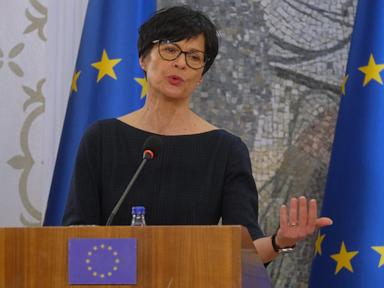
Brussels has signaled a hard pivot from constructive ambiguity to financial conditionality regarding Serbia’s integration into the European single market. The potential suspension of €1 billion in funding—primarily through the Growth Plan for the Western Balkans—is not a mere diplomatic friction point; it is a structural recalculation of risk. The European Union is transitioning from a policy of "enlargement as stabilization" to "enlargement as compliance," where democratic alignment serves as the primary gateway for capital injection.
The Mechanism of Conditional Liquidity
The €6 billion Reform and Growth Facility for the Western Balkans operates on a performance-based disbursement model. Unlike previous iterations of Instrument for Pre-accession Assistance (IPA) funds, which focused on infrastructure and capacity building with broad oversight, this facility utilizes a strict "reforms-for-cash" logic. For Serbia, the suspension of the allocated €1 billion creates a significant fiscal gap in planned modernization projects.
The conditionality logic is bifurcated into two distinct vectors:
- Rule of Law and Democratic Infrastructure: This includes judicial independence, freedom of the press, and the integrity of electoral processes. Recent reports highlighting irregularities in Serbian local and parliamentary elections have triggered the EU’s "Conditionality Regulation," which allows the freezing of funds if democratic deficiencies threaten the financial interests or the legal certainty of the Union.
- Geopolitical Alignment and Security: While often discussed as a separate track, the harmonization of foreign policy—specifically regarding sanctions against Russia and the normalization of relations with Kosovo—now functions as a prerequisite for the release of tranches.
The EU’s leverage is intensified by Serbia’s high degree of economic integration with the bloc. Over 60% of Serbia’s total exports are destined for EU markets, and the majority of Foreign Direct Investment (FDI) originates from EU-based corporations. A freeze on development funds creates a signaling effect that increases the risk premium for private investors, potentially leading to higher borrowing costs on international debt markets.
The Three Pillars of Democratic Backsliding Analysis
To understand why the EU has reached this tipping point, one must analyze the decay across three specific institutional pillars. These aren't just values; they are the functional components that ensure a predictable business environment for EU member states.
Institutional Capture and Regulatory Risk
When the executive branch exercises disproportionate control over regulatory agencies, the market loses its competitive neutrality. For Brussels, the "backsliding" in Serbia manifests as a lack of transparency in public procurement and the preferential treatment of state-aligned enterprises. If a billion euros are injected into a system where the judiciary cannot independently adjudicate contract disputes, those funds are viewed as "at-risk capital." The EU is effectively conducting a credit risk assessment on the Serbian state.
The Information Asymmetry Gap
A healthy democracy requires a media environment that allows for public scrutiny of state spending. The EU’s concern over media pluralism in Serbia isn't just about human rights; it is about the "oversight mechanism." Without a free press to investigate the use of EU funds, the risk of embezzlement and corruption increases exponentially. Brussels is signaling that it will no longer subsidize an information environment that prevents its own taxpayers from seeing how their money is spent abroad.
Electoral Integrity as a Proxy for Stability
The EU views the integrity of the electoral process as the ultimate indicator of long-term political stability. The systemic advantages granted to the ruling party—ranging from media dominance to the alleged "importation" of voters—create a brittle political system. While this may provide short-term continuity, it increases the probability of a "black swan" event: a sudden, non-linear shift in public sentiment or a constitutional crisis that could destabilize the region and threaten EU investments.
Quantifying the Opportunity Cost of Non-Compliance
The loss of €1 billion is the primary cost, but the secondary and tertiary effects are more damaging to Serbia's long-term GDP growth. The cost function of non-compliance can be expressed through three specific variables.
The FDI Multiplier Effect
European companies often use EU funding for infrastructure (roads, energy, digital networks) as a de-risking tool before committing private capital. If the Reform and Growth Facility is suspended, the "crowding-in" effect of private investment vanishes. Analysts estimate that for every euro of EU development aid lost, the potential for 2.5 to 3 euros of private investment is neutralized due to increased perceived political risk.
Energy Transition and Carbon Leakage
A significant portion of the EU funds was earmarked for green energy transition. As the EU prepares to implement the Carbon Border Adjustment Mechanism (CBAM), Serbia’s carbon-heavy industry faces a massive disadvantage. If Serbia loses the funding required to modernize its energy grid and decarbonize its manufacturing sector, its exports to the EU will be hit with significant carbon taxes. The failure to align democratically today results in a direct financial penalty on Serbian exports tomorrow.
Human Capital Flight
Economic stagnation resulting from frozen integration accelerates the "brain drain" of skilled labor to the EU. This creates a demographic trap. As the most productive segments of the population leave, the tax base shrinks, making it even harder for the state to fund the very reforms required to unlock EU funds. This creates a feedback loop of institutional decay and economic contraction.
The Kosovo Deadlock and the "Ohrid" Constraint
The normalization of relations with Kosovo remains the most significant roadblock. The EU has explicitly linked the Growth Plan funds to the implementation of the Ohrid Agreement. This creates a zero-sum game for Serbian leadership: the domestic political cost of recognizing Kosovo’s sovereignty (or steps toward it) versus the fiscal cost of losing €1 billion and stalling the accession process.
Currently, Belgrade is attempting a strategy of "multi-vector hedging," seeking infrastructure investment from China and energy security from Russia to offset EU pressure. However, these alternatives come with high costs:
- Chinese Loans: These often involve "debt-trap" dynamics and require the use of Chinese contractors, providing less benefit to the local Serbian economy compared to EU grants.
- Russian Energy: This creates a strategic dependency that further alienates Brussels and triggers secondary sanction risks.
The EU is betting that the sheer volume of the Growth Plan—coupled with the looming threat of the CBAM—will eventually make the cost of non-compliance unbearable.
The Strategic Path Forward
Serbia’s leadership faces a binary choice that will define the country’s economic trajectory for the next decade. The current path of "managed democracy" has reached its fiscal limit with the EU. To unlock the billion-euro facility and secure the broader economic benefits of the single market, Belgrade must execute a high-speed institutional pivot.
- Full Alignment with the ODIHR Recommendations: Immediate and verifiable implementation of election reforms to restore the credibility of the democratic process. This is the "low-hanging fruit" that would signal a genuine shift in intent to Brussels.
- Decoupling the Judiciary: Establishing a truly independent prosecutorial system to handle corruption, particularly concerning the use of international funds. This would reduce the "risk premium" associated with Serbian state-led projects.
- The Kosovo Pivot: Moving from rhetorical stalling to the functional implementation of agreed-upon points in the Ohrid Annex, specifically regarding the Association of Serb Municipalities (ASM) and the recognition of documents, which are the specific triggers for the next tranches of the Growth Plan.
The EU has moved past the era of verbal commitments. The billion euros are on the table, but the key to the vault is now held by the auditors and the human rights monitors, not just the diplomats. For Serbia, the cost of the status quo is no longer just political; it is a measurable, billion-euro deficit in the national balance sheet.


:strip_icc()/pic2513216.jpg)